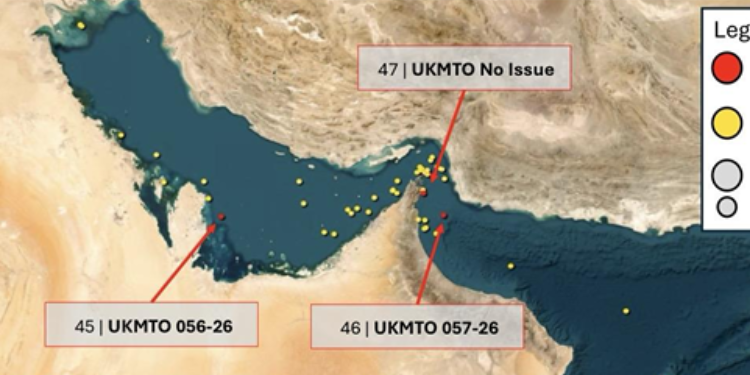
The United Kingdom Maritime Trade Operations (UKMTO) has issued a maritime security update regarding a vessel anchored northeast of Fujairah in the United Arab Emirates that was reportedly taken over by “unauthorized personnel” and later seen heading toward Iranian waters.
The incident was disclosed in UKMTO Warning 057/26 dated May 14, 2026, and later referenced in Update 045 issued by the Joint Maritime Information Center (JMIC), which described maritime tensions across the Middle East region as remaining at a “CRITICAL” threat level.
The advisory stated that traffic through the Strait of Hormuz remains “significantly reduced,” with two major security incidents recorded within 48 hours.
“UKMTO WARNING 057/26 (14 May) reported suspicious activity on a vessel taken by unauthorized personnel while at anchor northeast of Fujairah, UAE,” the report stated.
UKMTO reports vessel seized off the UAE coast
The maritime security update did not immediately identify the vessel, its crew nationality, ownership, or the identity of those who boarded it.
British maritime risk management group Vanguard said the incident was reported at 0545 GMT on Thursday.
“The company security officer reported that the vessel was taken by Iranian personnel while at anchor,” Vanguard said. “The vessel is reportedly bound for Iranian territorial waters.”
The group added that contact had been lost and the vessel was no longer transmitting its position through the Automated Identification System (AIS).
According to a Reuters report, two maritime security sources said the ship was believed to be the Honduras-flagged Hui Chuan fishery research vessel.
At least two other vessels have been seized by Iran during the war that began when the U.S. and Israel launched strikes against Tehran on February 28.
The development came hours after another maritime incident in the region involving an Indian-flagged livestock carrier that reportedly experienced an explosion before sinking off Limah, Oman.
Also Read: Strait of Hormuz: Heavy Exchange of Missiles as 3 U.S. Destroyers Are Targeted by Iran
The Indian Ministry of External Affairs said that all 14 crew members aboard the vessel were safely rescued by Omani authorities.
Regional shipping lanes remain under heightened scrutiny amid ongoing tensions involving Iran, the United States, and allied naval forces operating around the Strait of Hormuz and the Gulf of Oman.
The Strait of Hormuz is one of the world’s most strategically significant maritime chokepoints, handling a substantial portion of global oil and liquefied natural gas shipments.
In April and May, Tehran and Washington have traded accusations over military activities in the waterway, while merchant vessels have reported increased naval presence and electronic interference across the region.
Iran maintains the Strait is open
Iranian Foreign Minister Seyed Abbas Araghchi on Thursday said the strait remained open to commercial shipping “as far as we are concerned,” though he added that vessels were expected to coordinate with Iranian naval authorities.
“As far as we are concerned, the Strait of Hormuz is open for all commercial vessels,” Araghchi said during the BRICS foreign ministers’ meeting in New Delhi. “But they need to cooperate with our navy forces.”
Iranian state broadcaster IRIB separately reported that more than 30 ships had passed through the strait since Wednesday night “in coordination with our country’s authorities and maritime agencies.”
Also Read: EXCLUSIVE: Iran Says Strait of Hormuz is Open to Kenya and Other Countries
The broadcaster described the situation as “a new era” in the Strait of Hormuz, saying many countries now recognized coordination with the Islamic Revolutionary Guard Corps (IRGC) Navy as necessary for passage.
Meanwhile, U.S. Central Command (CENTCOM) told lawmakers in Washington that American military operations had significantly reduced Iran’s maritime capabilities, including destroying more than 90 percent of Tehran’s naval mine inventory.
CENTCOM commander Admiral Brad Cooper, speaking before the Senate Armed Services Committee, said Iran’s ability to disrupt shipping had been “dramatically degraded,” though he acknowledged that threats against merchant vessels remained active.
“The Iranian ability to stop commerce has been dramatically degraded through the straits, but their voice is very loud, and those threats are clearly heard by the merchant industry and the insurance industry,” Cooper said.
American forces redirect 70 commercial vessels
The U.S. has also intensified enforcement operations in the region. CENTCOM stated Thursday that American forces had redirected 70 commercial vessels and “disabled” four others to ensure compliance with ongoing maritime restrictions linked to Iran.
At the same time, diplomatic efforts around the crisis appear to be continuing. U.S. President Donald Trump, who is in China for a state visit, said Chinese President Xi Jinping had expressed a willingness to assist in efforts to secure a deal involving Iran and to fully reopen the Strait of Hormuz.
“President Xi would like to see a deal made,” Trump told Fox News. “He said, ‘If I can be of any help whatsoever, I would like to help.’”
U.S. Secretary of State Marco Rubio, however, insisted Washington had not formally requested Beijing’s assistance, while emphasizing that both countries opposed any attempt to militarize the strategic waterway or impose toll systems on commercial vessels.