
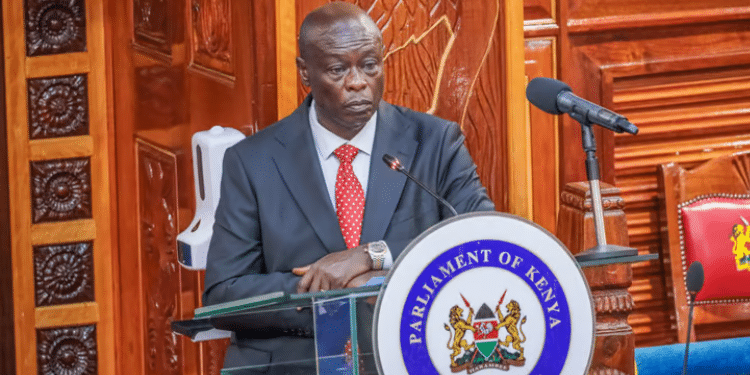
The Supreme Court has ruled on the impeachment case of former Deputy President Rigathi Gachagua.
In a judgment delivered on January 30, the court dismissed two applications filed by Rigathi Gachagua and the National Assembly.
The five-judge bench led by Chief Justice Martha Koome clarified that the matter before the Supreme Court was limited to the question of how the High Court bench was empanelled.
The impeachment proceedings involving Gachagua are separate and are still pending before the High Court.
In the first application, Gachagua sought the Supreme Court’s order to stop the proceedings on his impeachment before the High Court. In addition, the former Deputy President wanted the Supreme Court to strike out the National Assembly’s appeal regarding the ruling on the empanelment of judges in the Court of Appeal, and the expunging of certain documents from the Supplementary Record of Appeal.
The National Assembly, on its part, wanted the Supreme Court to strike out Gachagua’s Notice of Cross-Appeal.
However, the Apex Court dismissed Gachagua’s applications, holding that the Supreme Court can only stay proceedings before the Court of Appeal, not the High Court, as Gachagua had requested.
Similarly, the Supreme Court ruled that the National Assembly’s appeal is not capable of being summarily dismissed and warrants determination on the merits.
On the documents sought to be expunged, the Court found that they are integral to the determination of the appeal before the Supreme Court and were cited by both the High Court and the Court of Appeal in their decision on the dispute.
“The court dismissed the first omnibus application filed by Hon. Gachagua. It held that the Supreme Court has jurisdiction to stay proceedings only before the Court of Appeal and not the High Court, as sought in the application. The court further found that the National Assembly’s appeal was not suitable for summary dismissal and should be determined on its merits. It also ruled that the documents sought to be expunged were central to the appeal and had been relied upon by both the High Court and the Court of Appeal in resolving the dispute,” read part of the Judgement.
Justice Chacha Mwita had issued conservatory orders to halt the implementation of the Senate’s resolution and suspend the appointment of Rigathi’s replacement until October 24, 2024.
Supreme Court Dismisses Rigathi Gachagua’s Impeachment
In 2024, the ousted DP argued that the three-judge bench that lifted the conservatory orders allowing his replacement was unconstitutional and illegal, stating that it should have been constituted by Chief Justice Martha Koome.
Mwilu had appointed Justices Anthony Mrima, Eric Ogola, and Fridah Mugambi to hear the petition.
More than 40 cases were filed challenging Gachagua’s ouster, and they were consolidated.
Gachagua contested the impeachment, arguing that the allegations against him were based on falsehoods and outright lies.
The former DP stated that the motion to impeach him was based on deceit, misrepresentations, and the suppression of material facts, which had been spread to the public to achieve an improper and unconstitutional purpose.
Also Read: Gachagua Impeachment: What Next for Ruto If Senate Passes the Ouster Motion?
He further argued that the one-day public participation process initiated by Parliament was insufficient “to overturn the sovereign will of the people” who voted for him and President William Ruto in the last general election.
Gachagua described the process as a “choreographed political lynching designed to defeat the sovereign will of the Kenyan people” and prematurely end his long and productive career as a public servant.
Court Of Appeal Ruling on Whether Three-Judge Bench Was Properly Constituted
On May 9, 2025, the Court of Appeal, comprising President Daniel Musinga and Justices Mumbi Ngugi and Francis Tuiyott, sided with Gachagua’s legal team, ruling that it was not within the Deputy Chief Justice’s mandate to empanel the bench, especially without an explanation as to why Chief Justice Koome could not do so herself.
The appellate court held that, although the Judicial Service Act allows the Chief Justice to delegate certain duties to the Deputy Chief Justice, the act of empaneling a bench for cases involving substantial constitutional questions is a constitutional responsibility that cannot be delegated.
The Court of Appeal, however, rejected the appellants’ request to direct the Chief Justice to exclude the three judges from any newly constituted bench.
The court noted that only the Chief Justice has the authority to assign judges and declined to compel her to expand the bench to five.
Later, Chief Justice Martha Koome re-appointed the same bench previously selected by Deputy Chief Justice to hear petitions regarding the impeachment of Rigathi Gachagua as Deputy President.
As a result, Justices Eric Ogola, Anthony Mrima, and Freda Mugambi were once again presiding over the matter.
Follow our WhatsApp Channel and X Account for real-time news updates.