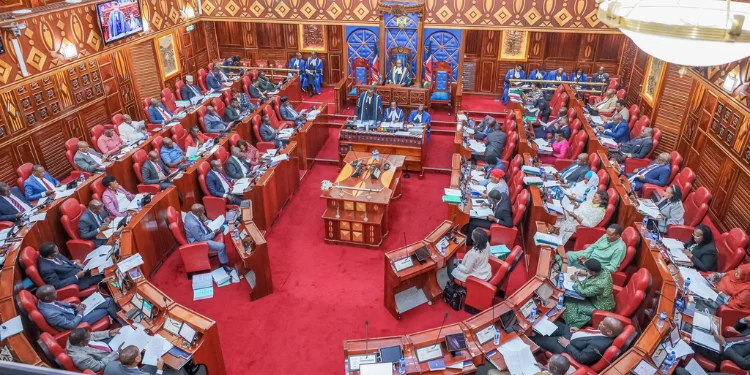

The National Council of Churches of Kenya (NCCK) has backed proposed changes to the tobacco laws, stating that stronger controls are needed to protect individuals and society from the effects of tobacco and nicotine products.
Appearing before the National Assembly Departmental Committee on Health on September 22, NCCK General Secretary Rev. Canon Chris Kinyanjui said the Council takes tobacco control seriously because it has witnessed the harmful effects of tobacco use on individuals and society.
He said the experiences reinforced the Council’s support for measures to strengthen tobacco control in Kenya.
“As a Council, we take the subject matter of tobacco control very seriously, having been the first-hand witnesses of the devastating effect tobacco has on individuals and the society,” a submission by NCCK General Secretary Rev. Canon Chris Kinyanjui reads in part.
NCCK was among government agencies, private-sector representatives and other stakeholders who supported the Tobacco Control (Amendment) Bill, 2024.
NCCK Among Stakeholders Backing Tobacco Bill
Other institutions that backed the Bill included the National Cancer Institute of Kenya (NCI-K), the Council of Governors, the National Treasury, and the Kenya Law Reform Commission.
Chief Executive Officer Elias Melly said the institute supports the proposed changes, citing the need to strengthen Kenya’s tobacco control framework.
“We strongly support the Bill and commend Parliament for strengthening Kenya’s Tobacco Control framework,” Elias Melly said.
Stakeholders also called for additional measures to protect the public from health risks associated with tobacco and nicotine products.
The proposal to raise the minimum age for purchasing tobacco and nicotine products from 18 to 21 years was among the measures that drew broad support.
Departmental Committee on Health Chairperson James Nyikal said the agreement among stakeholders would help the Committee as it reviews the submissions and prepares its recommendations.
“There has been a lot of concurrence among the stakeholders on issues such as increasing the age of consent to purchase nicotine products from 18 to 21,” Nyikal said.
Also Read: New Bill Targets Major Overhaul of M-Pesa, Bank and Fintech Payments
What Does the Bill State
The Tobacco Control (Amendment) Bill, 2024, proposes wide-ranging changes to Kenya’s tobacco control framework, including new rules for electronic cigarettes, nicotine pouches and other nicotine products.
Key proposals in the Bill include:
- Stricter regulation of vapes and nicotine products: Electronic nicotine delivery systems would be subject to limits on nicotine concentration, container sizes, ingredients, safety features and product approval.
- Nicotine pouches: The Bill proposes a maximum nicotine content of 20mg per pouch, with requirements for child- and tamper-proof packaging.
- Government approval of tobacco products: Manufacturers and importers would have to obtain approval from the Cabinet Secretary before producing or importing tobacco products. Products would also undergo testing by the Kenya Bureau of Standards.
- Ban on unapproved products: Selling, distributing, storing or importing tobacco products that have not been approved would become an offence, with penalties of up to Ksh1 million or 5% of gross turnover, whichever is higher, or imprisonment of up to two years.
Also Read: New Bill to Ban Teachers Strikes During Specific Calendar Dates
- Flavoured tobacco products: The Bill seeks to prohibit tobacco products containing additives that create a characteristic flavour, including fruit, spice, candy and menthol flavours.
- Restrictions near children: Tobacco products would not be allowed to be sold within 100 metres of places primarily serving people under 18.
- Online sales: The Bill proposes banning the sale or offering for sale of tobacco products, including nicotine pouches and electronic nicotine delivery systems, through online platforms and e-commerce.
- Mobile vending: Selling tobacco products through hawking, vehicles or mobile vending would be prohibited.
- Licensing: Anyone dealing in tobacco products would require a licence from the relevant county executive committee member and would only be allowed to operate from the fixed location specified in the licence.
- Plain packaging and health warnings: Health warnings would cover 75% of the front and back of tobacco product packaging, alongside plain-packaging requirements.
- Registration of dealers: Manufacturers, importers, sellers and distributors would be required to register with the Ministry of Health.
Follow our WhatsApp Channel and X Account for real-time news updates.