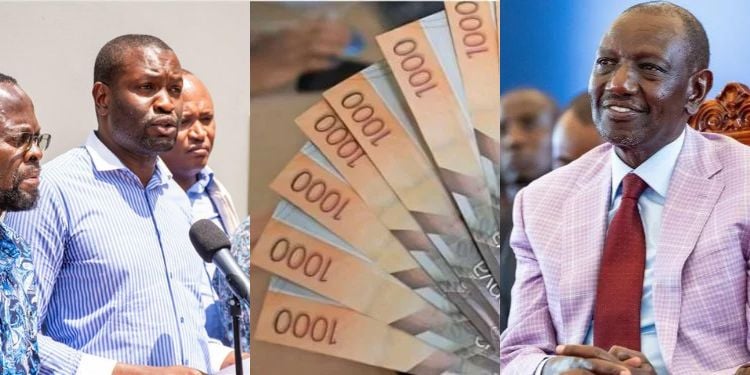
The Independent Electoral and Boundaries Commission (IEBC) has published the spending limit for candidates contesting the presidential election scheduled for August 10, 2027.
In a Gazette Notice No. 12251 published in a Special Issue of the Kenya Gazette dated August 7, 2026, the IEBC issued the spending limits under Article 88(4)(i) of the Constitution, the Independent Electoral and Boundaries Commission Act, 2011, and the Election Campaign Financing Act, 2013.
IEBC said the notice sets out the contributions and spending limits applicable to candidates and political parties during the expenditure period for the 2027 General Election.
The commission has also published the formula and parameters used to determine the unit costs forming the basis of the spending limits.
“IN EXERCISE of the powers conferred by Article 88 (4) (i) of the Constitution of Kenya, section 4 (i) of the Independent Electoral and Boundaries Commission Act, 2011 and sections 12, 18 and 19 of the Election Campaign Financing Act, 2013, the Independent Electoral and Boundaries Commission gives notice and publishes the contributions and spending limits, including the total amount that a candidate or political party may receive and spend during the expenditure period and the formula and parameters used in determining the unit costs for the spending limits,” the notice read in part.
IEBC Reveals Presidential Spending Limit
The presidential spending limit is contained in the First Schedule of the Gazette Notice, and the schedule provides the figures based on Kenya’s 47 counties, population and geographical area.
The First Schedule specifically prescribes:
- Presidential spending limit during the expenditure period.
- Formula and parameters used to determine the unit costs for the spending limits.
- Applicable election: General Election scheduled for 10 August 2027.
According to the published schedule, Kenya’s approximate population is listed as 47,564,296, while the total area is approximately 581,307 square kilometers.
The First Schedule sets the presidential election spending limit at KSh6,112,543,133 for the expenditure period.
| Election | Counties | Approx. Population | Approx. Area (Sq. Km) | Spending Limit (KSh) |
| Presidential | 47 | 47,564,296 | 581,307 | 6,112,543,133 |
Also Read: How IEBC Settled On KSh4.4 Billion Campaign Spending Limit for Presidential Candidates
County-Level Spending Limits
The Second Schedule sets spending limits for candidates contesting county-level positions, including County Governor, Senator and County Woman Member to the National Assembly.
The limits are specified for all 47 counties. Nairobi City County has the highest limit at KSh181,312,885, while Lamu has the lowest at KSh28,693,735.
Turkana and Marsabit also have high limits, at KSh142,072,389 and KSh127,022,462, respectively.
National Assembly Spending Limits
The Third Schedule sets spending limits for candidates contesting elections in all 290 constituencies.
North Horr in Marsabit County has the highest constituency limit at KSh100,424,301, followed by Wajir South at KSh73,016,747.
Wundanyi in Taita Taveta County has the lowest constituency spending limit at KSh15,430,114.
County Assembly Ward Limits
The Fourth Schedule provides spending limits for candidates contesting County Assembly Ward elections across the country.
Turbi Ward in Marsabit has one of the highest limits at KSh22,095,682, followed by Garsen West in Tana River at KSh19,232,323.
Among the lowest limits are Shella Ward in Lamu at KSh3,486,686 and Ziwani/Kariokor in Nairobi at KSh3,630,884.
Political Party Spending Limit
The Fifth Schedule sets the overall allowable expenditure for political parties at KSh24,450,172,531.
The largest allocation is for transportation, at KSh16,126,632,035, followed by advertising and media at KSh2,517,509,489 and election agents at KSh2,081,162,296.
Other allocations include administrative costs at KSh1,292,094,521, publicity materials at KSh1,066,714,464, venues at KSh375,052,688, security at KSh285,090,725, nomination fees at KSh213,818,044, communication at KSh134,230,217 and accommodation at KSh24,945,438.
Formula Used to Set Limits
The Sixth Schedule provides the formula and parameters used to calculate campaign spending limits at county, constituency and ward levels.
This formula gives 70% weight to population and 30% to land area when determining the applicable unit costs.
At county level, the parameters include a fixed cost of KSh14,406,545, a population unit cost of KSh33.83 and a land-area unit cost of KSh1,330.
At constituency level, the figures are KSh10,795,432 fixed cost, KSh53.72 population unit cost and KSh2,112 land-area unit cost.
At ward level, the parameters are KSh3,225,105 fixed cost, KSh42.10 population unit cost, and KSh1,655 land-area unit cost.
Contribution Limits and Penalties
According to IEBC, political parties may receive contributions of up to 100% of the spending limit prescribed for parties in the Fifth Schedule during the expenditure period.
Also Read: DIG Lagat Rushes to Presidential Escort Unit After Gachagua’s Leaked Intel
Candidates sponsored by political parties and independent candidates may also receive contributions of up to 100% of their applicable spending limits under the First, Second, Third and Fourth Schedules.
“The contribution limits that a political party candidate and independent candidate shall receive during the expenditure period shall be 100% of the spending limits prescribed in First, Second, Third and Fourth Schedules above,” the IEBC notice stated.
Under Section 12(2) of the Election Campaign Financing Act, 2013, contributions from a single source are limited to 20% of the total contributions applicable under the relevant schedules.
The IEBC warned that a candidate or political party committee that exceeds the prescribed spending limits and fails to report this to the Commission commits an offense under Section 18(7) of the Election Campaign Financing Act, 2013.
Under Sections 23 and 24 of the Act, a person convicted of an offense where no specific penalty is provided may face a fine of up to KSh2 million, imprisonment for up to five years, or both.
Follow our WhatsApp Channel and X Account for real-time news updates.