
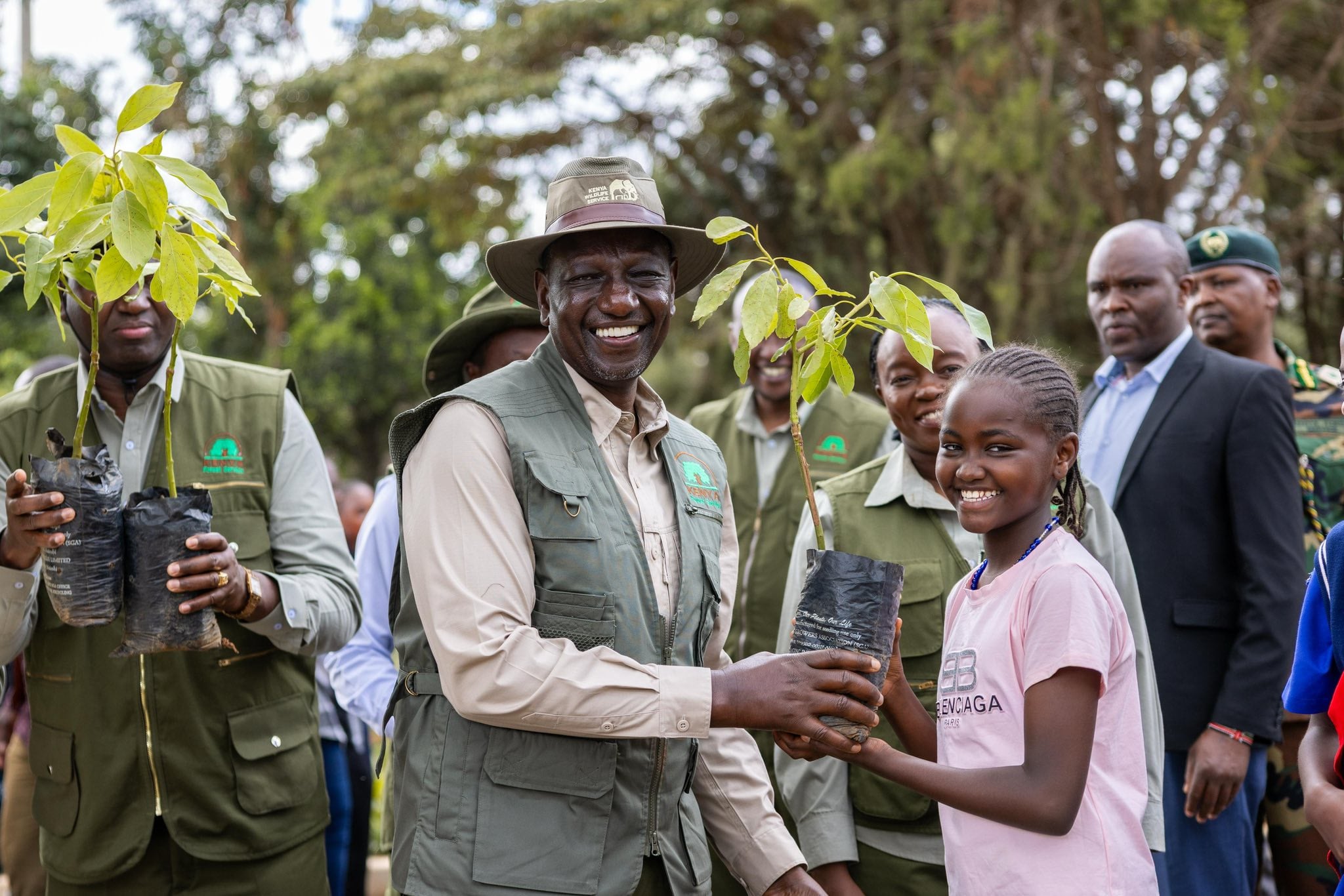
On 22nd April 2026, Timothy Kibiwott, also known as Buzeki, captured the nation’s attention as he attempted to break the Guinness World Record for planting the highest number of trees in 24 hours by an individual. The current record is held by Antoine Moses (Canada), who planted 23,060 trees in 2022.
Over the 24-hour period, Buzeki planted 23,326 trees. Although the record is yet to be officially ratified by Guinness World Records, the attempt itself, a physically demanding endurance challenge involving planting thousands of seedlings within a strict timeframe, fits squarely within Kenya’s broader reforestation push, including the 15 billion trees initiative.
His attempt comes shortly after Truphena Muthoni broke her own record, achieving 72 hours of tree hugging in Nyeri in 2025 (ratified in 2026), following a 48-hour record in Nairobi in 2025. Her action aimed to raise awareness of the protection of indigenous tree species and the broader environment, both locally and globally.
These are not small things. They matter. They should be celebrated. But they also force us to confront an uncomfortable truth. Because even as we clap for tree planting, we are cutting down mature trees, quietly, efficiently, and in large numbers, to build roads, expand cities, and chase development. So, what exactly are we doing?
Are we planting trees or replacing guilt?
Drive along Ngong Road, from Karen towards Ngong town, and you will see it for yourself. Or rather, you will not see it anymore. The trees are gone. Tall, old trees that stood there for decades. Trees that gave shade, character, and life to that stretch. One of them, we are told, was planted in honor of Wangari Maathai. Gone.
And in their place? Wider roads. Cleaner lines. Faster movement. But at what cost? We cannot pretend that planting seedlings somewhere else balances this out. It doesn’t.
A seedling is not a tree. Not today. Not tomorrow. Maybe in 20 or 30 years, if it survives. And I say this with authority, because since I was 11 years old, I have planted thousands of trees. Over that period, I have learned that out of every 10 trees planted, if I am lucky, only five or fewer make it to maturity, and that is after years of care and maintenance.
Also Read: Court Issues Orders On Alleged Secret Barracks Construction in Karura Forest
So, when we cut down a mature tree and plant another, we are not replacing anything. We are starting again. From zero.
This is not new. We have seen this before. There was a time when forests in this country were treated like empty land waiting to be taken. During the era of Daniel Arap Moi, forests and public spaces were under constant threat, allocated, grabbed, or repurposed.
It took the stubborn courage of people like Wangari Maathai to stand in the way. The fight for Karura Forest and Uhuru Park is not just history. It is a warning and a reminder of how easily we lose these spaces, and how hard we have to fight to keep them.
Some battles were won. But many were not. And now, years later, we seem to be walking back into the same story, only this time, we are calling it development.
The numbers sound good. The reality is different
We are told Kenya has just crossed the 12 percent forest cover threshold. We are told the government plans to plant 15 billion trees by 2032. These are big numbers. Impressive numbers. But numbers can hide a lot.
Because while we are counting seedlings, we are also losing mature forests, through road expansions, land allocations, and decisions that rarely get the same attention as tree-planting campaigns.
Take the discussions around Ngong Forest. Or the quiet feeling of trees along major roads like Waiyaki Way and Ngong Road. These things are happening in plain sight. So again, what exactly are we doing?
Development is not the enemy. Poor thinking is
Roads are important. Cities must grow. Infrastructure matters. But destroying the environment in the name of development is not progress. It is poor planning.
Look at Singapore. Smaller than many of our counties. Highly urbanized. Yet heavily green. Carefully planned. Singapore utilizes a “Green Plan 2030” where infrastructure is built around existing greenery or incorporates “Skyscraper Greenery.”
So, it is not that it cannot be done. It is that we are choosing not to do it properly. We are taking the easy route: cut now, explain later.
Also Read: Hillary Kibiwott Completes 24-Hour Attempt to Plant 24,000 Trees
This is not just about trees. It is about what comes after. When forests disappear, rivers shrink, rainfall becomes unreliable, soil loses its strength, and heat increases.
And suddenly, it is no longer an environmental story. It is a food story. A water story. A survival story.
We are an agricultural country. We depend on the very systems we are quietly dismantling. You cannot build enough roads to escape a collapsing environment.
We need to be honest with ourselves
Tree planting is good. Awareness is good. But let’s not lie to ourselves. We cannot hug trees in the morning and cut them down in the afternoon. At some point, we have to choose what we actually believe in.
So, what now? This is not complicated. If we are serious, we should stop treating forests as negotiable land, make environmental impact assessments real, not paperwork, plan infrastructure with the environment in mind from the start, not as an afterthought. And more importantly, we need to speak up.
Because if there is one thing history has taught us, it is this: when people keep quiet, forests disappear.
In the end, this is about the future. Not imagined, but a real future. The kind where rivers still flow. Where land still produces food. Where the air is still breathable.
We like to think that development will secure that future. But the truth is simpler than that. The environment was here before us. It will outlast us. And if we are not careful, it will move on without us. A country cannot plant its way out of the destruction of its own forests. At some point, we have to stop performing conservation and actually practice it.