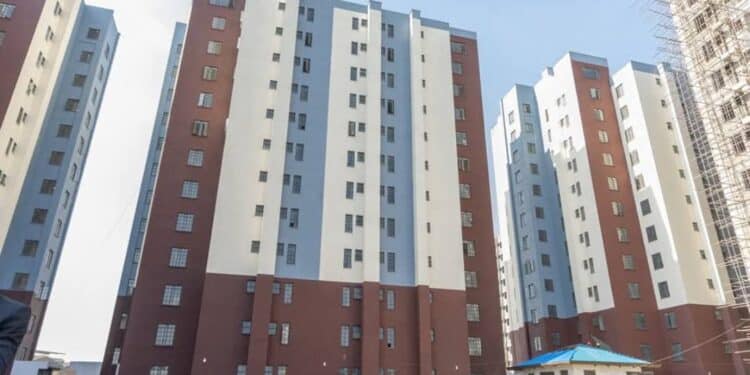

Look closely at the booming skylines of Nairobi, Machakos, and Athi River, and you will see the physical manifestation of Kenya’s grand development dreams. The massive push for affordable housing and infrastructure is a vital mission. When President Ruto campaigned in 2022, he spoke passionately about affordable housing.
Despite heavy resistance over its financial sustainability, particularly the housing fund that transitioned from a voluntary levy to a compulsory paycheck deduction, the project moved forward.
For a rapidly expanding nation, this seems like a net positive. Ask anyone in Nairobi, and they will tell you the city’s biggest headache is finding decent, affordable shelter.
It is a legacy that started under Uhuru Kenyatta and has been aggressively accelerated by the current administration, with one million units launched across 30 counties.
But therein lies the evil that we may have chosen not to ignore. This insatiable construction boom requires a staggering amount of raw material. Chief among them is sand.
To build just a single housing unit, engineers estimate you need up to five tippers of sand for the walls, floors, and finishing.
For a large-scale project, like the housing units in Nairobi’s Pangani area, we are talking about thousands of lorries. To get that sand, we must plunge deep into our riverbeds, lakes, and streams.
Sand is not Infinite
Unlike timber, where you can plant a tree, harvest it when mature, and nurture a sapling to replace it, sand does not self-regenerate, at least not that quickly.
It acts exactly like a mineral. The more we dig, the more it depletes, forcing us to dig deeper and deeper, permanently scarring the entire ecosystem. This extraction has created a deeply troubling local irony.
Also Read: Over 300 Eviction Notices Issued in Nairobi River Encroachment Crackdown
In regions with zero employment opportunities, sand harvesting offers immediate daily wages. It feeds families tonight, but it destroys their ability to survive tomorrow.
Many young men rely entirely on this trade because pastoral lands are disappearing due to climate change. We are trading our long-term ecological survival for short-term cash, igniting turf wars over who controls the riverbeds.

A Trail of Destruction
From Lodwar to Lamu, Machakos to Kajiado, the story repeats itself. Scientific research now confirms what locals have witnessed for years.
That sand mining causes severe soil erosion, drops groundwater levels, leads to biodiversity loss, and widespread pollution. Heavy machinery compacts the soil and chokes the air with dust near homes and schools.
Having already allowed private developers to invade and sell off our protective wetlands and riparian lands, we are now invading the water bodies themselves to strip the little that is left.
A sobering assessment by the United Nations Environment Programme (UNEP) warns that unregulated sand mining bleeds riverbeds dry, drains vital boreholes, and collapses ecosystems.
This warning hits hard in Kajiado’s parched landscape, where climate change leaves no margin for ecological error. Yet the trade there has escalated into an industrial assault.
Every single day, over 500 trucks pillage Kajiado’s riverbeds to feed the urban appetite of Nairobi and Machakos. It is highly lucrative; county officials budgeted roughly KSh 126 million, nearly $1 million USD, in extraction fees for the 2023-24 fiscal year alone.
Meanwhile, on the coast of Lamu, the consequences take on a different, devastating form. In historic sites, shoreline buildings that stood for decades are now structurally collapsing into the ocean because sand extraction has destabilized their foundations. Marine life is being wiped out, and coastal livelihoods are ruined.
A Broken Patchwork of Governance
The pattern across Kenya is undeniable. Construction demand is the driver, regulation is fragmented, and environmental damage is severe.
On paper, Kenya’s legal defenses are solid. The Environmental Management and Coordination Act (EMCA) requires rigorous Impact Assessments, and the National Sand Harvesting Guidelines of 2007 establish clear boundaries for riverbank protection and site rehabilitation.
In reality, enforcement is a ghost. Under our decentralized governance system, regulating sand falls to individual counties, creating an uneven patchwork.
While pioneer counties like Machakos and Makueni have tried to impose strict bans and operational limits, others are completely overrun by powerful transport networks and political brokers.
Also Read: Puzzle Over Who Really Owns Affordable Housing Land Countrywide
Predictably, illegal syndicates simply play geographic hopscotch, moving their operations to wherever enforcement is weakest.
The National Environment Management Authority (NEMA) and county teams try to collect conservation levies, but their efforts are routinely choked out by deep-seated corruption and a crippling lack of political will.
Cartels walk away with staggering profits, while vulnerable rural communities inherit the environmental debt.
The 10-Year Warning
We are moving toward a terrifying future. If we continue on this trajectory, in the next ten years, we might have beautiful, affordable houses to live in, but we will not have water to pump into their toilets, water to drink, or water to wash ourselves with.
The future of our rivers depends on whether we can replace this chaotic regulatory patchwork with unyielding, unified governance.
We must listen to environmental groups and front-line communities calling for iron-clad enforcement and a shift toward alternative construction materials, such as sustainably sourced timber, which is widely used in developed nations.
We must change our path before the damage becomes irreversible, or we will soon realize we have mined our own future out from under our feet, leaving our children with a roof over their heads, but not a drop to drink.
Follow our WhatsApp Channel and X Account for real-time news updates.