Tuesday, June 2, 2026
  • News
    • Latest News
    • Breaking News
    • Fact Check
    • Investigations
    • Explainers
  • Politics
    • Global Politics
    • Elections
    • Government & Policy
    • Diplomacy
    • Conflicts & Security
    • Political Analysis
  • Business
    • Global Economy
    • Markets
    • Technology
    • Startups
    • Energy
    • Finance
  • World News
    • Americas
    • Asia
    • Asia Pacific
    • Africa
    • Europe
    • Middle East
  • Africa
    • Central Africa
    • East Africa
    • West Africa
    • Southern Africa
  • Health
    • Global Health
    • Public Health
    • Health Policy
    • Medical Research
    • Diseases & Conditions
    • Mental Health
    • Nutrition
    • Climate & Health
    • Health Explainers
  • Sports
    • Athletics
    • Basketball
    • Boxing
    • Cricket
    • Football
    • Formula 1
    • Golf
    • Rugby
  • Weather
    • Climate Business
    • Climate Change
    • Climate Solutions
    • Living Green
  • Culture
    • Arts
    • Film & TV
    • Food
    • Music
    • Lifestyle
    • Travel
  • Opinion
    • Editorials
    • Letters
  • Behind The Brand
REGISTER
LOGIN
No Result
View All Result
The Kenya Times
  • News
    • Latest News
    • Breaking News
    • Fact Check
    • Investigations
    • Explainers
  • Politics
    • Global Politics
    • Elections
    • Government & Policy
    • Diplomacy
    • Conflicts & Security
    • Political Analysis
  • Business
    • Global Economy
    • Markets
    • Technology
    • Startups
    • Energy
    • Finance
  • World News
    • Americas
    • Asia
    • Asia Pacific
    • Africa
    • Europe
    • Middle East
  • Africa
    • Central Africa
    • East Africa
    • West Africa
    • Southern Africa
  • Health
    • Global Health
    • Public Health
    • Health Policy
    • Medical Research
    • Diseases & Conditions
    • Mental Health
    • Nutrition
    • Climate & Health
    • Health Explainers
  • Sports
    • Athletics
    • Basketball
    • Boxing
    • Cricket
    • Football
    • Formula 1
    • Golf
    • Rugby
  • Weather
    • Climate Business
    • Climate Change
    • Climate Solutions
    • Living Green
  • Culture
    • Arts
    • Film & TV
    • Food
    • Music
    • Lifestyle
    • Travel
  • Opinion
    • Editorials
    • Letters
  • Behind The Brand
  • News
    • Latest News
    • Breaking News
    • Fact Check
    • Investigations
    • Explainers
  • Politics
    • Global Politics
    • Elections
    • Government & Policy
    • Diplomacy
    • Conflicts & Security
    • Political Analysis
  • Business
    • Global Economy
    • Markets
    • Technology
    • Startups
    • Energy
    • Finance
  • World News
    • Americas
    • Asia
    • Asia Pacific
    • Africa
    • Europe
    • Middle East
  • Africa
    • Central Africa
    • East Africa
    • West Africa
    • Southern Africa
  • Health
    • Global Health
    • Public Health
    • Health Policy
    • Medical Research
    • Diseases & Conditions
    • Mental Health
    • Nutrition
    • Climate & Health
    • Health Explainers
  • Sports
    • Athletics
    • Basketball
    • Boxing
    • Cricket
    • Football
    • Formula 1
    • Golf
    • Rugby
  • Weather
    • Climate Business
    • Climate Change
    • Climate Solutions
    • Living Green
  • Culture
    • Arts
    • Film & TV
    • Food
    • Music
    • Lifestyle
    • Travel
  • Opinion
    • Editorials
    • Letters
  • Behind The Brand
No Result
View All Result
The Kenya Times ~ Trending, Breaking News and Videos
No Result
View All Result
ADVERTISEMENT

Kenya’s Flood Evictions May Violate the Law – Scholar

Smith OumabySmith Ouma
May 18, 2024
Reading Time: 9 mins read
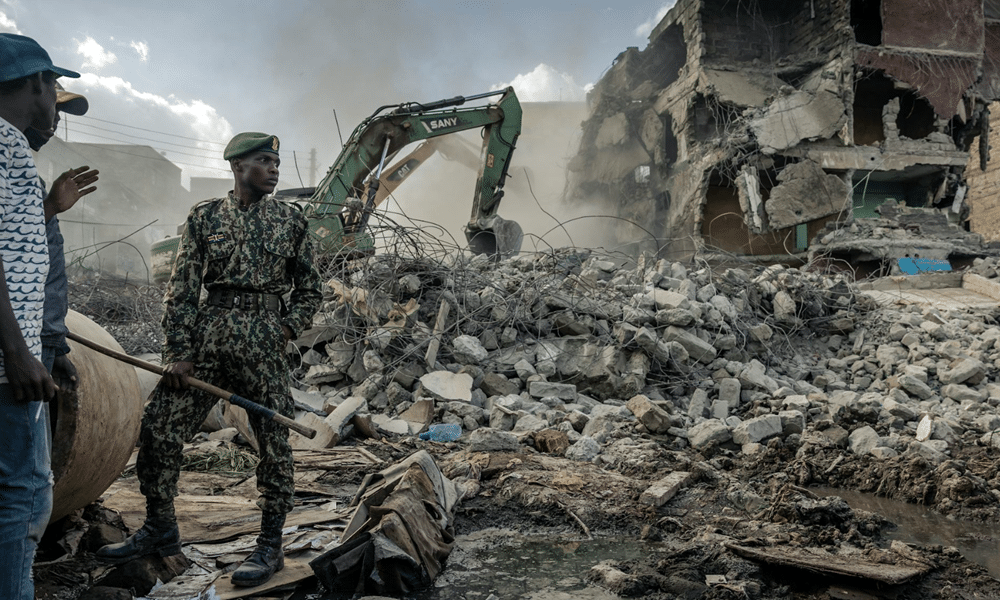
A Building Under Demolition In The Mathare Informal Settlement Of Nairobi, Kenya. Photo By Luis Tato/Afp Via Getty Images

A building under demolition in the Mathare informal settlement of Nairobi, Kenya. Photo by LUIS TATO/AFP via Getty Images

FacebookTwitterLinkedInRedditWhatsApp
Advertisement

Recent floods in Kenya have left at least 270 people dead, displaced more than 200,000 and destroyed property, infrastructure and livelihoods across the country. In Nairobi, hundreds of people in informal settlements were left homeless and thousands were displaced. And now, the government has been evicting people from flood-prone areas.

Smith Ouma is a legal expert with a focus on urban governance. His research has covered land and tenure rights in Nairobi’s informal settlements. Moina Spooner, from The Conversation Africa, asked Ouma to share his thoughts on the government’s response to the flooding in Nairobi’s informal settlements and how it can be improved.

Why are Nairobi’s informal settlements vulnerable to flooding?

Nairobi’s informal settlements sprang up in the colonial period. Colonial authorities used various laws and public health concerns as a way to remove Africans from areas considered commercially attractive. They were pushed into marginal areas of the city that were prone to hazards like flooding.

This continued after Kenya gained independence. Planning tools (like city master plans) were used to force low-income groups to relocate to the city’s peripheries.

Today, informal settlements cover only 5% of Nairobi’s total residential land area, but they are inhabited by at least half of the city’s population. Because they offer cheap living options, people end up crammed into this small space with minimal basic infrastructure and services.

Informal settlements continue to be vulnerable to hazards like floods because development plans haven’t considered their residents’ needs. The vast majority of informal settlements residents are left to cope in whatever way they can, often against established standards. For instance, residents will use whatever cheap material they can find to build their homes or improve infrastructure, like roads and sanitation facilities.


Also Read: You Are on Your Own; Linturi Tells Kenyans Who Lost Crops, Animals to Floods 


To make matters worse, as I’ve found in my previous research, there’s been a decline in city institutions. This has weakened the city’s ability to enforce rules and work with residents in low-income neighborhoods towards creating effective solutions.

For instance, the County Assembly, the primary legislative institution at the county level, has been sidelined. This has created room for unaccountable institutions.

The Nairobi Metropolitan Service, for example, was established as part of the president’s office rather than as an independent office in the county government system.

What did the government do to support those affected by flooding?

The government has used forceful evictions in low-income neighborhoods. President William Ruto ordered the evacuation of all homes along the nation’s waterways.

In the immediate aftermath of the floods, residents of informal settlements and community groups banded together to support each other. Community health workers helped affected households with essential services and medicines. Food and other essential items were distributed by social movements, using donations.

Wakenya & Friends, since April 24, The Network of Mathare Community Social Justice Centres has raised 3,129,661 KES to support flood victims. Here is how your donations have been spent. Asanteni sana for the ubuntu: indeed, we are because you are. https://t.co/9sqSV1tbBt pic.twitter.com/ijo6G9hfSv

— Mathare Social Justice Centre (MSJC) (@MathareSJustice) May 2, 2024

But, rather than acknowledging, applauding, and supporting these efforts – which are the government’s constitutionally mandated duties – the administration came out with reactionary policies and proclamations.


Also Read: A Child Among 2 People Killed in Govt Evictions


Despite the constitutional guarantee of the right to adequate housing and numerous court judgments reaffirming citizens’ rights against forceful evictions, the government has resorted to heavy-handed tactics.

There are concerns that the new affordable housing programme – aimed at constructing 250,000 affordable housing units per year – might serve as a cover for evicting people from their land. This would create space for investors to build houses for an exclusive market.

Are these forced and arbitrary evictions legal?

No. Based on applicable laws and the constitution, in my view Kenya is violating local laws and other international treaties in carrying out these forced evictions.

First, the state, through the National Land Commission, failed to provide adequate notice to residents (three months as stipulated in the Land Act), which renders the evictions arbitrary.

Second, under the Kenyan constitution, the state has a duty to ensure all Kenyans have a right to adequate housing.

The loss of lives and property as a result of the state’s actions is a violation of residents’ right to life and property. Indeed, the Supreme Court has ruled that landless individuals who establish housing on public land have a protectable right to housing on the same land. This includes public land that is along riparian reserves. Any evictions that are to be carried out by the state must respect these rights and procedural requirements.


Also Read: Kindiki, 2 Other CSs Dragged to Court Over Flood Effects


Third, Kenya is a signatory to various international treaties and conventions which say that any evictions carried out by the state must be in accordance with the United Nations Guidelines on Evictions. States must take all appropriate means to promote the right to adequate housing and prior to carrying out any evictions, explore – in consultation with the affected persons – all feasible alternatives with the view of avoiding or minimizing the need to use force.

Also, as determined by a high court case in 2013, the state was to develop appropriate legal frameworks for evictions. The Kenyan government failed to do this, leading to a 2018 ruling by the Supreme Court affirming that in the absence of such guidelines, the UN Guidelines on evictions would be applicable as soft law.

How should the government have prepared and reacted instead?

The government has invoked its duty to protect lives as justification for the ongoing evictions in low-income settlements. This is a duty that existed even before the onset of the heavy rains. The government received early warnings of possible heavy rains and floods from the meteorological department but did very little to act on these warnings.

The government is also aware of the current national housing deficit of more than 8,888,626 units. This contributes to the expansion of informal settlements.

Armed with this knowledge, the ongoing catastrophe could have been avoided, or at least mitigated.

The state should have mobilized a coalition of actors to develop and implement protective measures for the residents.


Also Read: Runda Estate Residents Buy Boats & Beg for Help as Houses Remain Flooded


Through the work I’ve done in various informal settlements in Kenya, such as Mukuru, I’ve seen how there are already long-standing initiatives by social movements and community groups which could have helped. These could be tapped into to identify risks and build community capabilities to respond to the flooding challenge.

These communities could also help with planning to prevent this situation from happening again. For instance, they’re already undertaking restoration activities along the rivers.

Additionally, in places like Mukuru, residents are actively seeking community-driven solutions to the land and housing challenges that are at the root of informal settlement development. These residents are the climate, environmental and universal housing champions who the government ought to have been working with even before the floods started.

Instead of forcibly evicting communities that have already experienced great hardship, if the government has no alternative option for them, policymakers should tap into their knowledge.The Conversation

Smith Ouma, Postdoctoral research fellow, University of Manchester

This article is republished from The Conversation under a Creative Commons license. Read the original article.


Tags: Informal SettlementsKenyaKenya FloodsNational DisasterWilliam Ruto
Smith Ouma

Smith Ouma

I am currently a Leverhulme early career researcher at the Global Development Institute. Prior to this role, I was a post-doctoral research fellow with the FCDO-funded African Cities Research Consortium. With a background in law, my research is inherently interdisciplinary, spanning legal geography, urban politics, urban health, and development studies. My primary focus lies in understanding the political economy of informal settlements and systems failings in cities, particularly in Africa. As part of this interest, I have engaged with multiple actors to understand how power is performed and how interests emerge and compete in informal settlements contexts. I also look at the everyday practices of marginalized urban residents to understand how agency is exercised, and the different strategies and tools that are employed to realize rights in the city. Additionally, I have strong research and professional interest in the field of land law.

Related Posts

Treasury Invites Applications For Board Recruitment Across 39 State-Owned Enterprises

Opinion | How New Taxes on Bank Card Transactions Charges Will Raise the Costs for Ordinary Kenyans if Adopted by Parliament

June 1, 2026
Artificial Intelligence Esther Muoria Is A Seasoned Manager And Phd Holder Appointed By President William Ruto As The Tvet Principal Secretary.

Opinion | AI Mistakes That Could Destroy Kenya’s Future — Global Lessons Every Leader, Business and Citizen Must See Now

May 31, 2026
Health Cs Aden Duale Denies Claims Sha Will Shut Down. Ebola Storm Rages On

Opinion | Kenya Should Think Before Rejecting the Laikipia Ebola Facility

May 31, 2026
Low Wages Squeeze Kenyans As As Computer Misuse And Cybercrimes Act Establishes Penalties For Unauthorized Access To Computer Systems, As Well The Legal Cybersecurity Practices.

Opinion | Why Wage Increases Won’t Fix What’s Broken in Kenya’s Economy

May 29, 2026
ADVERTISEMENT

The Kenya Times Facebook

LATEST ARTICLES

  • Why Transgender Troops Can Now Serve in the U.S. Military
  • “I Couldn’t Care Less” Trump Responds After Iran Ends Talks With US
  • Jill Biden Reveals Regret Over Joe Biden’s 2024 Run in New Interview
  • Stars Abroad: Moses Shumah, Kenyan Striker Breaking Records in Zambia
  • Doctors Question Transparency of Trump’s Heart Test Results
  • Corazone Aquino: Kenyan Star Named After Philippines’ Former President
  • KMA Reveals How to Know Licensed Doctors After Deadly Kitale Surgery
  • Iran Ends All Negotiations With US, Vows to “Completely” Block the Strait of Hormuz
  • Wise vs Remitly vs Western Union: Best International Transfer in 2026
  • KDF Soldiers Take Charge as Protests Erupt in Nanyuki Over Ebola Quarantine Facility
  • End of an Era as Paris Lounge & Grill Rebrands, Kentwood Address Undergoes Renovation
  • Benny McCarthy Makes Changes to Harambee Stars Squad Days After Unveiling 24 Players
  • Ruto Delivers Weighty Apology During Madaraka Day Speech [FULL TEXT SPEECH]
  • Njeri Maina Explains Why President Ruto Can’t Be Impeached
  • Plane Crashes in Maasai Mara
ADVERTISEMENT

Company

About Us

Our Authors

Our Experts

Social Media

Policies

Privacy Policy

House Rules

Standards and Policies

Terms and Conditions

Subscription

My Account

Contact Us

Contact Us

Join Our Team

Advertise With Us

© Copyright 2026 | The Kenya Times | All Rights Reserved

Welcome Back!

Sign In with Facebook
Sign In with Google
Sign In with Linked In
OR

Login to your account below

Forgotten Password? Sign Up

Create New Account!

Sign Up with Facebook
Sign Up with Google
Sign Up with Linked In
OR

Fill the forms below to register

All fields are required. Log In

Retrieve your password

Please enter your username or email address to reset your password.

Log In
Your Privacy and Cookies
We use cookies on our website to give you the most relevant experience by remembering your preferences and repeat visits. By clicking “Accept”, you consent to the use of ALL the cookies.
Do not sell my personal information.
Cookie settingsACCEPT
Privacy & Cookies Policy

Privacy Overview

This website uses cookies to improve your experience while you navigate through the website. Out of these cookies, the cookies that are categorized as necessary are stored on your browser as they are essential for the working of basic functionalities of the website. We also use third-party cookies that help us analyze and understand how you use this website. These cookies will be stored in your browser only with your consent. You also have the option to opt-out of these cookies. But opting out of some of these cookies may have an effect on your browsing experience.
Necessary
Always Enabled
Necessary cookies are absolutely essential for the website to function properly. This category only includes cookies that ensures basic functionalities and security features of the website. These cookies do not store any personal information.
Functional
Functional cookies help to perform certain functionalities like sharing the content of the website on social media platforms, collect feedbacks, and other third-party features.
Performance
Performance cookies are used to understand and analyze the key performance indexes of the website which helps in delivering a better user experience for the visitors.
Analytics
Analytical cookies are used to understand how visitors interact with the website. These cookies help provide information on metrics the number of visitors, bounce rate, traffic source, etc.
Advertisement
Advertisement cookies are used to provide visitors with relevant ads and marketing campaigns. These cookies track visitors across websites and collect information to provide customized ads.
Others
Other uncategorized cookies are those that are being analyzed and have not been classified into a category as yet.
SAVE & ACCEPT
LOGIN | REGISTER
  • Login
  • Sign Up
  • Cart
No Result
View All Result
  • News
    • Latest News
    • Breaking News
    • Investigations
    • Explainers
    • Fact Check
  • Politics
    • Global Politics
    • Conflicts & Security
    • Elections
    • Diplomacy
    • Government & Policy
    • Political Analysis
  • Business
    • Global Economy
    • Markets
    • Technology
    • Startups
    • Energy
    • Finance
  • World News
    • Americas
    • Asia
    • Asia Pacific
    • Africa
    • Europe
    • Middle East
  • Africa
    • East Africa
    • West Africa
    • Southern Africa
    • Central Africa
  • Health
    • Global Health
    • Public Health
    • Health Policy
    • Medical Research
    • Diseases & Conditions
    • Mental Health
    • Nutrition
    • Climate & Health
    • Health Explainers
  • Sports
    • Athletics
    • Basketball
    • Boxing
    • Cricket
    • Football
    • Formula 1
    • Golf
    • Rugby
  • Weather
    • Climate Business
    • Climate Change
    • Climate Solutions
    • Living Green
  • Culture
    • Arts
    • Film & TV
    • Food
    • Lifestyle
    • Music
    • Travel
  • Opinion
    • Editorials
    • Letters
  • Behind The Brand
  • Contact Us

Not enough quota to unlock this post
Unlock left : 0
Are you sure want to cancel subscription?