
Skater Kelvin Kiarie Ruhiu has become one of Kenya’s most remarkable sports figures in 2026, breaking barriers in a discipline that few at home understood, let alone celebrated.
On Saturday, May 2, 2026, the 26-year-old put Kenya on the continental map by winning a gold medal at the African Skating Championship, also known as the Africa Skate Games, held in Cairo, Egypt.
The victory crowned a difficult journey driven by talent, self-belief, and sacrifice rather than institutional backing.
Early Life and Education
Born and raised in Kenya, Kiarie did not grow up in a sporting household and never imagined a future built around medals or international podiums.
His early life focused on education and the pursuit of a stable career.
Inline skating entered his life while he was a student at the Technical University of Kenya (TUK), where he was pursuing a Bachelor of Technology degree in Civil Engineering.
Also Read: Ruto Issues Ksh8 Million Cheques to Sawe After Marathon Record
What began as a casual curiosity quickly developed into a serious commitment.
Without access to structured academies, professional coaches, or sponsorship, Kiarie trained himself.
According to Kiarie, he relied on self-discipline, repetition, and online learning to master the sport.
While still in university and later working as a structural engineer, he developed expertise in freestyle skating disciplines, particularly freestyle battle and classic slalom, which require balance, control, and creativity.
Over time, results followed effort. Kiarie became a two-time Kenya national freestyle skating champion, earning the right to represent the country internationally.
In December 2025, he competed at the Inline Freestyle World Championship in Singapore, finishing 18th globally, an important milestone for a skater competing largely without support.
Yet as his profile grew, backing remained limited.
Kelvin Kiarie’s Lonely Road to the Podium
Kiarie’s journey drew public attention earlier in 2026 when he revealed the financial strain behind his international appearances.
Also Read: FIFA Approves Plan That Will Force Clubs to Have Academy Players in Squads
In March, while preparing to travel for a competition, he lacked funds for airport transport.
With no sponsor and little money left, he left home late at night and boarded a matatu, arriving early enough to catch his 3 am flight.
He traveled alone, without a coach, federation officials, or government support.
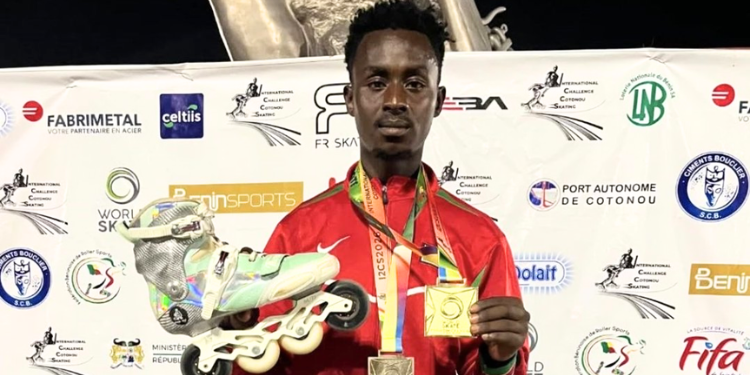
That reality followed him to the International Skating Challenge held in April 2026 in Cotonou, Benin.
Competing as the sole Kenyan representative, Kiarie won gold in the freestyle battle category and silver in classic slalom.
The Benin performance confirmed his status among Africa’s elite skaters and set the stage for Cairo.
At the African Skating Championship, Kiarie faced top competitors from across the continent.
He delivered a composed and controlled routine, earning gold and becoming one of the few Kenyans to win a continental title in inline freestyle skating, a sport still developing locally.
Recognition and a Wider Meaning
Kiarie’s Cairo triumph received national recognition.
President William Ruto congratulated him, describing the gold medal as a proud moment for Kenya.
The win renewed public conversation about the treatment and funding of athletes competing outside mainstream sports.
At 26, Kiarie balances two demanding paths.
He works professionally as a structural engineer, applying his academic training to engineering projects, while continuing to compete as an elite athlete.
He has consistently spoken about the need for greater support for young people involved in alternative sports.
Beyond medals, Kiarie’s rise has challenged the narrow definition of Kenyan sporting success.
His achievements have highlighted the potential that exists beyond athletics and football and exposed the gaps in institutional support for emerging disciplines.
Crucially, Kiarie does not have major sponsorships or government funding, which means his wealth remains limited despite his continental success.
Recent public fundraising drives that raised between Ksh100,000 and Ksh150,000 were support contributions rather than long-term income and do not significantly alter his overall net worth.