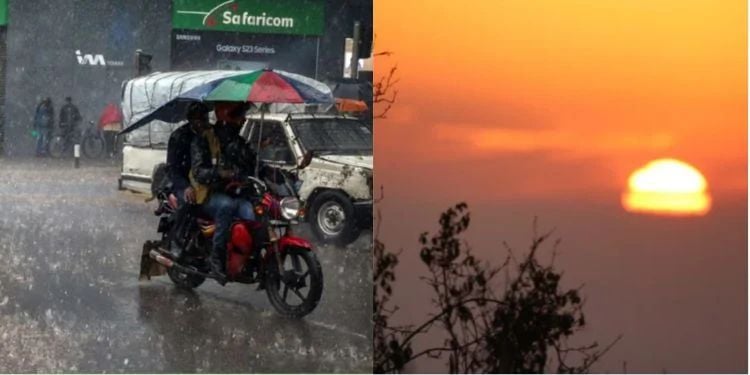
The Kenya Meteorological Department (KMD) has warned that heavy rains will continue in several parts of the country over the next five days, with specific regions expected to experience intense downpours. In its latest five-day forecast covering May 16 to May 20, Kenya Met said rainfall will persist across the Highlands East and West of the Rift Valley, the Lake Victoria Basin, the Rift Valley, parts of the Coast, and northwestern Kenya.
According to the weatherman, heavy rainfall is expected in the Highlands West of the Rift Valley, the Lake Victoria Basin, and the Rift Valley, raising concerns about flooding and disruptions.
Regions Expected to Receive Heavy Rainfall
In the forecast, Kenya Met identified several counties in the western and Rift Valley regions that are expected to receive the heaviest rainfall. These include:
- Lake Victoria Basin counties: Kisumu, Siaya, Homabay, Migori, Busia, Kakamega, Vihiga, Bungoma
- Western highlands counties: Kisii, Nyamira
- Rift Valley counties: Nakuru, Narok, Baringo, Uasin Gishu, Trans Nzoia, Elgeyo Marakwet, Nandi, West Pokot, Kericho, Bomet
The department noted that these regions will experience afternoon showers and thunderstorms in several places on multiple days during the forecast period.
Also Read: Kenya Met Issues Heavy Rainfall Alert for Parts of Kenya This Week
Weather Outlook Across Other Regions
At the same time, Kenya Met predicted that areas East of the Rift Valley, including Nairobi, Nyeri, Kiambu, and Murang’a, will have cloudy mornings followed by light afternoon showers in some places.
The Coastal region, including Mombasa, Kilifi, Lamu, and Kwale, will experience occasional showers, particularly in the mornings, with sunny intervals expected in the afternoons.
Meanwhile, northwestern Kenya (Turkana and Samburu) will largely remain hot but may receive isolated showers toward the end of the forecast period.
The north-eastern and south-eastern lowlands are expected to remain mostly sunny and dry, with only minimal chances of rainfall.
Kenya Met classifies heavy rainfall as precipitation of 21-50mm in 24 hours, which can result in heavy rain and thunderstorms.
The department adds that these conditions can lead to flooding in low areas, reduced visibility, slippery roads, and landslides in highland regions.
Residents in the affected areas are advised to stay alert, especially those in flood-prone zones, and keep checking updates from Kenya Met and local authorities.
The weatherman has urged Kenyans to use the five-day forecast alongside daily weather updates for better planning, noting that conditions may vary within counties.
Also Read: Kenya Met Issues Flood and Heavy Rainfall Alert in Parts of the Country
Earlier Kenya Met Warning on Flood and Heavy Rainfall
The Kenya Meteorological Department (KMD) had warned that heavy rains were expected across several parts of the country, which could raise the risk of flooding, flash flooding, and poor visibility, especially in low-lying, flood-prone areas.
In an advisory on May 7, Kenya Met said the rains are forecast to intensify between May 8 and May 14, with some areas likely to receive more than 20 millimeters of rain within 24 hours.
The alert was in force from 6 pm on May 7 to 7 pm on May 14, 2026, with rainfall intensity expected to peak between May 10 and May 13.
Kenya Met said the ongoing rains in areas on both sides of the Rift Valley, the Central Highlands, and parts of the southeastern lowlands are expected to spread and intensify, with additional rainfall also likely in parts of north‑western Kenya.
“The rainfall being experienced over several parts of the Highlands West and East of the Rift Valley, and Central Highlands, including parts of the Southeastern Lowlands, is expected to intensify to more than 20mm in 24 hours, from 8th to 14th May 2026,” noted the department.
Kenya Met said the rainfall was expected to peak between May 10 and May 13, before gradually reducing from May 14. However, it cautioned that even as the intensity decreases towards the end of the advisory period, rainfall was still expected to persist in several regions.