Global tensions have heightened as North Korea fired ballistic missiles just hours after a U.S. military operation in Venezuela captured President Nicolas Maduro.
The missiles fired on Sunday, January 4, coincided with South Korea’s leader beginning a state visit to China.
According to South Korea’s military, the missiles were launched at around 7:50 a.m. local time and traveled approximately 900 km.
Japanese officials reported that at least two missiles were launched, reaching distances of about 900 km (560 miles) and 950 km (590 miles).
The South Korean military said it, alongside the United States, is closely analyzing the specifications of the missiles while maintaining “a full readiness posture.”
Meanwhile, U.S. forces in the Asia-Pacific region stated that the launches did not pose an “immediate threat to U.S. personnel, territory, or allies.”
North Korea Launches Missiles into Sea as South Korean Leader Visits China
Japan’s Defence Minister Shinjiro Koizumi warned that the missile launches pose a threat to the security and stability of Japan, the wider region, and the international community.
‘Our government has filed a strong protest with North Korea and condemns the action in the strongest terms,’ Koizumi said.
“North Korea’s nuclear and missile development threatens the peace and stability of our country and the international society, and is absolutely intolerable.”
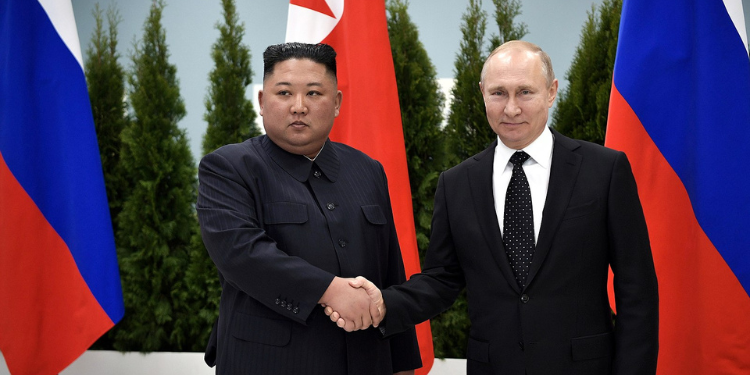
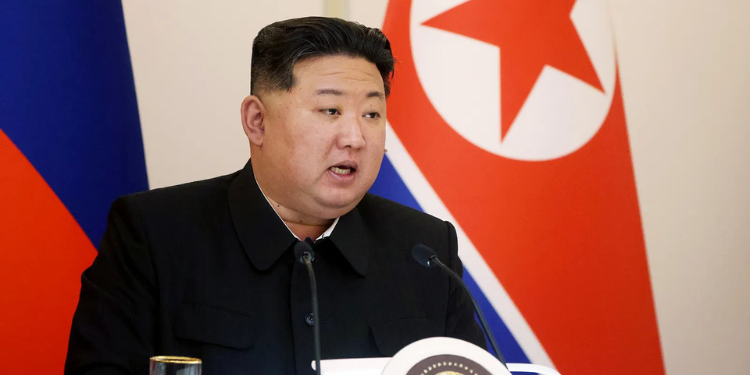
North Korean state media reported that on Saturday, leader Kim Jong Un visited a munitions factory and called for the country to double its production capacity of tactical guided weapons.
Also Read: North Korea Eyes Nuclear Test and New Spy Satellites with Russia’s Support
South Korea President Begins Visit to China
South Korean President Lee Jae-myung began a state visit to China on Sunday, aiming to promote peace on the Korean Peninsula, just hours after North Korea launched ballistic missiles.
During the four-day trip, Lee is expected to meet with Chinese President Xi Jinping, marking their second meeting in just two months. He arrived in Beijing with a delegation that includes over 200 South Korean business leaders, according to Chinese state broadcaster CCTV.
The two countries are anticipated to discuss issues such as supply chain investment, the digital economy, and cultural exchanges, CCTV reported.
Also Read: South Korea to Acquire U.S. Aircraft and Engines Worth $50 Billion Following Trump Visit
North Korea Eyes Nuclear Test and New Spy Satellites with Russia’s Support
North Korean Supreme Leader Kim Jong Un could authorize a nuclear test at the Punggye-ri site facility.
According to a report by South Korea’s Defense Intelligence Agency (DIA), as cited by Yonhap News Agency on Wednesday, November 5, North Korea could soon conduct additional military activities.
The agency further indicated that North Korea is preparing new spy satellite launches with technical assistance from Russia to deploy higher-resolution reconnaissance satellites than those it currently possesses.
The Punggye-ri facility, located in the mountainous northeast, has long been the focal point of North Korea’s nuclear testing program. Analysts believe it remains operational and ready for a new test if ordered by Kim.
In September, Kim vowed to “exponentially increase” North Korea’s nuclear arsenal, pledging no limits on the country’s military expansion, according to the state-run Korean Central News Agency (KCNA).
The declaration was made during a speech marking the 76th anniversary of North Korea’s founding, his first such address since assuming power in 2011, according to South Korea’s Unification Ministry.
Follow our WhatsApp Channel and X Account for real-time news updates.