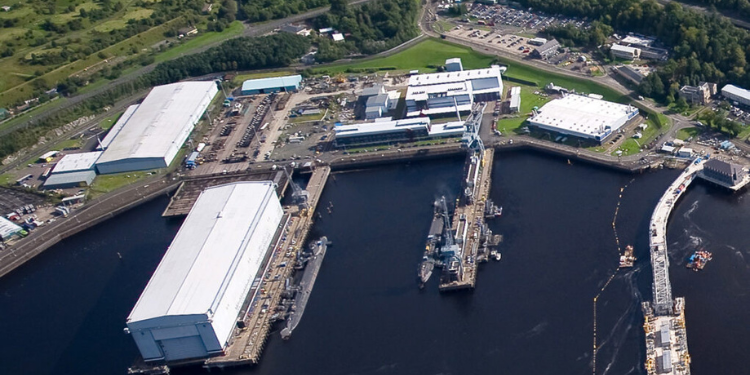

An Iranian man has been arrested after attempting to gain access to the His Majesty’s Naval Base (HMNB) Clyde in Scotland.
The 34-year-old man, accompanied by a woman of unknown nationality, approached the gate of the nuclear missile base on Thursday while traveling in a vehicle.
According to a Police spokesperson, they were turned away for lack of security passes, then seen ‘acting suspiciously’ in the area, and soon arrested.
“Around 5 pm on Thursday, 19 March 2026, we were made aware of two people attempting to enter HM Naval Base Clyde. A 34-year-old man and a 31-year-old woman have been arrested in connection with this,” said the Police Scotland spokesperson.
He added that the investigation is ongoing and that they would comment further on the matter when it is complete.
Iranian Man Arrested for Attempting to Enter Nuclear Missile in Scotland
The police spokesperson argued that it is an offence under the Official Secrets Act 1911 to approach, inspect, pass over, or be in the neighbourhood of a protected military site if it threatens the safety or interests of the state.
The major security alert came as two Iranian men appeared in court in London, charged with spying for Tehran.
Also Read: Iran’s Revolutionary Guards Spokesperson Ali Mohammad Naini Killed in Strikes
Nematollah Shahsavani, 40, and Alireza Farasati, 22, appeared in Westminster Magistrates Court suspected of spying on Jewish targets, including the Israeli embassy in London, a Jewish community centre, and Britain’s oldest synagogue.
The pair were arrested earlier this month after the US and Israel attacked Iran on Feb 28 in Operation Epic Fury.
But most of their alleged spying is alleged to have taken place in July and August, just weeks after the US and Israel bombed Iran’s nuclear sites in Operation Midnight Hammer.
Last year, Ken McCallum, director general of MI5, said his Security Service had tracked “more than twenty potentially lethal Iran-backed plots in just the one year”,
About His Majesty’s Naval Base (HMNB) Clyde
HM Naval Base Clyde, commonly known as Faslane, was first constructed and used as a base in the Second World War.
During the 1960s, the British Government began negotiating the Polaris Sales Agreement with the United States regarding the purchase of a Polaris missile system to fire British-built nuclear weapons from five specially constructed submarines.
Also Read: UK Army Chief Vows Action on Wrongs Done to Kenyans by British Soldiers
As a result, only four were constructed: HMS Resolution, HMS Repulse, HMS Renown, and HMS Revenge. These four submarines were permanently based at Faslane
Faslane was chosen to host these vessels at the height of the Cold War because of its geographic position, which forms a bastion on the relatively secluded but deep and easily navigable Gare Loch and Firth of Clyde on the west coast of Scotland.
This position provides for rapid and stealthy access through the North Channel to the submarine patrolling areas in the North Atlantic, through the GIUK gap to the Norwegian Sea.