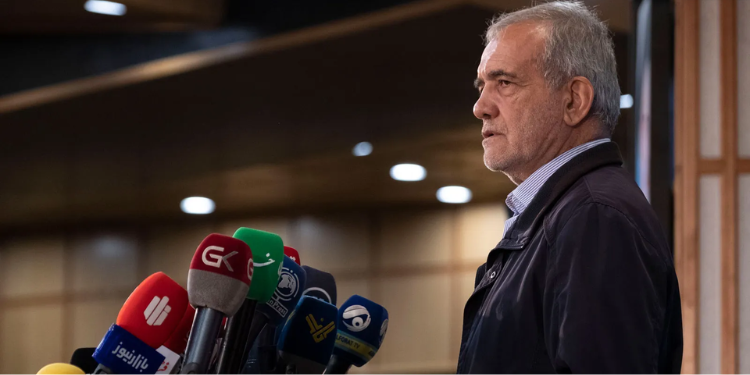
Iranian President Masoud Pezeshkian has delivered a rare, sweeping speech directly to the American public, accusing Washington of creating hostility with Tehran to justify military pressure, sanctions, and regional dominance.
In a public statement on April 1, Pezeshkian stated that Iran’s record as a modern state contradicts claims that it threatens global or regional stability.
He argued that Iran, despite repeated foreign pressure, has never started a war in its modern history and has always acted in self-defense when attacked or threatened.
“To the people of the United States of America, and to all those who, amid a flood of distortions and manufactured narratives, continue to seek the truth and aspire to a better life,” President Pezeshkian stated.
Defense, not Aggression
Pezeshkian based his argument on Iran’s extensive civilizational history, stating that the country’s identity has been molded by survival rather than conquest.
He stated that even during times when Iran had military advantages over neighboring countries, it did not seek expansion or domination.
According to the statement, Iran has instead endured occupation, invasion, sanctions, and prolonged political and military pressure without shifting toward an aggressive stance.
Pezeshkian rejected the portrayal of Iran as an enemy of the American people, stressing that Iranians draw a clear distinction between governments and the citizens they represent.
He said this distinction has stayed intact even during times of increased tension between Tehran and Washington and is grounded in Iranian culture rather than short-term politics.
The statement clarifies that hostility has consistently been aimed at US policy, not at the American people.
“Portraying Iran as a threat is neither consistent with historical reality nor with present‑day observable facts,” the statement says.
Pezeshkian argued that these portrayals serve political and economic interests, claiming that powerful states create enemies to justify military dominance, support arms industries, and maintain control over strategic regions and markets.
The president highlighted the clustering of US military bases, forces, and capabilities around Iran as proof that Tehran is being surrounded, not acting as an aggressor.
He pointed to recent US military actions launched from regional bases as evidence that deterrence arguments hide a more confrontational stance.
Also Read: UK Leader Wants US Prevented from Accessing Country’s Sea Based Nuclear Weapons System
Under these circumstances, Pezeshkian said, no country would hesitate to bolster its defense capabilities, describing Iran’s military stance as lawful and proportionate rather than provocative.
US-Iran History of Distrust
Turning to US‑Iran relations, Pezeshkian said the two countries were not always adversaries and that early interactions were relatively cooperative.
He identified the 1953 overthrow of Iran’s elected government as the moment relations significantly worsened, describing it as an illegal intervention that dismantled Iran’s democratic process and brought back dictatorship.
He said mistrust deepened through US support for Saddam Hussein during the Iran‑Iraq war in the 1980s and through decades of sanctions.
Pezeshkian described those sanctions as the longest and most comprehensive imposed on any country in modern history, adding that Washington carried out two military attacks against Iran during periods of negotiation.
“Iran pursued negotiations, reached an agreement, and fulfilled all its commitments,” the statement says, accusing the United States of withdrawing from agreements, escalating tensions, and launching attacks while talks were ongoing.
Despite sustained pressure, Pezekshian said Iran has strengthened internally since the 1979 Islamic Revolution.
He pointed to higher literacy rates, the expansion of higher education, advances in technology, improved healthcare, and major infrastructure development as measurable outcomes.
He also warned of the human cost of sanctions and military action, citing damage to civilian infrastructure, including pharmaceutical facilities.
“When wars inflict irreparable harm on lives, homes, cities, and futures, people will not remain indifferent toward those responsible,” the statement says.
Pezeshkian challenged Americans to consider whether ongoing confrontation benefits their interests or enhances the US’s global reputation.
He accused Israel of exaggerating the Iranian threat to distract from its actions against Palestinians, arguing that Americans pay the price.
The address ended with a call for Americans to judge Iran by observable facts instead of official narratives, warning that the decisions made today will influence future generations.