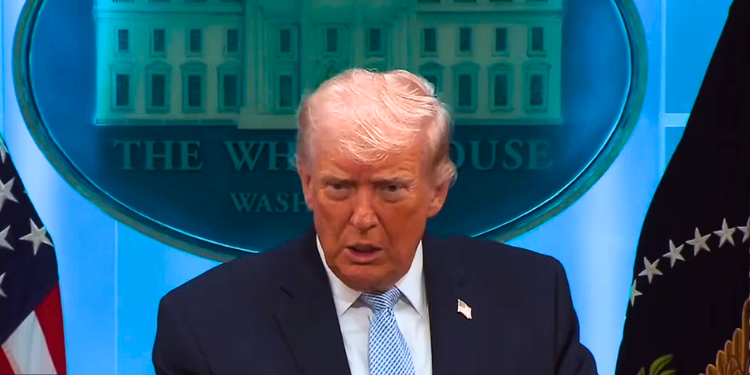
President Donald Trump is facing a tightening political and military timeline as Republicans set their own deadline for congressional oversight while the world awaits his 8 p.m. decision on Iran.
Trump set an 8 p.m. ET deadline on Tuesday, April 7th, for Iran to reopen the Strait of Hormuz or face major U.S. military action.
Some Republican lawmakers have pointed to a federal law that requires congressional approval for military operations lasting longer than 60 to 90 days. Congress is currently on holiday recess and will not return until next week.
The situation stems from Iran’s effective blockade of the Strait of Hormuz, a key waterway for global oil shipments. Trump has demanded that Iran lift the blockade. In a Truth Social post on Tuesday morning, Trump wrote:
“A whole civilization will die tonight, never to be brought back again. I don’t want that to happen, but it probably will.” He added that the night could mark “one of the most important moments in the long and complex history of the World.”
Trump Reiterates Threats of Widespread Strikes
Trump has said U.S. forces could target bridges, power plants and other infrastructure across Iran. On Monday, he told reporters that every bridge in Iran could be hit within hours and that the country could be taken out in one night.
The president also mentioned the possibility of regime change, stating that “different, smarter, and less radicalized minds” could take over.
Also Read: Trump Issues Warning to Iran Ahead of Strait of Hormuz Deadline
Iran has rejected a proposed 45-day ceasefire that would reopen the strait. Mojtaba Ferdousi Pour, head of Iran’s diplomatic mission in Cairo, told The Associated Press that Iran wants a permanent end to the war with guarantees against future attacks.
Tehran has urged young people to form human chains around power plants to protect them.
Reports from a British newspaper, The Times, citing a diplomatic memo, claim Iran’s new supreme leader Mojtaba Khamenei is unconscious and receiving treatment for a severe medical condition in Qom.
The memo reportedly states he is unable to participate in decision-making.
Lawmakers Cite War Powers Requirement
Some Republicans in Congress have noted that the War Powers Resolution requires the president to seek approval from lawmakers if fighting continues beyond 60 to 90 days.
With Congress out of session, direct involvement from the legislative branch remains limited for now.
Also Read: Trump Reveals Why He Has Not Yet Taken All of Iran’s Oil
On Monday, Trump addressed the rescue of an F-15E pilot and said the U.S. military could remove the Iranian regime in one night.
Why This Matters
The approaching deadline has raised questions about the balance of war powers between the executive and legislative branches.
The 60- to 90-day limit cited by some Republicans could force a congressional vote if operations extend into that period.
This situation also affects global energy markets and international stability, as any escalation in the Strait of Hormuz region could disrupt oil flows and widen the conflict.
Iran’s rejection of a short-term ceasefire and reports about its leadership add uncertainty to how the country will respond by the 8 p.m. deadline.