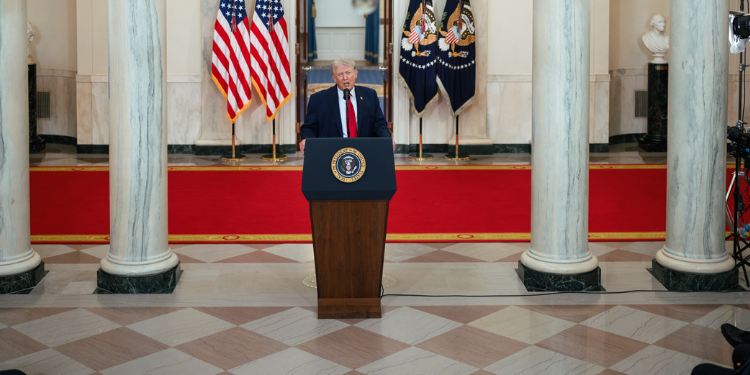
U.S. President Donald Trump on Tuesday issued a stark ultimatum to Iran, warning that “a whole civilization will die tonight” unless Tehran reopens the Strait of Hormuz by the set deadline, threatening with what he described as the “complete demolition” of Iran’s power plants and bridges in a single night of military action.
The warning came just hours before the president’s self‑imposed 8:00 p.m. Eastern Time cutoff, as tensions remained high.
In a post on his Truth Social platform, Trump issued one of his strongest warnings yet, saying:
“A whole civilization will die tonight, never to be brought back again. I don’t want that to happen, but it probably will… However, now that we have Complete and Total Regime Change, where different, smarter, and less radicalized minds prevail, maybe something revolutionarily wonderful can happen… We will find out tonight, one of the most important moments in the long and complex history of the World.”
Trump Threatens Military Action as Deadline Nears
Trump made the remarks as negotiations remained stalled. On Tuesday, U.S.–Israeli military operations against Iranian targets were intensified, with Israeli forces launching several attacks on Iranian infrastructure.
Also Read: Israel Warns Iranians to Avoid Trains as Trump Prepares Possible Strikes
Trump has threatened large‑scale strikes on Iranian civilian infrastructure if the strategic waterway is not fully reopened.
Al Jazeera and NBC News reported that the president explicitly warned of attacks on power plants and bridges, dismissing concerns raised by international observers about potential violations of the laws of war.
Earlier, Trump had posted a message declaring Tuesday would be “Power Plant Day, and Bridge Day,” warning Iran it would be “living in Hell” if it failed to comply. The White House later confirmed the deadline was set for 8:00 p.m. EDT.
Global Stakes Rise as Oil Markets React
The Strait of Hormuz, which connects the Persian Gulf to global markets, carries roughly 20 percent of the world’s oil and gas shipments. Disruptions since the escalation of U.S.–Israeli military operations in late February have already triggered rises in oil prices and renewed fears of global economic fallout.
Reuters and the Associated Press reporting indicate that Iran has rejected several ceasefire proposals, including a reported 45‑day truce, and instead demands a permanent end to hostilities, sanctions relief, and reconstruction assistance.
Also Read: Trump Sends Strikes Warning to Iran Over Strait of Hormuz
Iranian officials have warned that any attack on civilian infrastructure would be met with severe retaliation and have mobilized efforts to protect key facilities, including power plants.
Trump told journalists that the “entire country can be taken out in one night,” adding that bridges could be “decimated” and power plants left “burning, exploding and never to be used again” if the deadline passes without a deal.
While the Trump administration has expressed optimism that a last-minute deal remains possible, senior U.S. officials, including Defense Secretary Pete Hegseth, Chairman of the Joint Chiefs of Staff Gen. Dan Caine, and U.S. Mideast envoy Steve Witkoff, acknowledge that failure to reopen the strait could trigger an escalation with far-reaching political, economic, and security consequences across the Middle East and beyond.
Oil markets have reacted ahead of the deadline, with crude prices climbing on fears of prolonged disruption through the Hormuz corridor.
Last‑ditch diplomatic efforts are continuing through intermediaries, including Pakistan, to avert a potentially devastating escalation. While the Trump administration has expressed optimism that a last‑minute deal could ease tensions, failure to comply risks significant escalation with wide‑ranging implications for the Middle East and global energy markets.