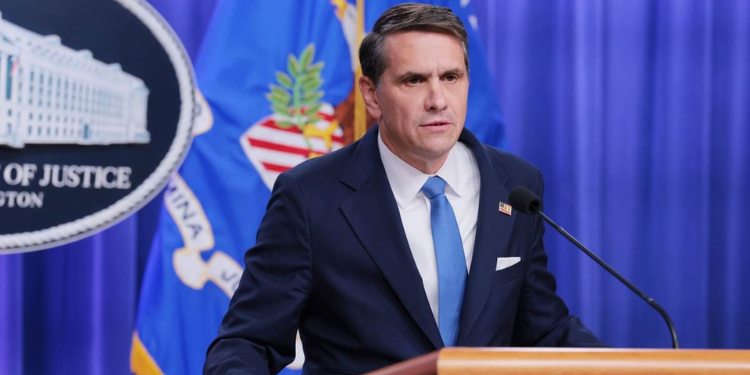

The United States (U.S) has warned it will criminally prosecute any individual, company, or government involved in the purchase, sale, transport, or financing of Iranian oil still subject to U.S. sanctions.
The warning was issued on April 12 by the U.S. Department of Justice after the collapse of high-level negotiations between Washington and Tehran to end weeks of open hostilities and restore unrestricted shipping through the Strait of Hormuz.
Acting Attorney General Todd Blanche said federal prosecutors had been instructed to pursue cases aggressively against violators, regardless of jurisdiction, nationality or corporate structure.
“The Department of Justice will vigorously prosecute anyone who buys or sells sanctioned Iranian oil,” Blanche said, adding that enforcement actions would extend to shipping operators, brokers, insurers, and financial institutions that facilitate the trade.
Failed U.S – Iran Talks
The statement followed President Donald Trump’s order for the U.S. Navy to begin preparations for a full blockade of the Strait of Hormuz after talks on Iran’s nuclear program failed.
Iran’s oil exports, already restricted under a long-standing U.S. sanctions regime, have remained a key source of revenue for Tehran despite repeated enforcement crackdowns.
American officials say Iran has relied on an expansive “shadow fleet” of tankers, falsified documentation, ship-to-ship transfers, and hidden ownership structures to move crude primarily to Asian markets, including China.
Also Read: Russia Claims Peace is Possible “Today” if Zelensky Takes Required Steps
Iran’s talks with the United States collapsed after roughly 20 hours of negotiations in Islamabad failed to produce an agreement on core issues.
According to U.S. officials, negotiations stalled over Iran’s refusal to end all uranium enrichment, dismantle major nuclear facilities, and allow full international control of nuclear material.
Iranian officials said they entered the talks in good faith but accused the United States of making excessive demands that threatened national sovereignty.
The Strait of Hormuz is under severe tension following the collapse of U.S.–Iran talks and a sharp escalation of military and legal measures by Washington.
U.S. naval forces have already begun mine-clearing and interdiction preparations, with American officials saying the objective is to prevent Iran from profiting from oil exports or transit fees while maintaining pressure on Tehran to reverse course.
Iran has rejected U.S. demands and insists it retains full control over the strait. Iranian military commanders, including the Revolutionary Guard Navy, have warned foreign vessels that any miscalculation could trigger confrontation, while parliament has backed plans to impose tolls and maintain security authority over the waterway.
Also Read: Iran Mulls Over Plans to Seize and Sell Ships Belonging to Select Nations
Commercial traffic has slowed as shipping companies reassess risks, while insurers have raised premiums for vessels transiting the route.
Iran’s Booming Business in China
China is central to the Iranian oil equation because it is the largest buyer of Iranian crude and the primary destination for oil moving through sanctions-evasion networks.
Despite U.S. sanctions, China has continued to import Iranian oil, often through indirect channels.
Iranian crude is typically relabeled, blended, or transferred ship-to-ship before delivery to independent Chinese refineries, commonly known as “teapot” refiners.
Payments are often routed through intermediaries or barter arrangements that bypass the U.S. dollar system, reducing exposure to American financial controls.
U.S. officials say Chinese port operators, storage terminals, and refiners have played a critical role in sustaining Iran’s export volumes, which have remained above one million barrels per day in recent months.
Several China‑based entities and facilities have already been sanctioned by the U.S. Treasury for handling Iranian oil.
Beijing opposes unilateral U.S. sanctions and maintains that its energy trade is conducted in accordance with Chinese law.
China has not indicated it will comply with a U.S. naval interdiction or halt imports, raising the risk of diplomatic and commercial friction as pressure on Iran intensifies.
The country’s continued demand has mitigated the impact of sanctions and is a key reason the Strait of Hormuz remains strategically vital amid the current crisis.