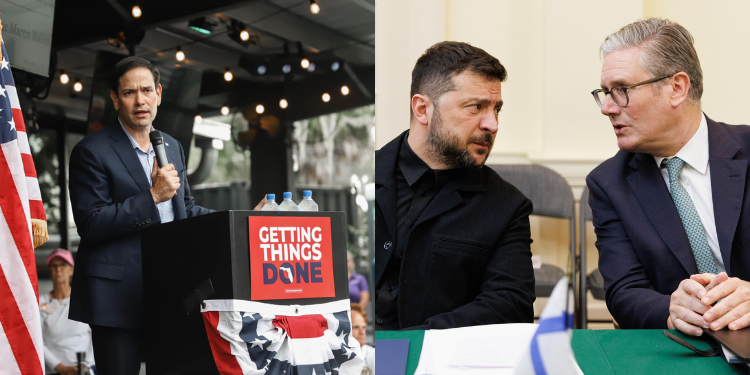
Ukrainian President Volodymyr Zelenskyy has highlighted the impact of ongoing Russian strikes on Ukraine, urging world leaders to recognize the full extent of the challenges posed by Russian aggression and modern warfare.
Speaking at the Munich Security Conference in Germany, Zelenskyy stressed the ongoing effort Ukraine must make to secure international support in defending its national interests.
He illustrated the situation with visuals showing recent attacks, including strikes that occurred during his visit.
Zelenskyy revealed that in January alone, Ukraine faced attacks from 6,000 drones, mostly Shahed drones, over 150 Russian missiles of various types, and more than 5,000 glide bombs.
On his part, US Secretary of State Marco Rubio said Washington remains unsure if Russia really wanted to end the Ukraine war.
Speaking at the 62nd Munich Security Conference, held at the Bayerischer Hof hotel in Munich, Germany, on February 14, Rubio expressed uncertainty about the prospects for a negotiated end to the war.
“We don’t know if the Russians are serious about ending the war, they say they are, and under what terms they were willing to do it, and whether we can find terms that are acceptable to Ukraine,” he said.
At the same summit, the United Kingdom’s Prime Minister Keir Starmer stated that Russia has demonstrated a strong appetite for aggression, causing severe suffering for the Ukrainian people.
“Its threat extends across our continent, not just threatening our security, but tearing our social contract, collaborating with populists who undermine our values, using disinformation to sow division, using cyberattacks and sabotage to disrupt our lives, and deepening the cost-of-living crisis,” he said.
Starmer warned that Russia is continuing to rearm despite the ongoing war in Ukraine, cautioning that this buildup is likely to persist even if a peace deal is reached.
Also Read: Putin Gains Edge as Ukraine Warns Russian Missile Barrages Overwhelm Air Defenses
Rubio and Starmer Pledge Closer Ties to EU
Rubio said the United States will remain closely connected to Europe even as it seeks changes in the relationship and in the international institutions that have supported the post-World War II world order.
He acknowledged past mistakes, stressing that the U.S. and its partners have a shared responsibility to confront these issues and work toward rebuilding.
Rubio added that under President Trump, the U.S. would take on the task of renewal and restoration, often communicating directly and urgently to ensure seriousness and reciprocity from its European allies.
On the other hand, the British Prime Minister stated that the country must explore opportunities to move closer to the European Union’s single market.
Starmer stressed the need to work together to lead a generational shift in defence industrial cooperation.
He noted that this effort includes revisiting closer economic alignment, six years after Britain left the European trading bloc.
Keir added that deeper economic integration is in the interest of both sides and highlighted the potential for collaboration in other sectors where it would be mutually beneficial.
Also Read: Ukraine Downs 112 of 129 Russian Drones in Overnight Assault
US and China Ties
Chinese Foreign Minister Wang Yi, who was also present at the Summit, warned that efforts to separate China from Taiwan could push Beijing and Washington closer to conflict.
Speaking at a conference in Munich, Wang said the most positive outcome in today’s global environment would be cooperation between the US and China.
Wang noted that China is encouraged by recent signs of respect from Washington.
He also stressed that China does not want the narrative of systemic rivalry between Europe and Beijing to be exaggerated.
Follow our WhatsApp Channel and X Account for real-time news updates.