
The United States warned Ukraine after strikes on a key Russian Black Sea oil export facility affected American-linked investments, Kyiv’s ambassador to Washington has revealed.
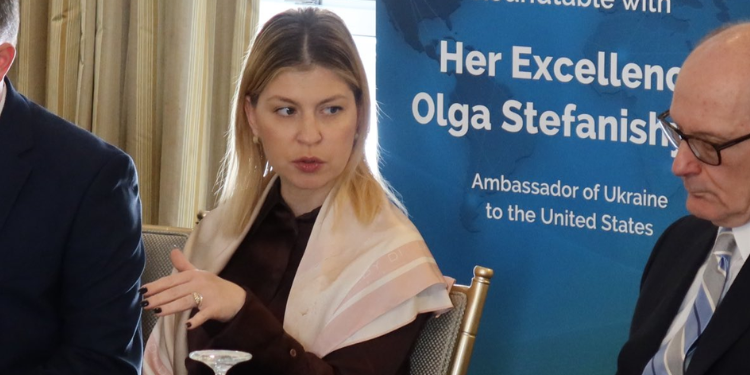
Ukraine’s Ambassador to the United States, Olha Stefanishyna, said on February 24 that the U.S. State Department issued a formal diplomatic notice following Ukrainian attacks on Russia’s Novorossiysk port late in 2025.
The strikes targeted energy infrastructure in the Russian Black Sea port city, including a November 14 attack that damaged a major oil terminal.
Naval drone strikes later hit the Caspian Pipeline Consortium’s marine terminal on November 29, forcing a temporary suspension of oil shipments from one of the region’s most important export routes.
Kyiv has never officially confirmed responsibility for the November 29 attack, although Ukrainian forces have regularly targeted Russian energy infrastructure to weaken Moscow’s war capabilities.
Ukraine reveals U.S. warning after Black Sea oil strike
Speaking during a briefing marking the fourth anniversary of Russia’s full-scale invasion, Stefanishyna said Washington raised concerns that the attacks had affected American economic interests.
“We have been hearing that Ukrainian attacks to Novorossiysk affected some of the American investments which are being performed through Kazakhstan,” she said.
“And we have heard from Department of State that we should refrain from, from, you know, attacking American interests.”
The ambassador said she received a demarche, a formal diplomatic communication, from the U.S. State Department following the November strikes.
According to Stefanishyna, the warning did not amount to a broader restriction on Ukrainian military operations but was specifically related to economic concerns.
“This concerned the very fact that American economic interests were violated there,” she said, adding that Ukraine acknowledged the warning.
Also Read: Putin Chooses Force, Strikes Ukraine with Over 1,400 Bombs and Drones
The Caspian Pipeline Consortium operates a major oil pipeline linking Kazakhstan’s western oil fields to Novorossiysk’s export terminal on the Black Sea.
The project is an international venture involving Russian, Kazakh, and foreign energy companies and serves as a critical route for Kazakh crude exports to global markets.
U.S. oil giant Chevron is among the major shareholders in the consortium, making the facility strategically important to American investors.
Damage to the terminal reportedly caused a significant drop in Kazakh oil exports after the November drone strikes.
Stefanishyna said the diplomatic warning underscored the extent of U.S. economic interests in Kazakhstan compared with Ukraine.
“I was really, really sorry that in 35 years of Ukraine independence, having so many chances, we never brought ourselves to the situation where we can do the same,” she said.
The revelations came as Ukraine marked four years since Russia launched its full-scale invasion on February 24, 2022, a conflict that has become Europe’s largest war in decades.
Ukrainian President Volodymyr Zelenskyy said Russia had failed to achieve its objectives since the invasion began, insisting that Ukraine would continue working toward peace and justice.
European leaders reaffirm support for Kyiv
European leaders used the anniversary to reaffirm support for Kyiv with British Prime Minister Keir Starmer on Tuesday saying Ukraine’s allies must “defeat the falsehood that Russia is winning,” while French President Emmanuel Macron described the war as “a triple failure for Russia.”
Also Read: Foreign Nation Speaks on Plans to Invade Iran if Trump Approves Strike
A joint statement by leaders of the Group of Seven nations reaffirmed their “unwavering support” for Ukraine’s sovereignty and territorial integrity and called for continued international backing.
Despite strong political support from Western allies, the battlefield situation remains largely concentrated in eastern Ukraine, where Russian forces have made slow advances at high cost.
When launching the invasion, Russian President Vladimir Putin said the goals were to “demilitarize” and “denazify” Ukraine — claims Kyiv and its allies have dismissed as propaganda.
Putin has repeatedly questioned Ukraine’s legitimacy as a state, arguing that Russia created modern Ukraine after the 1917 revolution — a claim rejected by historians and Ukrainian officials.
Stefanishyna criticized what she described as insufficient international pressure on Russia, saying that stronger sanctions and military support were needed to force Moscow into meaningful negotiations.
“Because of lack of sanctions, lack of pressure, lack of commitment, in terms of military systems, we were doing enough for Ukraine to survive, but we were not doing enough for Russia not to evolve,” she said
Follow our WhatsApp Channel and X Account for real-time news updates.