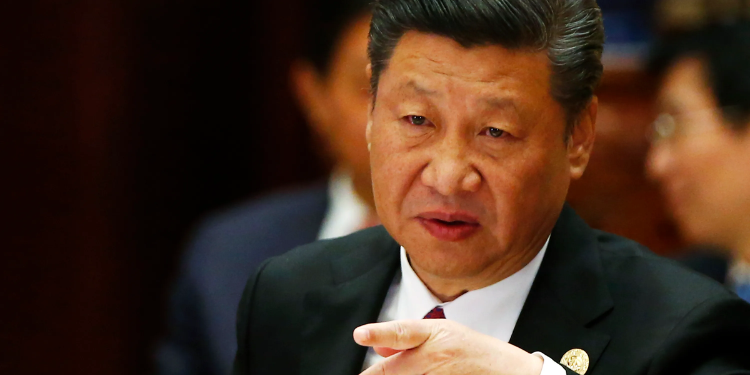
Chinese President Xi Jinping has set out four propositions on safeguarding and promoting peace and stability in the Middle East, positioning China as a consistent advocate of political dialogue, state sovereignty, and development-driven security in one of the world’s most volatile regions.
The proposals were outlined on April 14, 2026, and later amplified by Chinese diplomatic missions, including the Chinese Embassy in the United States.
China’s role in the Middle East has expanded steadily through diplomacy, trade and mediation efforts.
Xi Jinping Presents China’s Four Principles on Middle East Peace and Security
The first proposition calls for unwavering commitment to the principle of peaceful coexistence.
China’s position stresses that disputes in the Middle East should be resolved through dialogue and negotiation rather than force.
Beijing has repeatedly argued that military intervention and bloc confrontation have deepened divisions in the region, weakened state institutions, and prolonged humanitarian crises.
Under this proposition, China urges all parties to respect the purposes and principles of the United Nations Charter, reject zero-sum thinking, and pursue political solutions to the root causes of conflict.
Also Read: Ukraine Set for Fresh $60bn NATO Boost Alongside €90bn EU Loan
The approach aligns with China’s long-standing policy of noninterference and its emphasis on inclusive talks among all relevant stakeholders.
The second proposition focuses on respect for national sovereignty.
President Xi’s framework holds that the sovereignty, independence, and territorial integrity of Middle Eastern states must be upheld without exception.
China has consistently opposed externally imposed regime change and unilateral sanctions, arguing that such actions undermine international norms and exacerbate instability.
In the context of the Middle East, China maintains that every country has the right to choose its own development path and political system based on its domestic conditions.
This principle has featured prominently in China’s positions on Syria, Iran, and the Palestinian issue, where it has called for solutions led by the people of the region rather than dictated by outside powers.
The third proposition reiterates commitment to the international rule of law.
China argues that lasting peace in the Middle East requires adherence to universally recognized rules rather than the selective application of international law.
President Xi’s proposal emphasizes the authority of the United Nations and its Security Council as the central platform for conflict resolution.
China has repeatedly criticized what it describes as double standards in the enforcement of international law, particularly on issues such as civilian protection and the use of force.
By promoting the rule of law, China says it seeks to ensure fairness, predictability, and broad international legitimacy in efforts to address regional crises.
The fourth proposition advocates a balanced approach to development and security.
Also Read: Gaza Ceasefire Breached as Israeli Fire Kills Eight
China’s position holds that security cannot be sustained without economic development, and development cannot advance amid persistent conflict.
President Xi’s proposal links peacebuilding to economic recovery, infrastructure development, and improved livelihoods.
China has promoted partnerships under initiatives such as the Belt and Road to support connectivity, trade, and industrial cooperation in the Middle East.
According to Beijing, promoting development helps address unemployment, inequality, and weak governance, which are viewed as underlying drivers of instability and extremism.
China’s Increased Role in the Middle East
Over the past decade, China has steadily expanded its role in the Middle East, moving beyond trade into diplomacy and conflict mediation.
The country is the region’s largest trading partner and a major buyer of crude oil, especially from Saudi Arabia, Iraq, the United Arab Emirates, and Iran.
Chinese state firms are involved in infrastructure, energy, and telecommunications projects across the Gulf, North Africa, and the Levant.
Diplomatically, Beijing has cultivated relations with mutually hostile actors, including Iran, Saudi Arabia, Israel, and the Palestinian authorities, maintaining engagement without formal alliances.
Its most significant diplomatic intervention came in 2023, when China brokered the restoration of diplomatic relations between Saudi Arabia and Iran after seven years of rupture.
Since then, China has increased high‑level visits, issued policy frameworks on regional security, and hosted Middle East dialogue forums.