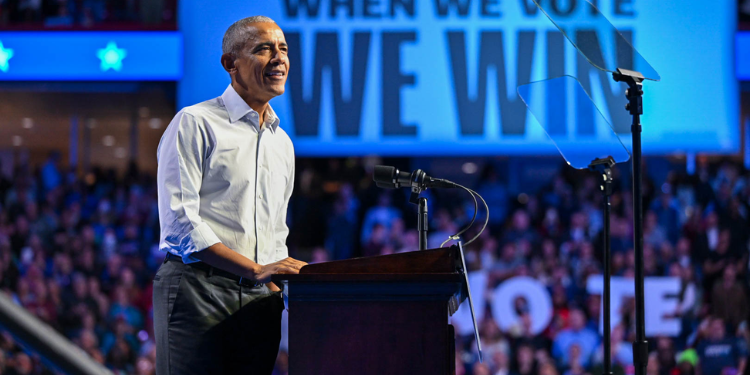
Former President Barack Obama sharply criticized the Supreme Court on Wednesday, April 29, after it struck down Louisiana’s congressional map that included a second majority-Black district.
In a 6-3 decision, the court ruled that the map amounted to an unconstitutional racial gerrymander. Justice Samuel Alito wrote the majority opinion.
The conservative justices said Louisiana lawmakers relied too heavily on race when they drew the new district to comply with Section 2 of the Voting Rights Act. The ruling means the map cannot be used in future elections.
Obama shared his reaction on X hours after the decision came down. He called it a direct blow to minority voting power.
“Today’s Supreme Court decision effectively guts a key pillar of the Voting Rights Act,” Obama wrote.
He said the ruling lets state legislatures draw districts that weaken the influence of racial minorities, as long as they describe the changes as partisan rather than racial.
Obama argued the decision fits a pattern, adding the current court majority is stepping back from its duty to protect equal participation in democracy and to shield minority groups from majority overreach.
Louisiana v. Callais Case
The case, Louisiana v. Callais, centered on Louisiana’s congressional districts after the 2020 census. Black voters make up about one-third of the state’s population.
Civil rights groups had pushed for two districts where Black voters could elect their preferred candidates.
A lower court earlier found that the original map likely violated Section 2 of the Voting Rights Act, which bars practices that diminish minority voting strength.
Louisiana’s Republican-led legislature then passed a new map with two majority-Black districts. Challengers, including voters who described themselves as non-Black, sued.
They said the new map violated the Constitution by making race the primary factor in redistricting. The Supreme Court agreed on Wednesday. It sent the case back to the lower courts for further action.
Also Read: Did Trump allies Plan an Attack for political gain ahead of the midterms? Americans Answers
The decision does not strike down Section 2 of the Voting Rights Act outright, but critics say it sharply limits how states and courts can use race to create districts that give minority voters a fair chance.
Justice Elena Kagan, joined by Justices Sonia Sotomayor and Ketanji Brown Jackson, dissented. She warned that the ruling could render key protections under the law nearly useless in practice.
Louisiana Attorney General Liz Murrill welcomed the outcome and called it the end of a “long-running nightmare” of federal courts forcing the state to draw what she described as racially discriminatory maps.
The practical effect could reach beyond Louisiana as Republican-controlled states in the South and elsewhere may now find it easier to redraw maps in ways that reduce the number of districts where Black or Latino voters form a majority.
Such changes frequently favor Republican candidates. Democrats have held most of the majority-Black districts in Congress.
Obama issues a directive to voters.
The former President directed Americans to keep fighting through voting. “The good news is that such setbacks are able to be overcome,” Obama wrote.
“But that will only happen if citizens across the country who cherish our democratic ideals continue to mobilize and vote in record numbers, not just in the upcoming midterms or in high-profile races, but in every election and every level.”
Obama’s call mirrors language he has used before, urging steady grassroots action rather than depending solely on the courts or Washington.
With the 2026 midterm elections approaching, redistricting fights are expected to heat up in several states. Louisiana will likely need to draw yet another map in time for candidate filing deadlines.
Also Read: Win for Democrats After Virginia Vote Delivers Exactly What the GOP Feared
Apart from Obama, voting rights groups also expressed deep disappointment, saying the ruling weakens one of the last major tools left from the 1965 Voting Rights Act to prevent dilution of minority votes. Civil rights lawyers predict more lawsuits as states move to redraw lines.
Supporters of the decision argue it restores color-blind principles to redistricting. They say the Constitution does not allow states to draw voting districts primarily based on skin color, even to address past problems.
The majority opinion stressed that compliance with Section 2 cannot justify race-based map drawing when the law does not actually require it.