President Donald Trump has signed an executive order cracking down on mail-in votingw which will require the Department of Homeland Security (DHS) to create a list of confirmed U.S. citizens eligible to vote in each state.
White House in a press release on Tuesday, March 31, said the order signed directs the U.S. Postal Service to only send ballots to citizens on each state’s approved mail-in ballot list. Ballots will now be issued in secure envelopes with unique barcodes for tracking.
Trump has repeatedly claimed, without evidence, that widespread fraud in mail-in voting cost him the 2020 election. He has pressed Congress for months to pass the SAVE America Act, which would require photo identification and proof of citizenship to vote.
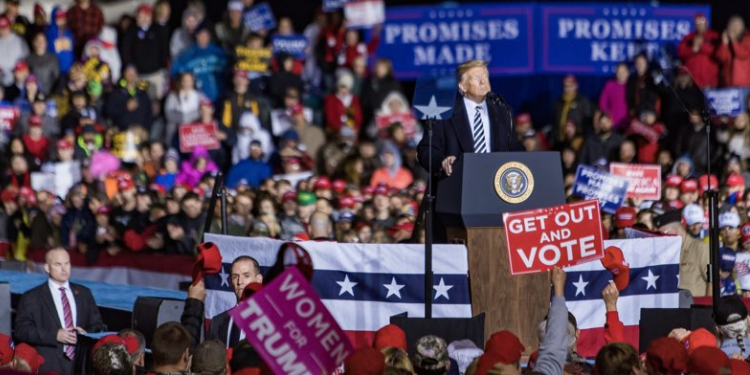
President Trump signs mail-in voting executive order
The Daily Caller previously reported that states failing to comply with the executive order could lose federal funding. Attorney General Pam Bondi has been directed to prioritize the investigation and prosecution of anyone accused of sending ballots to ineligible voters.
“To ensure the faithful execution of Federal law, protect the integrity of the mail as a medium for transmitting Federal election ballots and establish uniform standards for mail-in or absentee ballot services implemented through the United States Postal Service (USPS), the Postmaster General is hereby directed to initiate a proposed rulemaking pursuant to 39 U.S.C. 401 and other applicable authority within 60 days of the date of this order,” A White House statement explained.
The White House outlined that the new proposal will strengthen federal election safeguards by linking voter verification systems with existing government databases and introducing unique identifiers for mail-in ballots.
According to the administration, records maintained by the Social Security Administration, combined with the DHS’s SAVE Program, could be used to help confirm voter identity and eligibility in federal elections.
The SAVE system is currently used to verify immigration status for access to certain public benefits.
Focus on identity verification and election integrity
The White House said the federal government has a constitutional obligation to enforce election laws and prevent criminal violations tied to voting.
“The Federal Government has an unavoidable duty under Article II of the Constitution of the United States to enforce Federal law,” the statement said, adding that this includes maintaining public confidence in election outcomes.
As part of that effort, the administration is proposing additional safeguards for ballots sent through the mail.
Also Read: Outrage as Trump Imposes Severe Consequences on States Supporting Mail-In Voting
Central to the proposal is the introduction of secure ballot envelope identifiers, such as barcodes, which would allow authorities to track and verify ballots.
According to the White House, these identifiers would provide a “reliable, auditable mechanism” to ensure compliance with federal law while avoiding undue burden on eligible voters.
Officials said the system would allow election authorities to confirm that ballots are issued to and cast by eligible citizens.
“Unique ballot envelope identifiers, such as bar codes, enable confirmation that only citizens receive and cast ballots, reducing the risk of fraud and protecting the integrity of Federal elections.”
The SAVE America Act passed the House in February but has stalled in the Senate. Senate Majority Leader John Thune and other Republicans have floated passing the measure through reconciliation, which requires only 51 votes.
However, the Senate Parliamentarian has indicated the measure would be stripped from any reconciliation package because it is not budgetary.
Trump has urged Republicans to end the filibuster to pass the bill, warning that failure to act will cost them the November midterm elections.
Voting-rights groups say the executive order will disenfranchise millions of Americans, particularly those who rely on mail-in voting.
Legal challenges are expected, with courts likely to determine whether the President has the authority to impose such restrictions without congressional approval.
White House concerns over midterms
The executive order comes as senior White House officials privately express concern about GOP prospects in the midterms.
Sources told CBS News that aides, including Chief of Staff Susie Wiles and Deputy Chief of Staff James Blair, have been briefing Trump on polling showing rising dissatisfaction among independent voters.
Gasoline prices in the U.S. topped $4 a gallon on Tuesday for the first time since 2022, according to AAA. Officials concede that Republican losses are likely if economic sentiment does not improve.
Also Read: Another Loss as Court Halts Trump’s Plan to Splash $200 Million for White House Project
CBS News polling found Trump’s approval rating among independents at 31%, with 69% disapproving. His overall approval rating sits at 40%, with a disapproval rating of 60%.
Polling averages show Trump at the lowest approval rating of his second administration, with an average of 41% according to Real Clear Polling.
Sixty-seven percent of Americans said they were unwilling to pay more at the pump during the conflict in Iran. A third of Americans now expect a recession within the next year.
White House press secretary Karoline Leavitt said, “When Operation Epic Fury is complete, gas prices will plummet back to the multi-year lows American drivers enjoyed before these short-term disruptions.”
Spokesman Kush Desai added: “The president has always been clear about short-term disruptions as a result of Operation Epic Fury, and the Administration has had a plan in place to mitigate these disruptions while continuing to restore long-term working-class prosperity by implementing the President’s proven economic agenda of tax cuts, deregulation, and energy abundance.”
Desai also pointed to Trump’s executive orders on housing affordability and initiatives such as TrumpRx.gov, not taxing tips or overtime, and Trump accounts for children as part of efforts to ease financial pressure.