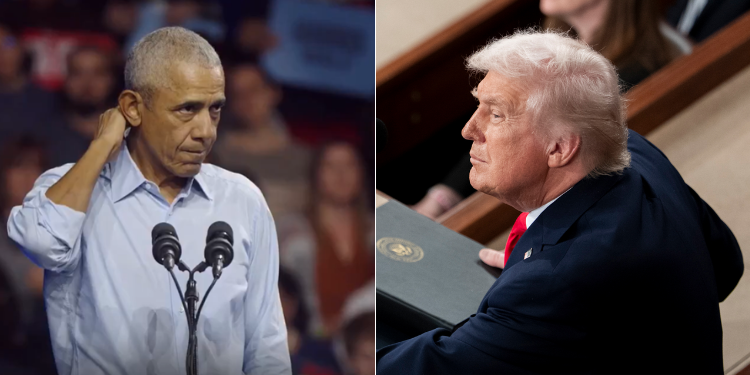
Former President Barack Obama sharply criticized the Trump administration’s handling of the recent conflict with Iran, saying the short war delivered little lasting benefit despite its high costs.
According to Obama, the U.S. has spent billions of taxpayers’ money to sustain the Iran war; lives have been lost, but the end results do not reflect the same.
Obama Says Iran War Delivered Few Lasting Benefits
“We’ve now fought a war, spent billions and billions of dollars, put an enormous strain on our military, a lot of people have died, and it feels like we are back where we were before we started the war, except maybe a little worse off,” Obama said in an interview that aired Friday morning on NBC’s “Today” show.
Obama sat down with NBC News correspondent Craig Melvin ahead of the public opening of his presidential library in Chicago.
In the interview, Obama pointed to President Trump’s decision to withdraw from that 2015 deal in 2018 as a key factor that allowed Iran to expand its nuclear program.
Also Read: JD Vance Warns Israeli Critics Over Trump Iran Deal, Says Israel Depends on U.S. Weapons
He said the initial goal of the recent military action was to stop Iran from developing nuclear weapons, a problem he argued grew worse after the U.S. left the agreement.
“I am very happy to see a ceasefire, and I am hopeful that it holds,” Obama added. “But in terms of what was the original rationale for this war, which was there was a deal in place in which Iran agreed not to develop nuclear weapons. This administration, or a prior administration, pulled out of it, which caused Iran to develop more nuclear capacity.”
How the End of the JCPOA Shaped Current Tensions
The conflict began with U.S. and Israeli strikes on February 28, targeting military assets in Iran as well as Tehran leadership. Iran responded by targeting American bases in the Middle East and directly hit Israel using missiles and drones.
Trump pulled the United States out of the Obama-era deal during his first term, arguing it was flawed.
Tensions rose in the years that followed as Iran enriched uranium to higher levels and supported proxy groups across the region.

This week, Trump signed a memorandum of understanding with Tehran on Wednesday. The agreement sets up further technical talks aimed at ending the conflict for good and reopening the Strait of Hormuz, a critical waterway for global oil shipments.
Trump Defends New Iran Agreement as a Victory
Trump has described the 14-point framework as a major victory, claiming it forced an “unconditional surrender” from Iran.
In a Thursday interview with Axios and a Friday morning post on Truth Social, he said Iran came to the table out of weakness.
“We didn’t meet out of desperation, Iran did,” Trump wrote. “They are FINISHED! We’ll play out the 60 days. They get no money, not ten cents!”
Some Republican lawmakers remain doubtful about parts of the emerging deal. They have raised concerns about a proposed $300 billion reconstruction fund for Iran and the prospect of easing sanctions.
Sen. Joni Ernst of Iowa told NewsNation on Thursday that she does not want to see anything resembling “JCPOA 2.0.”
Also Read: Trump Invited to Obama Presidential Center as Obama Celebrates Grand Opening in Chicago
Most GOP members of Congress have shown little interest in returning to the framework of the original Obama deal. They claim it failed to prevent Iran from advancing its nuclear work and funding militant groups in the Middle East.
The war was relatively short, but it did involve major military resources, and it did cost American and Iranian lives.
The financial toll has attracted the attention of Capitol Hill, where lawmakers are reviewing spending related to the operation.
The former president stopped short of calling the military action a complete failure. He suggested the U.S. finds itself in a position similar to before the strikes, but with added burdens on the military and the federal budget.
Obama’s recently opened presidential library in Chicago has a museum that features an exhibit on the Iran nuclear agreement reached during his presidency, commonly known as the Joint Comprehensive Plan of Action, or JCPOA.