Construction on President Donald Trump’s planned White House ballroom can proceed for at least another week, following a ruling by the U.S. Court of Appeals for the District of Columbia Circuit.
The decision, issued Saturday, April 11, temporarily stayed a lower court order that had blocked the project, extending the administration’s ability to continue work until April 17.
In a 2‑1 decision, Judges Patricia Millett and Bradley Garcia — appointees of Presidents Barack Obama and Joe Biden — voted to allow construction to continue while the case undergoes further review.
Judge Neomi Rao, appointed by President Trump, dissented, arguing that the injunction should be stayed indefinitely during the appeals process.
The ruling temporarily lifts an injunction issued by U.S. District Judge Richard Leon, a George W. Bush appointee, who in March ordered construction halted.
Leon had concluded that the president lacked statutory authority to proceed without congressional approval and independent reviews.
The appeals court instructed Leon to reconsider his decision with greater attention to safety and security concerns. The administration has argued that halting construction would leave the White House vulnerable to attacks, citing national security risks.
Preservationists challenge White House ballroom project
The National Trust for Historic Preservation filed suit in December to stop the demolition of the East Wing and the construction of the ballroom.
The group contends that the White House, as a historic landmark, requires oversight from federal review panels and congressional authorization before major alterations.
“We appreciate the court of appeals acting quickly and await further clarification from the district court,” Carol Quillen, president and CEO of the National Trust, said in a statement.
“The National Trust remains committed to honoring the historic significance of the White House, advocating for our collective role as stewards, and demonstrating how broad consultation, including with the American people, results in a better overall outcome.”
Judge Leon’s earlier ruling echoed these concerns, writing: “The President of the United States is the steward of the White House for future generations of First Families. He is not, however, the owner.”
Also Read: Trump’s Triumphal Arch Proposal Faces Pushback Over Costs, Location
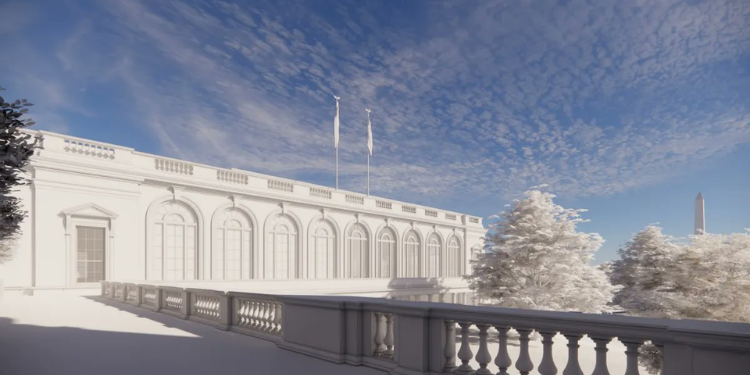
The White House announced the ballroom project in July 2025, describing it as a long‑awaited addition to the executive residence. The planned facility, valued at approximately $200 million, would seat 650 guests and cover 90,000 square feet.
Trump argued that the existing East Room, with a capacity of 200, was insufficient for hosting major events. The ballroom, he said, would eliminate the need for temporary tents erected on the South Lawn during state functions.
The administration emphasized that the project would be funded through private donations, including contributions from Trump himself.
“President Trump, and other patriot donors, have generously committed to donating the funds necessary to build this approximately $200 million dollar structure,” a White House press release stated.
Architect Jim McCrery was selected to lead the design, with Clark Construction and AECOM handling construction and engineering. McCrery described the project as a necessary modernization.
“Presidents in the modern era have faced challenges hosting major events at the White House because it has been untouched since President Harry Truman. I am honored that President Trump has entrusted me to help bring this beautiful and necessary renovation to The People’s House,” the architect said.
Demolition of the East Wing
By October 2025, the administration had demolished the East Wing to make way for the ballroom. The East Wing, originally built in 1902 and modified in 1942, had undergone multiple renovations over the decades.
Also Read: “The White House Was Infested” Trump Administration’s Claim in $400M Ballroom Legal Fight
The White House said the new ballroom would be “substantially separated from the main building” but designed to match its architectural heritage.
The demolition sparked criticism from preservationists, who argued that the East Wing held historic value and that its removal bypassed established review processes.
“Importantly, the government has presented credible evidence of ongoing security vulnerabilities at the White House that would be prolonged by halting construction,” Judge Rao wrote.
“This constitutes irreparable injury and is clearly a weightier interest than the generalized aesthetic harms identified by a single member of the Trust.”
The majority, however, limited the stay to April 17, leaving open the possibility of further appeals, including to the Supreme Court.