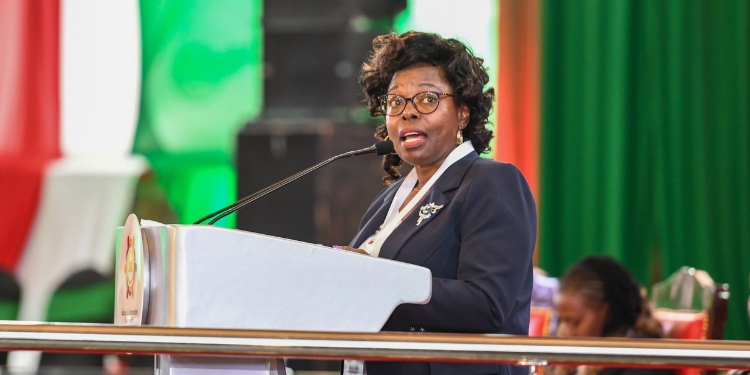
The Controller of Budget, Margaret Nyakang’o, has raised concerns over the proposed Sovereign Wealth Fund Bill, 2026, warning that its investment framework is overly broad and lacks sufficient safeguards.
In a statement submitted to the National Assembly Finance Committee on Wednesday, April 22, Nyakang’o said the Bill is silent on the relationship between the Sovereign Wealth Fund and the Consolidated Fund.
She warned that this would deny the Controller of Budget’s office oversight over withdrawals from the fund, presenting a grave risk.
“The real risk here is that the fund will operate as a parallel financial architecture outside the national budget framework, which is unconstitutional,” she warned.
CoB Nyakang’o Flags Constitutional Risks
At the center of the concerns is the lack of clarity on how funds will flow between the proposed Sovereign Wealth Fund Bill and the Consolidated Fund, the main account into which all national government revenue is deposited.
Under Article 206 of the Constitution of Kenya 2010, all money raised by the national government must first be paid into the Consolidated Fund. However, the Controller of Budget has warned that the Bill does not explicitly enforce this constitutional requirement.
As a result, the Controller of Budget is proposing that all proceeds be first credited to the Consolidated Fund and then channeled into the Sovereign Wealth Fund through formal parliamentary appropriation, to ensure compliance and strengthen oversight.
“The Sovereign Wealth Fund Board, as constituted in the Bill, is susceptible to executive capture and there is a need to amend the Bill and provide for independent non-voting observation to mitigate this risk,” she warned.
“Our recommendation here is that all revenues must first be paid into the consolidated fund and then transferred to the sovereign wealth fund by parliamentary appropriation to be consistent with Article 206 of the Constitution.”
Also Read: Kenyans Seeking Loans Face Stricter Repayment Checks
Nyakang’o has recommended the establishment of a statutory investment policy to guide the Fund’s operations, to be reviewed every three years and approved by Parliament.
She also proposes the creation of an independent advisory committee, alongside clear performance benchmarks linked to publicly available targets to strengthen transparency and accountability.
On withdrawals, she faults provisions that vest authority in the Cabinet Secretary, arguing that the power should instead rest with Parliament. She further states that any withdrawals should require written approval from the Controller of Budget.
Additionally, Nyakang’o is pushing for a statutory withdrawal framework that would cap annual withdrawals as a proportion of the Fund, aimed at protecting its long-term sustainability and reducing the risk of misuse.
Als0 Read: Ruto Secures KSh 39.2 Billion for Kenyan Farmers During His Trip to Italy
About the Bill
The Sovereign Wealth Fund Bill seeks to establish a legal framework for the creation and management of a national savings fund into which Kenya can invest proceeds from its natural resources, such as oil, gas, and minerals.
If passed into law, the fund will be structured into three key components: a stabilization fund, which will cushion the economy during financial shocks; an infrastructure fund, which will finance major development projects; and a future generations fund, which will save and invest wealth for the benefit of Kenyans in years to come.
The proposed law is also designed to ensure income from non-renewable resources is invested in global assets to secure long-term returns.
The bill, sponsored by National Assembly Majority Leader Kimani Ichung’wah, was published on March 9, 2026, read for the first time on March 11, 2026, and then referred to the Finance Committee for further scrutiny.
The Finance and National Planning Committee has already invited stakeholders and members of the public to submit their input before the legislation is debated.