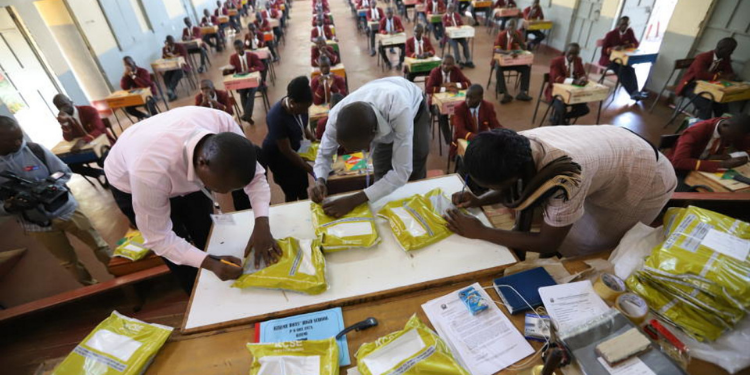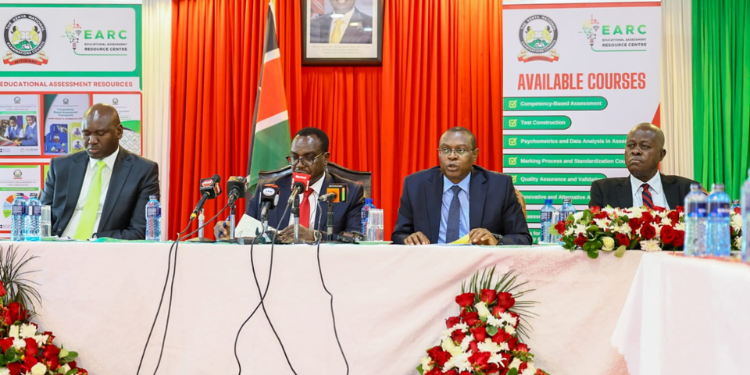
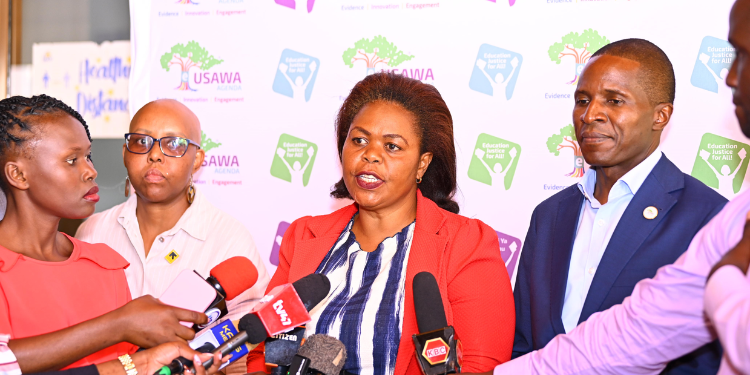
Kenya’s 2025 Foundational Literacy and Numeracy Assessment (FLANA) by the Usawa Agenda has shed light on core learning outcomes among Grade 3 and 9 learners, with literacy improving while numeracy remains largely unchanged.
The nationwide household‑based survey assessed 49,835 children aged 10–15 and learners in Grades 3–9 across all 47 counties, documenting performance patterns shaped by geography, school type, gender, and socioeconomic conditions between June and July 2025.
Improvement in Literacy Skills
National literacy levels have improved since 2023, marking steady progress in children’s ability to read and understand Grade 3 English texts.
In Grade 3, two in five learners can read and understand a Grade 3 story.
Private schools lead with more than half of their Grade 3 learners achieving literacy proficiency, compared to about two in five in public schools and only one in five in refugee community schools.
Impressively, girls outperform boys in Grade 3 literacy in both public and private schools.
Private schools report literacy proficiency levels above 60 percent in Grade 4, significantly higher than the 45.9 percent recorded in public schools and the 19.6 percent in refugee community schools.
Girls continue to lead in Grade 4 literacy, reaching 51.5 percent compared to 47.8 percent among boys.
Urban schools post stronger performance, with 58 percent of Grade 4 learners achieving literacy proficiency, while rural schools record 47.8 percent.
Also Read: KNEC Releases List of Schools Involved in KCSE 2025 Exam Irregularities
Among children aged 10 who are in school, 45.3 percent meet the literacy benchmark.
Among those out of school, 32.6 percent are out of school.
By Grade 6, literacy declines sharply. Nationwide, 49.9 percent of learners cannot read and comprehend a Grade 3 English story.
Public schools record 52.6 percent lacking proficiency, private schools 42.3 percent, and refugee community schools 57.5 percent.
Rural areas show 54.5 percent lacking proficiency, while urban areas show 48.9 percent.
Underlying Inequalities
Learning outcomes reflect broader inequalities in access, household conditions, and educational environments.
Children from poor households are more than five times more likely to have never enrolled in school than children from wealthy households.
Fifteen percent of school‑age children living in households headed by persons without formal education are out of school, making them nearly three times more likely to miss school than the national average.
All counties with enrolment levels below the national average are in the Arid and Semi‑Arid Lands (ASALs), where learning deficits also remain highest.
Refugee communities show the sharpest disparities.
Only one in five Grade 3 learners in refugee community schools can read a Grade 3 English story, and about two in five Grade 6 learners cannot meet basic literacy standards.
Overall, 19 percent of school-age children in refugee communities are out of school, compared to 6 percent nationally.
Also Read: Dr. Ribeiro Parklands Boys’ High School, KCSE Performance and Contacts
In Kenya’s refugee communities, 21% of school‑age girls are out of school—higher than boys—against an overall out‑of‑school rate of 19.6%.
Classroom Factors Linked to Literacy Performance
Classroom observation findings show that Grade 6 learners spend more time on task during English lessons than Grade 3 learners, with learner time‑on‑task exceeding teacher time‑on‑task in both grades.
In Grade 6 English lessons, learner time-on-task is 98.1% in public schools and 98.1% in private schools, compared to 96.7% in public schools and 97.1% in private schools in Grade 3.
Urban teachers spend more time on task in Grade 3 English lessons than rural teachers, recording 98.5% time on task in urban areas, compared with 98.1% in rural areas.
Private school teachers spend 97.4% of Grade 6 English lesson time on task, compared to 96.5% in public schools.
Across all observations, learners are more consistently on task than teachers during English lessons at both Grade 3 and Grade 6 levels.
Follow our WhatsApp Channel and X Account for real-time news updates.