
Ukraine’s President Volodymyr Zelenskyy has accused Russia of directly aiding Iran’s war effort, claiming Moscow captured satellite images of a U.S. airbase in Saudi Arabia days before Iranian missiles and drones struck it.
According to a summary shared with NBC, Russian satellites photographed the Prince Sultan Air Base in Saudi Arabia on March 20, March 23, and March 25.
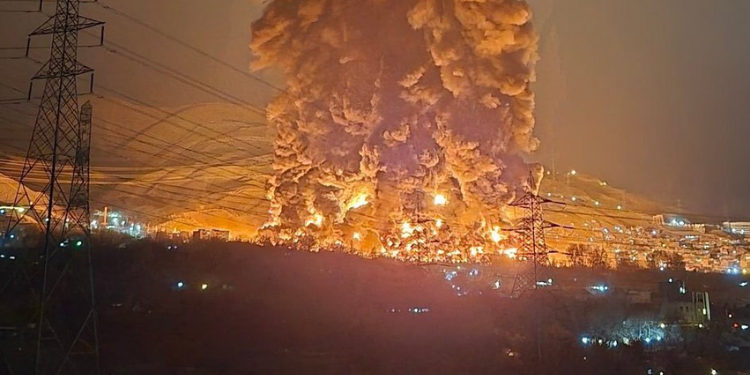
On Thursday, March 26, Iran launched a major attack on the base, firing six ballistic missiles and 29 drones. At least 15 troops were injured, including five seriously, according to people briefed on the matter cited by the Associated Press. U.S. officials had earlier reported 10 wounded, including two seriously.
The allegations by Zelenskyy come amid concerns about Russia-Iran cooperation and its implications for U.S. forces in the Middle East.
Zelenskyy “100%” certain
The Ukrainian president said Kyiv’s experience suggests repeated satellite imaging by Moscow often signals imminent military action.
“I think that it’s in Russia’s interest to help Iranians. And I don’t believe — I know — that they share information,” he told NBC. “Do they help Iranians? Of course. How many percent? One-hundred percent.”
Also Read: Critical U.S. Surveillance Aircraft Damaged in Iran Attack on Saudi Base
President Zelenskyy added that the intelligence came from his routine presidential briefings compiled by Ukrainian agencies.
“We know that if they make images once, they are preparing. If they make images a second time, it’s like a simulation. The third time, it means that in one or two days, they will attack.”
The allegations come after Zelenskyy earlier this week posted on social media that Ukraine had “irrefutable evidence” Russia was providing signals and electronic intelligence to Tehran.
He said Russian satellites had photographed U.S. military facilities in Diego Garcia, Kuwait, Saudi Arabia, Turkey, and Qatar “in the interests of Iran.”
Earlier this month, Russia’s Foreign Minister Sergey Lavrov denied providing Tehran with intelligence, telling French media that while Moscow has supplied military equipment to Iran under their alliance, it has not shared targeting information.
However, European allies have privately and publicly told U.S. diplomats that Russia’s support for Iran is deeper than Washington acknowledges.
A U.K. official told CBS News that Russian-Iranian defense cooperation has “ballooned” in recent years, with Iran transferring Shahed drones and production know-how to Moscow.
France’s Foreign Minister Jean-Noël Barrot described the relationship as “two-way cooperation,” saying there are reasons to believe Russia is supporting Iran’s military efforts against American targets.
U.S. response
United States officials have, however, downplayed the claims. “There is nothing Russia is doing for Iran that is in any way impeding or affecting our operation or the effectiveness of it,” Secretary of State Marco Rubio said after a G7 meeting in France.
Also Read: Trump Presses Zelenskyy on Key Territory Concessions as Putin Suffers Heavy Daily Losses
President Donald Trump also this month told Fox News he believed Russian President Vladimir Putin was “helping them a bit,” but added: “He probably thinks we’re helping Ukraine. They do it, and we do it.”
The Wall Street Journal reported on March 6, citing U.S. officials and a former Russian intelligence officer, that Russia has shared coordinates of U.S. ships and aircraft with Iran, potentially aiding targeting efforts.
The alleged Russian involvement comes as the U.S.-Iran war continues to escalate. Since the conflict began on February 28, more than 300 American service members have been wounded, with 273 returned to duty, according to the U.S. military. At least 13 U.S. troops have been killed.
Iran has expanded its attacks across the region, striking bases in Saudi Arabia, Qatar, Bahrain, and the UAE. Pro-Iranian militias in Iraq have threatened U.S. sites in Jordan, while Yemen’s Houthi rebels have launched missiles at Israel.
Israel and the U.S. have carried out thousands of strikes on Iranian targets, including universities, water facilities, and missile sites.