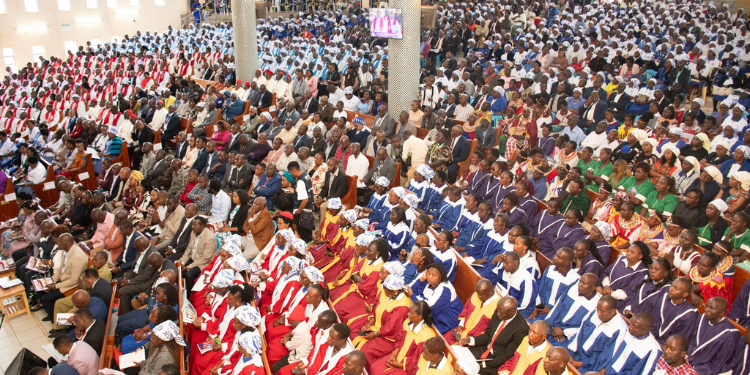

The Anglican Church of Kenya (ACK) is one of the largest Protestant denominations in Kenya.
It operates as a province of the global Anglican Communion with millions of adherents and a historical footprint in education, healthcare, and social development.
The headquarters of the Anglican Church of Kenya is located at the ACK Provincial Secretariat at All Saints Cathedral along Kenyatta Avenue in Nairobi.
Historical Development and Growth of ACK
The history of ACK dates to 1844, when missionaries of the Church Missionary Society (CMS), led by Johann Ludwig Krapf, arrived in Mombasa and introduced Anglican Christianity in Kenya.
Also Read: Inside CITAM Church’s Multi-Billion Property in Kenya
Early missionary activity expanded into central and western Kenya by the late 19th century, where they established churches, schools, and hospitals.
By 1927, Kenya had become a distinct diocese, and in 1960 it formed part of the Province of East Africa together with Tanzania.
In 1970, ACK became an independent Anglican province with its own archbishop after separating from the Province of East Africa
Since then, the church has experienced significant growth in membership and structure. Today, the ACK comprises approximately 41 dioceses across the country and serves millions of members, making it one of the most influential religious institutions in Kenya
Property Assets Owned and Managed by ACK
The Anglican Church of Kenya sponsors and manages thousands of learning institutions across the country, many of which were established during the missionary era.
Schools associated with Anglican foundations include Maseno School, Mangu High School, St. Andrew’s School, Turi, and Alliance High School, all shaped by the historical influence of Protestant missionaries.
The church runs diocesan learning institutions and theological colleges, including Bishop Hannington Institute, Christian Industrial Training Center (CITC) in Mombasa, ACK Youth Polytechnic Kaloleni, ACK Ethi Polytechnic in Nanyuki, and several Bible schools and clergy training centers across dioceses.
Several dioceses have established large education departments managing church-sponsored schools.
The Diocese of Kericho alone reports ownership of 17 church-owned schools and sponsorship of 36 schools.
The church manages hospitals, mission dispensaries, clinics, counseling centers, and outreach programmes, particularly in rural areas where access to healthcare remains limited.
Health facilities linked ACK include St. Luke’s Mission Hospital Kaloleni, Maseno Mission Hospital, ACK Mt. Kenya West Hospital, ACK Hoito Mission Clinic, Chelebei Mission Clinic, and Cheptais Mission Dispensary.
Other church-supported health institutions include maternity clinics, HIV/AIDS support programmes, mental health units, and hospital chaplaincy departments.
In Mombasa Diocese, the church operates the Mwareni Unit for the Mentally Handicapped and health outreach programmes.
Some dioceses also operate guest houses, retreat centres, bookshops, conference facilities, and agricultural projects as income-generating ventures.
Facilities such as Safari ya Biblia Retreat Center in Kirinyaga and Macumo Development Integrated Centre in Embu form part of the church’s property network.
Healthcare programmes are coordinated through Anglican Development Services, which supports nutrition, maternal health, water, sanitation, food security, and community health initiatives across dioceses.
Also Read: Details of Luxurious Multi-Million Shilling Car Used by President Ruto in Kazakhstan
ACK Churches and Leadership Structure
The ACK owns thousands of churches, cathedrals, diocesan offices, and retreat centers in the country.
Major worship centers include All Saints Cathedral, Mombasa Memorial Cathedral, and All Souls’ Cathedral in Machakos.
Leadership is headed by the Archbishop of Kenya, currently Jackson Ole Sapit, who also serves as Bishop of All Saints Cathedral Diocese.
The church is governed through the House of Bishops, diocesan synods, archdeaconries, and parish leadership structures.
Currently, it operates 41 dioceses, including Nairobi, Mombasa, Kitale, Kericho, Machakos, Kirinyaga, Mt Kenya Central, and Mt Kenya West.
The Provincial Secretariat serves as the church’s national administrative center, coordinating:
- The Archbishop’s office
- The House of Bishops
- National church programmes
- Anglican Development Services (ADS) coordination
- Education, health, mission, and theological departments
- Provincial synod operations and policy implementation