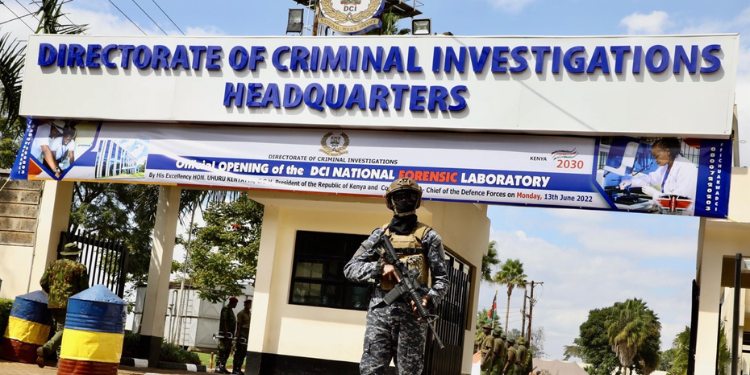
Kenya’s Directorate of Criminal Investigations (DCI) has several specialized units and directorates that investigate different categories of crime.
Mohamed Amin is the overall head of the DCI, while John Onyango is the Deputy Director of the DCI, having been appointed in February 2024 to succeed Nicholas Ireri Kamwende upon his retirement.
Before his promotion, Onyango headed the Crime Research and Intelligence Bureau (CRI).
As the head of DCI, Amin is responsible for the overall command of the Directorate, an organ of the National Police Service tasked with investigating serious crimes and performing other functions provided for under the Constitution and the National Police Service Act.
“The Directorate of Criminal Investigations derives its mandate from Article 247 of the Constitution of Kenya and through the National Police Service Act 2011, which establishes the Directorate as an organ of the NPS responsible to the Inspector General,” part of the DCI function handbook states.
Anti-Terrorism Police Unit
The Director of the Anti-Terrorism Police Unit (ATPU) is responsible for preventing, detecting, and disrupting terrorist activities in Kenya. Commissioner of Police (CP) Johnstone Kola currently heads it.
ATPU also investigates terrorism-related cases, secures evidence from terrorist incident scenes, develops profiles of suspected terrorists, and shares intelligence with other security agencies.
It also has a specialized tactical team trained to respond to high-risk terror incidents.
Established in 2003, the unit has regional sub-units covering Nairobi, North Eastern, Coast, and Western Kenya, as well as detachments in other parts of the country.
Homicide Investigations
The Director of Homicide Investigations, who is a gazetted officer, heads the DCI formation responsible for investigating murder and other unlawful-death cases.
Homicide detectives examine circumstances surrounding deaths, interview witnesses and suspects, collect evidence, and work with forensic specialists to establish what happened and identify those responsible.
Further, the unit can also take over sensitive or complex homicide cases initially reported to other police formations.
According to the DCI history, the Homicide Investigations Directorate was formed in September 2008 and has since been elevated to a full directorate with specialized resources and a team of 48 detectives.
Anti-Narcotics Unit
Samwel Laboso, the Director of the Anti-Narcotics Unit (ANU), heads the DCI Kenya formation responsible for investigating offenses involving narcotic drugs and psychotropic substances.
Established in 1983, ANU detectives operate at airports, seaports, border points, and along major highways.
Their roles include investigating drug trafficking, gathering intelligence, identifying trafficking networks, arresting suspects, and supporting prosecutions.
In addition, the unit also works with Kenyan and international agencies in cases involving cross-border drug trafficking.
Investigations Bureau
The Investigations Bureau oversees one of the DCI’s principal investigative formations.
The bureau handles and coordinates investigations into serious crime, economic and commercial offenses, financial crimes, cybercrime, banking fraud, insurance fraud, capital-market offenses, land fraud, revenue and tax-related offenses, environmental and wildlife crimes, human trafficking, and transnational organized crime.
Francis Ndiema heads the unit, having replaced Abdallah Komesha in March 2026 as part of ongoing restructuring within the DCI.
Eliud Kipkoech Lagat, the Deputy Inspector General (DIG) of the Kenya Police Service, also served in the position.
Operating within the DCI Kenya investigations structure, the Serious Crime Unit handles major and violent offenses requiring specialized detective work.
Its investigations include homicides, kidnappings and serious assaults, particularly where cases are complex or require intervention by specialized detectives.
The unit was established in 2001.
Also Read: Njeri Maina Wants DCI to Probe Wangui Ngirici Over Gachagua Rally Violence
DCI Kenya Crime Research and Intelligence Bureau
Dennis Okadapau, Director of the Crime Research and Intelligence Bureau (CRIB), heads the unit responsible for collecting, analyzing, and using criminal intelligence to support investigations and crime prevention.
CRIB examines crime patterns and trends and provides intelligence that can help investigators understand emerging criminal threats in cases involving organized criminal networks and serious offenses.
Economic and Commercial Crimes Unit
The head of the Economic and Commercial Crimes Unit (ECCU) oversees investigations into white-collar and economic offenses.
Cases handled in this area include financial fraud, embezzlement, corporate fraud, and other offenses involving the unlawful acquisition or movement of money and assets.
Investigators examine financial records, transactions, company documents, and other evidence to establish how an offense was committed and identify those responsible.
Financial Investigations Unit and Banking Fraud Investigations Unit
The Financial Investigations Unit (FIU) leads investigations involving financial crime, money laundering, suspected illicit proceeds, and other complex financial transactions.
Detectives trace financial movements and examine records to establish the source and destination of suspected criminal proceeds.
Financial investigations can also support cases handled by other DCI units where money trails are central to establishing an offense.
The DCI Kenya Banking Investigation Unit oversees cases involving fraudulent transactions and other criminal activity affecting banks and financial institutions.
Investigations may involve fraudulent withdrawals, account manipulation, electronic banking fraud, and other schemes targeting financial institutions or their customers.
Detectives work with banks and other agencies to obtain financial records and other evidence required for investigations.
Land Fraud Investigations Unit
The Land Fraud Investigations Unit investigates criminal activity involving land transactions and ownership documents.
Cases handled by the DCI Kenya Land Fraud Unit include forged title deeds, fraudulent transfers, falsified records, and other attempts to unlawfully acquire or dispose of property.
Detectives work with land registries and other government agencies to verify documents and establish the circumstances surrounding disputed transactions.
Anti-Human Trafficking and Child Protection Unit
The unit oversees investigations involving human trafficking and serious offenses against children.
Its work includes investigating trafficking networks, exploitation, and other crimes in which children are victims.
Transnational Organized Crime
The function oversees investigations into organized criminal activity extending across national borders involving human trafficking, migrant smuggling, drug trafficking, document fraud, and other criminal networks operating in more than one country.
In July 2026, the DCI also established a 29-member Counter-Organized Immigration Crime Team under the Serious Crime Unit to investigate trafficking in persons, migrant smuggling, travel-document fraud and related cross-border offenses.
National Central Bureau – INTERPOL Nairobi
Kenya’s INTERPOL coordination function within the DCI Kenya, with the bureau facilitating the exchange of criminal intelligence between Kenyan law-enforcement agencies and police authorities in other countries.
INTERPOL works on cases involving international fugitives, cross-border investigations, and suspects or criminal networks operating in several countries.
Also Read: Puzzle as DCI Busts Two Men with 180 ID Cards, Tear Gas and Military Boots
Forensic Services
The Director of Forensic Services leads the DCI’s scientific investigation arm, which provides technical evidence for criminal investigations and court proceedings.
Services offered through the DCI kenya unit include fingerprint identification, ballistics, digital forensics, crime-scene investigation, biology and DNA-related analysis, chemistry, document examination, forensic imaging, and explosives-related examination.
Forensic specialists can examine fingerprints, biological samples, firearms, electronic devices, documents, and other exhibits to provide investigators with evidence linking people, objects, and crime scenes.
Additionally, the Principal Criminal Registrar heads the Forensic Fingerprint Identification Bureau (FFIB), formerly known as the Criminal Records Office.
FFIB maintains the national central repository of criminal records and examines fingerprints recovered during investigations.
Its functions include processing police clearance certificates and previous conviction records, identifying unknown bodies, examining latent fingerprints, and providing expert evidence in court.
Regional DCI Commands
At the regional level, Regional Criminal Investigations Officers (RCIOs) oversee DCI operations in their respective regions.
At the same time, County Criminal Investigations Officers (CCIOs) and Sub-County Criminal Investigations Officers (SCCIOs) supervise investigations within their jurisdictions.
Officers coordinate investigations locally and can call in specialized DCI units when a case requires expertise beyond that of ordinary criminal investigations.
Regional commanders can change through transfers and internal reshuffles, so check their current postings against the latest DCI command information.
Follow our WhatsApp Channel and X Account for real-time news updates.