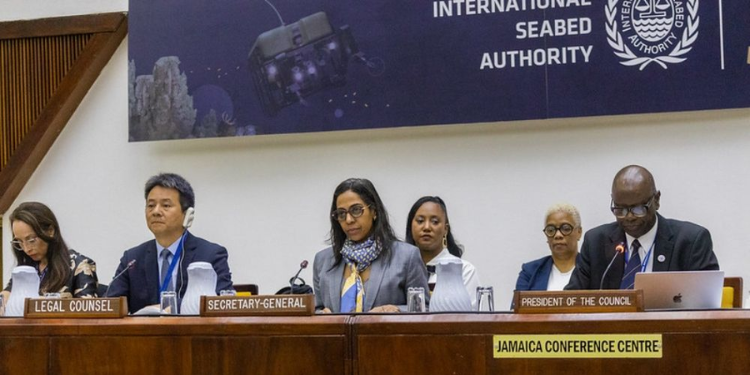

Kenya has been elected to the Council of the International Seabed Authority (ISA) for the 2027–2030 term, following elections held during the 31st Session of the ISA Assembly in Kingston, Jamaica.
In a statement issued on August 1, Principal Secretary for Foreign Affairs Korir Sing’Oei said the election reflected the international community’s confidence in Kenya’s commitment to the United Nations Convention on the Law of the Sea (UNCLOS), rules-based ocean governance, and the sustainable management of marine resources.
“Kenya is honoured to have been elected to the Council of the International Seabed Authority (ISA) for the 2027–2030 term, during the just concluded 31st Session of the ISA Assembly in Kingston, Jamaica,” read part of the statement.
According to Sing’Oei, Kenya’s election also recognizes its efforts to advance maritime scientific research and promote equitable and inclusive stewardship of the world’s oceans.
He added that Kenya remains committed to advancing these priorities in line with the mandate of UNCLOS and strengthening international cooperation on the sustainable use of ocean resources.
The Role Kenya Will Play As a Council Member
Kenya’s election to the Council gives the country a seat on the organization’s 36-member executive body.
The Council is responsible for shaping policies governing the exploration and potential exploitation of mineral resources found in the international seabed beyond national jurisdiction.
It oversees the implementation of the United Nations Convention on the Law of the Sea (UNCLOS) framework for the international seabed, develops regulations for mineral-related activities, and reviews applications submitted by governments and contractors seeking to conduct exploration in these areas.
It also plays a key role in ensuring compliance with environmental protection standards, monitoring activities in the international seabed, and taking action against operations that violate ISA rules.
For Kenya, membership of the Council provides an opportunity to influence global discussions on ocean governance, sustainable use of marine resources and the development of regulations for deep-sea mining.
Also Read: Kenya Elevated to AU Tier One Economic Status: What It Means and the Criteria Behind It
What is the International Seabed Authority
The International Seabed Authority (ISA) is an independent international organization headquartered in Kingston, Jamaica.
It was established in 1994 under the United Nations Convention on the Law of the Sea (UNCLOS) to regulate mineral-related activities on the international seabed beyond the jurisdiction of individual countries.
The ISA is responsible for managing the international seabed, often referred to as “the Area,” which covers about 54% of the Earth’s ocean floor.
Under UNCLOS, these resources are considered the common heritage of humankind, meaning they are to be managed for the benefit of all people.
One of the organization’s key responsibilities is developing a “mining code” that will govern future commercial deep-sea mining while ensuring the protection of the marine environment from harmful impacts.
The ISA is made up of several key organs. The Assembly, comprising all member states, sets the organization’s general policies. The Council, a 36-member executive body, oversees operations and approves work plans for seabed activities.
The Secretariat manages the Authority’s day-to-day administration, while the Legal and Technical Commission provides scientific and technical advice on exploration, environmental protection and resource management.
Also Read: Kenya Beats US, UK and China in Global Stock Market Rankings
Outcomes of the Blue Economy Conference
Kenya hosted the 11th Our Ocean Conference in Mombasa from June 16 to 18, 2026, becoming the first African country to host the global ocean summit.
Held under the theme “Our Ocean, Our Heritage, Our Future,” the conference brought together more than 4,500 delegates to advance commitments on sustainable ocean governance.
The summit focused on key issues including sustainable fisheries, marine conservation, maritime security, reducing marine pollution and strengthening ocean-based climate solutions.
It also showed global efforts to achieve the target that seeks to protect 30% of the world’s oceans by 2030.
Follow our WhatsApp Channel and X Account for real-time news updates.