
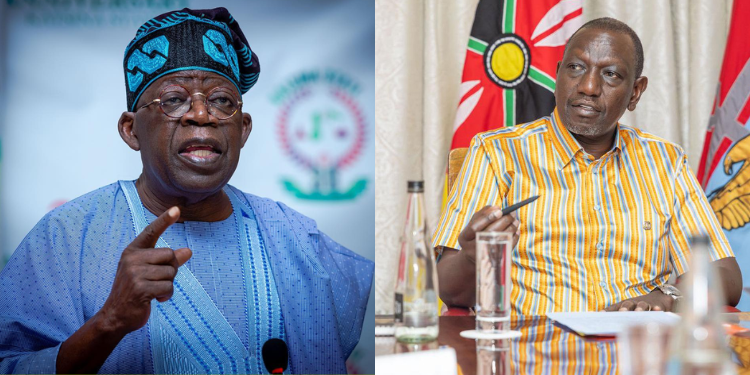
A heated debate comparing English proficiency in Kenya and Nigeria erupted online this month after comments by President William Ruto triggered a wave of reactions across African social media.
During an official address attended by international partners, President Ruto said Kenyans speak “some of the best English in the world,” adding that Nigerians would need an interpreter to follow the discussion.
The remarks quickly went viral, drawing sharp responses from Nigerian users, politicians, journalists, and academics, many of whom disputed the claim and accused the president of misrepresenting facts.
As the exchange escalated into a cross-border argument, competing claims emerged, with supporters on both sides insisting their country speaks better English.
This fact-check examines global data to determine whether credible evidence supports either position.
What Global Rankings Show
One of the most comprehensive datasets cited in the debate is the 2026 Global Outsourcing Talent Index published by Ataraxis Management, a US-based research and advisory firm.
The index evaluates all 193 UN-recognized countries using five indicators: labor cost competitiveness, English proficiency, talent availability, digital infrastructure, and political and business stability.
Also Read: Govt Introduces Mandatory Registration for Irrigation Professionals with Set Academic Qualifications
English proficiency accounts for 20 percent of the overall score and is measured using multiple international datasets, including education statistics, workforce profiles, and global employment data.
The index focuses on functional English used in professional and international work settings rather than informal speech or accent.
According to the 2026 index, Kenya and Nigeria score identically on English proficiency, each receiving 90 out of 100.
The score places both countries in the same global category as other strong English-speaking markets, including Ireland, Switzerland, the Philippines, Argentina, and Ghana.
The data, therefore, do not support claims that Nigerians struggle with English, nor do they show that Kenyans have higher English proficiency than Nigerians, as measured by global standards.
South Africa, ranked as Africa’s top English‑proficient outsourcing destination in the same index, provides a useful benchmark for comparing language proficiency across the continent.
Why Nigeria Ranks Higher Overall
Although Kenya and Nigeria tie in English proficiency, their overall positions in the Global Outsourcing Talent Index differ.
Also Read: Safaricom Increases Fuliza Limits for Thousands of Customers in New Rate Adjustment
Nigeria ranks sixth globally, while Kenya is ranked eleventh.
This ranking gap has been widely misunderstood online as a language issue.
In reality, the difference is driven mainly by labor cost and talent availability.
Labor cost competitiveness accounts for more than half of the index’s total weighting.
Nigeria scores higher in this category because of lower average wages and a much larger workforce, which significantly improves its overall standing.
Kenya performs comparatively better in digital infrastructure but has higher labor costs, which affects its final ranking.
English proficiency is not a distinguishing factor between the two countries in the index.
This distinction is critical because the index does not conclude that Nigeria ranks higher because it speaks better English, nor that Kenya ranks lower because of weaker language skills.
Both countries are assessed as equally strong English-speaking environments for global work.
Much of the online argument has relied on stereotypes, anecdotal experiences, and national pride rather than data.
Some commentators have confused accent, slang, or style of speech with proficiency, while others have treated political statements as factual assessments.
The Global Outsourcing Talent Index measures practical English use in education and professional settings. It does not compare accents, cultural expression, street language, or literary style.
As a result, it cannot be used to support claims of English superiority based on personal perception.
Based on available global data, there is no factual basis for claims that one country requires translators while the other does not.
Both Kenya and Nigeria are recognized internationally as English-proficient countries.