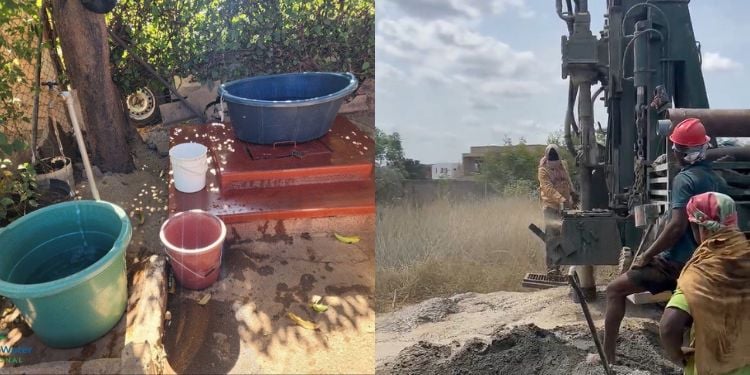
Drilling a borehole in Nairobi requires several approvals, including authorization from the Water Resources Authority (WRA), environmental approval from NEMA where applicable, and county clearance in some cases before drilling begins.
After drilling, borehole owners must obtain a water abstraction permit before they can legally pump and use groundwater.
The approval process typically takes between three and six months in Nairobi, depending on the project and the completeness of the application.
Steps to Legally Drill a Borehole in Nairobi
The first step is to conduct a hydrogeological survey through a registered hydrogeologist to determine whether the site is suitable for drilling and has sufficient groundwater.
The hydrogeological report, together with proof of land ownership or consent, is then submitted to the Water Resources Authority (WRA) to obtain drilling authorization before any work begins.
Where the project requires environmental assessment, the applicant must obtain an Environmental Impact Assessment (EIA) license from the National Environment Management Authority (NEMA).
Depending on the location, the applicant may also need county government clearance and, in some cases, a letter of no objection from the local water service provider.
Once all the required approvals have been secured, drilling can commence in accordance with the approved conditions.
After the borehole has been drilled, the owner must obtain a Water Resources Authority water abstraction permit before groundwater can be legally extracted and used.
Costs Of Licenses and Approvals Needed
For a borehole in Nairobi, the main approvals are a WRA permit, NEMA environmental approval/EIA where required, and sometimes county clearance or a local water-office no-objection letter.
Also Read: Borehole Owners Risk Ksh1M Fine After Govt Directive
The WRA permit is the core legal approval because groundwater use must be authorized before drilling and later before abstraction.
The approximate costs are often quoted at KSh 22,000 for the WRA water permit, KSh 10,000–50,000 for a NEMA EIA license, and KSh 2,000–10,000 for county approval.
A borehole registration fee of KSh 1,000–5,000 and an annual abstraction permit of KSh 3,000–25,000 may also apply.
In total, permit and license fees can come to about KSh 87,000–200,000 before drilling and equipment costs. For Nairobi, the process may take 3–6 months because approvals are usually stricter in urban areas.
The usual order is: hydrogeological survey, county approval, NEMA approval if needed, WRA drilling authorization, drilling by a licensed contractor, then abstraction permit.
Other Costs Incurred
According to Wavelink Networks’ 2026 Nairobi cost breakdown, a hydrogeological survey costs KSh 50,000–80,000, while drilling ranges from KSh 6,500 to KSh 7,500 per meter.
Also Read: Kenyans React After American YouTuber Mr. Beast Builds 52 Boreholes in the Country
Other costs include;
| Item | Estimated Cost |
| Mobilization | KSh 30,000–70,000 |
| Casing | KSh 3,000–5,000 per metre |
| Gravel packing | KSh 200–600 per metre |
| Well development | KSh 50–150 per metre |
| Test pumping | KSh 200–500 per metre |
| Water quality analysis | KSh 15,000–30,000 |
Further, Grekkon Limited estimates drilling costs in Nairobi at KSh 6,500–9,500 per meter, a figure also reflected in Water Equation Solar’s 2025 guide.
Wavelink Networks also estimates that drilling and completing an 80-meter borehole costs about KSh 1,083,000 for fieldwork alone.
The company says a complete domestic borehole system with a pump and water tank typically costs between KSh 1.5 million and KSh 2 million.
Grekkon Eldoret estimates borehole drilling in Nairobi at KSh 6,100–9,500 per metre, with the total project cost ranging from KSh 600,000 to more than KSh 2.5 million, depending on the borehole depth and the equipment installed.
Follow our WhatsApp Channel and X Account for real-time news updates.