


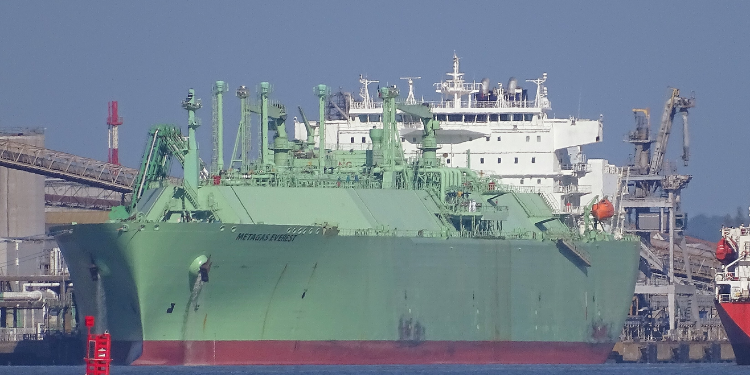
A liquefied natural gas (LNG) tanker from Russia caught fire in the Mediterranean following a reported explosion. The Russian-flagged vessel, identified as the Arctic Metagaz, was reportedly destroyed around 4 a.m. local time on Tuesday, February 4, in waters between Malta and Libya.
Multiple sources cited by the Times of Malta said a series of explosions occurred before the crew abandoned ship and were later rescued.
Shipping and maritime security sources told Reuters the tanker was ablaze, although no official distress signal had initially been recorded.
While Reuters cited maritime sources placing the fire near the coast of Malta, other publications indicated the blaze may have originated closer to the Libyan coast, reflecting differing accounts of where the incident unfolded.
The LNG tanker is subject to sanctions by the United States, the European Union, and the United Kingdom.
Photos and videos began circulating on social media in the early hours of March 3, appearing to show large flames engulfing a vessel at sea.
Crew in LNG tanker from Russia located in lifeboat
The Armed Forces of Malta (AFM) on, March 3, confirmed that all crew members were found safe.
In a press release, the AFM explained that its Rescue Coordination Centre Malta had been informed of a distress situation involving the merchant vessel MT Arctic Metagaz while it was transiting the central Mediterranean, outside Malta’s designated Search and Rescue (SAR) area.
“Earlier this afternoon, the Rescue Coordination Centre Malta of the Armed Forces of Malta was informed of a distress situation outside its Search and Rescue area involving the merchant vessel MT ARCTIC METAGAZ while transiting the central Mediterranean.
Upon receipt of the alert, RCC Malta initiated verification procedures and efforts to establish the exact position of the vessel. The vessel was located, and coordination actions were undertaken in line with international search and rescue obligations, including broadcasts to shipping and liaison with relevant international authorities.
Survivors were subsequently located within the Libyan SRR in a lifeboat during the search effort All crew were reported safely onboard the lifeboat.”
Authorities indicated that environmental damage was unlikely because the vessel was carrying LNG rather than crude oil, providing some reassurance amid the incident.
According to Reuters, the fire may have been caused by a Ukrainian naval drone attack, though those reports have not been confirmed.
Security firm EOS Risk Group indicated the ship may have suffered a drone strike while transiting eastbound toward the Suez Canal after departing Murmansk on February 24.

According to the firm, the vessel had loaded LNG cargo from a floating storage unit before beginning its Mediterranean transit.
Ship-tracking data from MarineTraffic showed that the Arctic Metagaz last reported its position off the coast of Malta on Monday.
The tanker reportedly deactivated its Automatic Identification System (AIS) tracker for around 300 kilometers before the incident, allegedly taking a “gray route” to evade sanctions enforcement.
If confirmed as a conflict-related strike, the destruction of the Arctic Metagaz would mark the first known instance of an LNG carrier being blown up in such circumstances, highlighting the unprecedented nature of this event.
Reuters has reported three separate incidents in the past month involving oil tankers damaged in Mediterranean blasts.
Ukraine has been suspected in previous attacks targeting Russia-linked shipping. However, no immediate confirmation of responsibility was available.
Also Read: Blow to Putin as Russia Admits Major Oil Depot Hit by Ukrainian Missiles
Kyiv has intensified its campaign targeting Russian oil and gas infrastructure, which remains a key source of revenue supporting Moscow’s military operations. Previous strikes have focused on refineries, export terminals, and oil tankers.
Link to Arctic LNG 2
The Arctic Metagaz had recently taken part in a complex Arctic LNG logistics operation designed to sustain exports despite Western sanctions.
According to maritime reporting by gCaptain and analyst Malte Humpert, the cargo on board originated from Russia’s sanctioned Arctic LNG 2 project. The Arctic Metagaz reportedly received LNG from the Arc7 ice-class carrier Christophe de Margerie via the Saam floating storage unit (FSU) in the Murmansk region.
On February 19, Russia conducted its first known triple simultaneous LNG ship-to-ship (STS) transfer operation in Arctic waters.
Two of those transfers occurred at the Saam FSU, where LNG from the Arctic LNG 2 project was offloaded and reloaded for onward shipment at the same time.
The Christophe de Margerie delivered a cargo from Arctic LNG 2, with the Arctic Metagaz loading the LNG for further transport.
The likely destination of the cargo was China’s Beihai LNG terminal, which, according to maritime data, has so far been the only confirmed recipient of cargoes from Arctic LNG 2.
A third STS transfer during the same operation involved LNG from the unsanctioned Yamal LNG project near Kildin Island.
The Murmansk region has become a central hub for Russia’s Arctic LNG exports and STS operations, enabling Moscow to bridge ice-class shipping routes with conventional tanker fleets serving global markets.
Sanctions and trade
Russia’s Arctic LNG projects, including Yamal LNG and Arctic LNG 2, represent a critical source of export revenue for Moscow.
Also Read: US Navy Ready to Escort Tankers Through Key Oil Shipping Route After Iran Warning
Yamal LNG, led by Novatek and partners, has shipped tens of millions of tonnes of LNG since beginning operations in 2017. Arctic LNG 2 is designed to further expand Russia’s liquefaction capacity, tapping gas reserves on the Yamal and Gydan peninsulas.
Despite sanctions imposed by the U.S., EU, and UK following Russia’s invasion of Ukraine, LNG exports have proven more difficult to curtail than pipeline gas.
Trade data indicate that Europe purchased approximately 93% of Yamal LNG output in January 2026, a record level.
EU imports from Yamal are reported to be up 8% year over year for 2026, as buyers secure supply ahead of a planned EU import ban on Russian LNG due to take effect in January 2027.
Follow our WhatsApp Channel and X Account for real-time news updates.