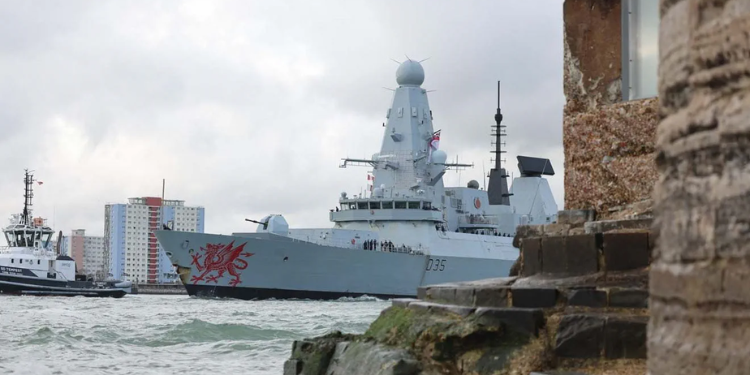
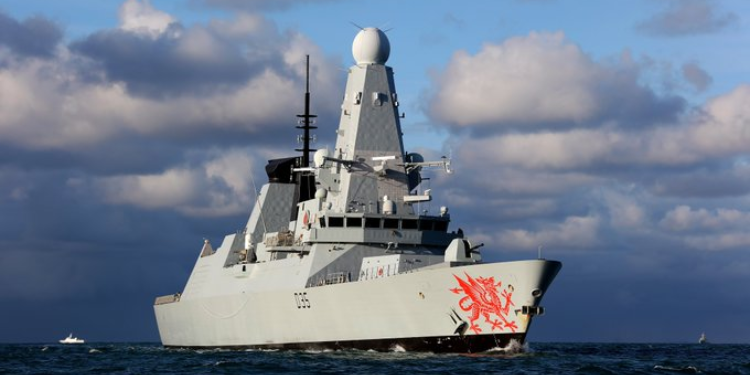
Britain’s warship HMS Dragon has withdrawn from active operations after the Ministry of Defense denied reports that Hezbollah missiles had struck a British warship in the Mediterranean.
The ministry on Tuesday, April 7, confirmed that the the Royal Navy’s only warship deployed to the Middle East withdrew due to problems with its onboard water systems.
HMS Dragon, a Type 45 destroyer dispatched to protect UK bases in Cyprus amid escalating conflict with Iran, has sailed to a safe berth in the Eastern Mediterranean for repairs.
UK Defense officials described the issue as a “minor technical problem” with the ship’s water supply, insisting that sailors have had access to provisions throughout. Defense sources added that the logistics stop had been planned “at approximately this point in her deployment.
United Kingdom issues an update on HMS Dragon
The MoD said the vessel remains at a “very high level of readiness” and can return to operations at short notice.
Sky News reported that the Ministry of Defense characterized the stop as a “routine logistics stop and short maintenance period,” allowing HMS Dragon to take on provisions, optimize systems, and conduct maintenance.
The MoD emphasized that the destroyer’s operational capacity has not been affected, stressing that the ship remains able to sail at short notice if required.
Also Read: UK Issues Middle East Operations Update Ahead of Anticipated Iran Bombing
Also, the statement highlighted Britain’s “robust and layered defensive presence” in the Eastern Mediterranean, coordinated with allies and supported by Typhoon and F-35 jets, Wildcat and Merlin helicopters, and advanced counter-drone and air defense systems.
The withdrawal comes after weeks of scrutiny over Britain’s preparedness for war. Prime Minister Keir Starmer announced HMS Dragon on March 3, a day after a drone strike hit RAF Akrotiri in Cyprus.
However, the destroyer did not leave Portsmouth until a week later, prompting criticism that the UK had no major warship in the region when fighting broke out on February 28.
United States President Donald Trump has mocked Britain’s naval capabilities, describing its carriers as “toys.” At the same time, U.S. Secretary of War Pete Hegseth derided the “Big Bad Royal Navy” for failing to enter the Strait of Hormuz.
The Ministry of Defense stressed that HMS Dragon’s weapons and systems will also be “further optimized” during the stop, allowing greater flexibility for future deployments.
Defense officials insist the vessel remains a critical part of Britain’s regional posture, despite the temporary withdrawal.
The destroyer’s pause follows a weekend of confusion after Hezbollah claimed to have struck an Israeli warship off Lebanon with a naval cruise missile.
Social media speculation quickly suggested the target was HMS Dragon, but the MoD flatly denied the reports.
The United Kingdom Maritime Trade Operations (UKMTO), which monitors attacks on British-flagged ships in the area, also confirmed it had not received any such reports, according to The Telegraph. Later analysis indicated the ship involved may have been French.
Also Read: UK Reports Tanker Hit as First Country Moves to Join Strait of Hormuz Reopening Force
France has since announced a major deployment of eight frigates and two amphibious assault ships to the region, joining its aircraft carrier FS Charles De Gaulle.
Greece, Italy, and Pakistan have also dispatched naval assets, underscoring the growing multinational presence in the Eastern Mediterranean as the war with Iran intensifies.
HMS Dragon remains one of Britain’s most advanced destroyers, designed to provide air defense and protect allied forces. Britain’s RAF Regiment gunners have continued to shoot down Iranian drones as they defend British airbases, according to the MoD.
UKMTO on April 7, 2026, said it had received 28 reports of incidents affecting vessels operating in and around the Arabian Gulf, Strait of Hormuz (SOH), and Gulf of Oman from February 28, 2026, when the United States and Israel launched a massive, coordinated surprise military operation against Iran, targeting its nuclear infrastructure, missile capabilities, and senior leadership.
These include 17 total attack reports and 11 total suspicious activity reports.
“UKMTO has received a time-late report of an incident 25NM south of Kish Island, Iran. The container vessel was struck by an unknown projectile which has caused damage above the waterline. The crew are safe and accounted for. No environmental impact has been reported. Authorities are investigating,” the monitoring authority said on Tuesday.
Meanwhile, UK Typhoons and F-35 jets, supported by Voyager and Royal Navy Merlin and Wildcat helicopters, have continued defensive missions over the eastern Mediterranean, Jordan, Bahrain, and the United Arab Emirates (UAE).