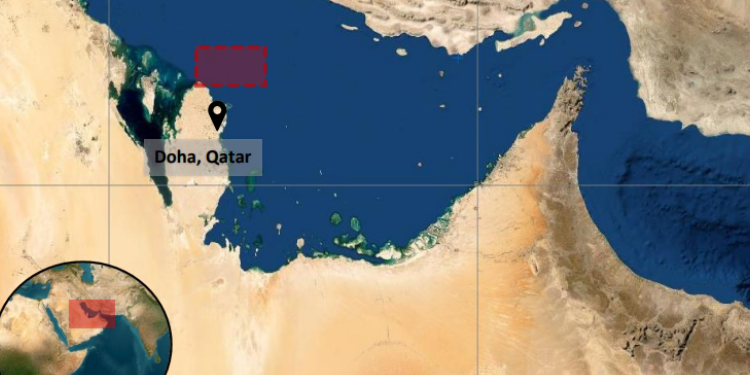
The United Kingdom Maritime Trade Operations (UKMTO) has reported that a tanker transiting north of Doha, Qatar, has been struck by an unidentified projectile.
This comes as regional tensions continue to escalate and the United Arab Emirates (UAE) moves closer to joining an international effort to forcibly reopen the Strait of Hormuz.
UKMTO in an incident report dated April 1, 2026, said it received a report from the vessel’s Company Security Officer indicating that the tanker was hit on the port side approximately 17 nautical miles north of Doha.
The impact caused damage above the waterline, though all crew members were confirmed safe.
UKMTO reports tanker hit near Qatar
Authorities are investigating the source of the projectile, and UKMTO advised all vessels in the area to transit with caution and report suspicious activity.
“The Company Security Officer reported the tanker has been hit by unknown projectile on the port side causing damage to the hull above water line. The crew are reported as safe. There is no environmental impact. Authorities are investigating. Vessels are advised to transit with caution and report any suspicious activity to UKMTO.”
The incident follows a similar report last week in which a bulk carrier sailing 15 nautical miles north of Sharjah, UAE, experienced an explosion from an unknown projectile near its hull.
UKMTO confirmed at the time that the crew aboard the vessel was also unharmed, and no group claimed responsibility for the strike.
Meanwhile, the UAE is reportedly pushing to become the first Persian Gulf country to join a U.S.- and ally-backed operation to reopen the Strait of Hormuz by force.
According to Arab officials cited by The Wall Street Journal, Emirati diplomats have urged Washington, European partners, and Asian military powers to form a coalition capable of breaking through Iran’s near‑total blockade of the waterway.
The UAE is reportedly lobbying for a United Nations Security Council resolution authorizing such action.
The Financial Times, citing Reuters, reported that the UAE has informed the U.S. and other Western allies that it would participate in a multinational maritime task force to reopen the Strait of Hormuz and is pushing for the formation of a “Hormuz Security Force.”
This coalition would escort shipping and protect commercial vessels from Iranian attacks, which UAE officials note have targeted Emirati infrastructure more frequently than any other regional state.
Diplomats said the UAE and Bahrain are already working on a draft Security Council resolution to mandate such a force, though it could face vetoes from Russia or China.
Also Read: UKMTO Reports Ship Explosion After Hit Near Strait of Hormuz
The proposed resolution follows earlier talks among U.N. members exploring measures to authorize “all necessary means” to protect maritime traffic in and near the strait.
Despite the deteriorating security situation, several U.S. allies have declined the Trump administration’s requests to send naval assets to join any reopening mission.
France stated it had conducted discussions with more than 35 countries about possible future participation but insisted such a mission could only be considered once the U.S.-Israeli war on Iran concludes.
Iran has effectively blocked the Strait of Hormuz, which carries an estimated 20 percent of the world’s oil and liquefied natural gas.
The closure has disrupted energy markets, worsened global inflation concerns, and sharply limited commercial shipping, with vessel traffic in the area reportedly falling by around 90 percent since the conflict began.
Intensifying regional conflict
The new maritime incident near Qatar and the UAE’s diplomatic moves come as President Donald Trump, on Tuesday, March 31, said the United States could end its military campaign against Iran within “two to three weeks.”
He further claimed that Tehran “doesn’t have to make a deal” for the U.S. to withdraw.
Also Read: Trump Confirms When U.S. Military Will End Iran War After Sending Third Carrier
Trump said U.S. objectives included degrading Iran’s nuclear and military capabilities to the point of being “put into the stone ages.” He added that oil prices would fall sharply once the U.S. leaves Iran.
The president also criticized U.S. allies for not contributing more to securing the Strait of Hormuz. He said Washington “will not have anything to do with” protecting the waterway going forward and suggested that countries relying on the strait should take responsibility themselves.
U.S. Secretary of State Marco Rubio, in an interview on Fox News, said the conflict was “nearing the finish line,” though he cautioned that it would not end immediately.
He indicated that a direct meeting with Iranian representatives might become possible as diplomatic channels shift.
The White House has since announced that Trump will deliver an address to the nation on Wednesday with an update on the conflict.
Officials have not released details on whether the speech will cover plans for maritime security or U.S. naval posture in the Gulf.