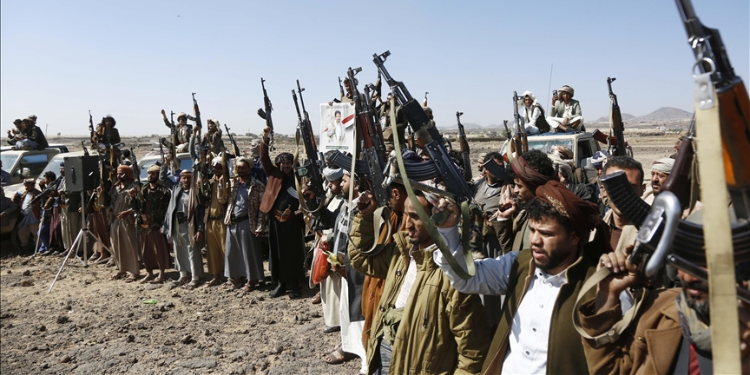
Yemen’s Iran-aligned Houthis have issued direct warnings threatening to disrupt the Bab al-Mandeb Strait if U.S. or Israeli military operations expand in the region.
The statement raises fears of a dual chokepoint crisis, with both the Strait of Hormuz and Bab al-Mandeb at risk of closure.
In a formal declaration on Friday, March 27, the Yemeni Armed Forces said their “fingers are on the trigger” for direct military intervention.
The Houthis outlined three triggers for action, including expansion of military alliances backing U.S. and Israeli operations, use of Red Sea waters for hostile missions, and ongoing escalation against Iran.
Houthis threaten Bab al-Mandeb shipping lane
They positioned themselves as aligned with Tehran and the “axis of jihad and resistance.”
“We confirm that our fingers are on the trigger for direct military intervention” if any new alliances join Washington and Israel against Iran and its allies, or if the Red Sea is used for “hostile operations” against Iran, the group’s military spokesperson Yahya Saree said in a televised speech.
Also Read: Trump Scrambles Another Aircraft Carrier as Iran War Escalates
The Bab al-Mandeb Strait, a 29-kilometre-wide passage between Yemen and Djibouti/Eritrea, links the Red Sea to the Gulf of Aden.
Roughly a tenth of global trade passes through it, including oil, gas, and container traffic moving between Asia and Europe.
The strait is divided into two channels by Mayyun Island: a narrower eastern lane for smaller vessels and a wider western lane for large commercial traffic.
Ships slow down and funnel into predictable lanes, placing them within range of shore-based missiles, drones, and small-boat attacks.
From late 2023 through October 2025, Houthis carried out over 100 attacks on merchant ships, affecting vessels from more than 60 nations.
While no confirmed attacks have occurred since the October 2025 Israel–Gaza ceasefire, officials continue to view the group as a credible threat. Past assaults forced rerouting and raised insurance costs, with war-risk premiums withdrawn or repriced.
Link to Hormuz
The Strait of Hormuz and Bab al-Mandeb are geographically distant — 3,500 to 4,000 km apart — but operationally linked.
Ships leaving the Gulf exit via Hormuz, cross the Arabian Sea, enter the Gulf of Aden, pass through Bab al-Mandeb, and head to the Suez Canal.
If the Strait of Hormuz is blocked, oil struggles to leave the Gulf. If Bab al-Mandeb is blocked, it struggles to reach Europe. If both are hit, the artery breaks end-to-end, threatening global energy flows.
The warning comes as oil markets remain volatile. Brent crude held steady above $108–$110 per barrel this week, while WTI hovered in the mid-$90s.
Brent dipped slightly to $108.5 after peaking at nearly $110, driven by fears over Hormuz’s closure. WTI rebounded to $89.33 on March 23.
Also Read: Putin Pulls Plug on Gasoline Exports as Prices Surge Worldwide
The Strait of Hormuz has been closed by an Iranian naval blockade since late February, with traffic plummeting from over 100 tankers daily to near zero.
Stranded oil tankers idle outside the Gulf, though a few China-linked vessels have reportedly passed selectively. The blockade has pushed physical oil premiums sky-high, generating windfall gains for major oil companies.
Trump’s remarks and diplomacy
President Donald Trump this week extended the deadline for Iran to reopen the Strait of Hormuz, claiming that diplomacy is progressing.
He threatened strikes on Iranian power plants if not met by March 24 and described U.S. operations as “very complete.”
On Friday, the president announced that Iran allegedly allowed 10 ships through as a “gift,” despite Tehran’s denials.
He quipped about renaming Hormuz the “Strait of Trump,” before correcting himself. Trump has portrayed Tehran as “on the run” and eager to make a deal, emphasising U.S. military success.
At the same time, the president hinted that “Cuba is next,” as he pointed out his administration’s use of America’s “great” military in Iran and Venezuela.
“And Cuba’s next by the way, but pretend I didn’t say that … Media, please disregard that statement,” he added in a somewhat casual tone.
His remarks came amid lingering speculation that Trump could shift his attention to other potential adversaries, including Cuba, after the war in Iran comes to an end.
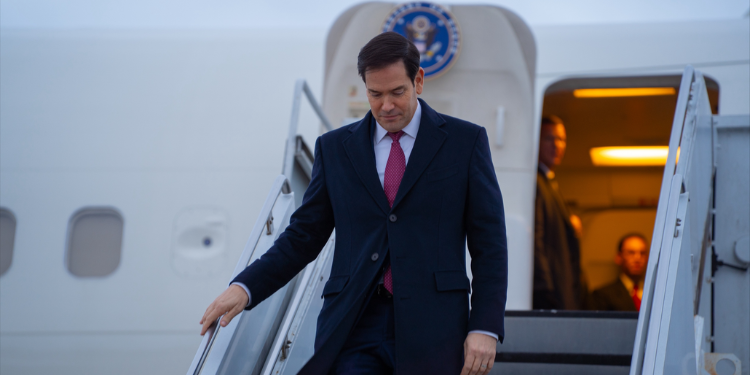
Meanwhile, Secretary of State Marco Rubio said the U.S. expects to end its operation in Iran in “weeks, not months.”
Following a G7 meeting in France, Rubio warned against any Iranian attempt to impose tolls on traffic through the Strait of Hormuz, claiming broad support for opposing such measures.