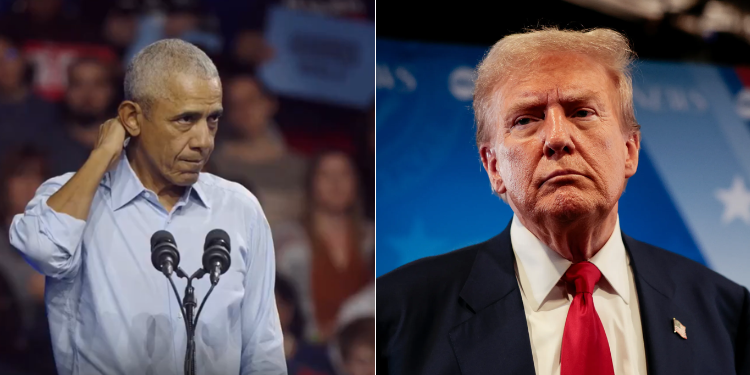
The President Donald Trump administration has formally revoked the landmark 2009 “endangerment finding” that concluded greenhouse gases pose a threat to public health and welfare.
The scientific determination which was made during former President Barack Obama’s first term has underpinned nearly all United States federal climate regulations for over a decade.
During a ceremony held at the White House on Thursday, February 12, the Environmental Protection Agency (EPA) finalised the move to revoke it, with President Trump and EPA Administrator Lee Zeldin declaring the reversal the “largest deregulatory action in American history.”
The move by Trump effectively dismantles the legal foundation used to justify federal limits on greenhouse gas emissions from vehicles, power plants, oil and gas operations, aviation and other major pollution sources.
In his speech, the Head of State framed the decision as part of his broader deregulation agenda and economic strategy.
“During my campaign, I promised to cut 10 old regulations for every new regulation, and we’ve exceeded that. We’ve instead done 10 regulations. We were able to cut 129. I promised to cut 10 old regulations for every new one, but we did more than 10.,” Trump said.
“We did 129. It’s something nobody can even believe it. So, we did a lot of regulation cutting in the first administration, a record. Nobody even close to it now. We’re actually exceeding it in this administration. The biggest one yet that we’ve done is happening right now.”
Trump ends core Obama-era U.S. climate policy
He added that rolling back emissions rules would boost the U.S. auto industry, reduce costs for consumers and drive investment into domestic manufacturing.
“These regulation cuts, combined with our tax cuts and tariffs, are the reason why the world’s largest automakers have announced that they’re going to be spending in excess of $100 billion in the United States in the next very short period of time building new auto plants,” Trump added.
“We’re bringing our auto plants, assembly plants, and factories roaring back to life, not even mentioning AI and all of the other things.”
Also read: Erasing Obama: Trump’s New Plan to Issue Cash Instead of Health Insurance
Former President Obama moments later reacted to the move in a statement on X, highlighting the potential consequences.
“Today, the Trump administration repealed the endangerment finding: the ruling that served as the basis for limits on tailpipe emissions and power plant rules. Without it, we’ll be less safe, less healthy and less able to fight climate change — all so the fossil fuel industry can make even more money.”
Earlier, the White House maintained the move would save Americans more than $1 trillion in regulatory costs and significantly lower vehicle prices.
Press secretary Karoline Leavitt told reporters the rollback would cut manufacturing costs for automakers by more than $2,400 per vehicle, particularly for light-duty cars, SUVs and trucks.
Climate science ruling that anchored U.S. emissions limits
The endangerment finding, issued by the EPA in 2009, determined that six key greenhouse gases — including carbon dioxide and methane — contribute to climate change and threaten human health.
It became the legal basis for federal climate regulations under the Clean Air Act after Congress failed to pass comprehensive climate legislation.
Legal experts describe the finding as the cornerstone of U.S. climate governance.
“The endangerment finding has really served as the lynchpin of U.S. regulation of greenhouse gases,” said Meghan Greenfield, a former EPA and Department of Justice attorney. “It covers motor vehicles, power plants, oil and gas, methane from landfills, even aircraft — essentially the full range of emissions standards.”
By revoking the finding, the administration has opened the door to rolling back or weakening a wide range of federal climate rules introduced over the past 15 years.
U.S. courts have repeatedly upheld the legal framework behind the endangerment finding. In the landmark 2007 case Massachusetts v. EPA, the Supreme Court ruled that greenhouse gases qualify as pollutants under the Clean Air Act, paving the way for the 2009 determination.
Also Read: Trump-Backed Bill Requiring Citizenship Proof and Photo ID During Voting Approved
Courts have since consistently rejected challenges to the finding, most recently in a 2023 ruling by the U.S. Court of Appeals for the District of Columbia Circuit.
Greenfield said the reversal could trigger a new wave of litigation at both federal and state levels.
“I would expect states and non-profit groups to bring suits to determine where the contours of this new regulatory landscape lie,” she said.
Dispute over science
A key battleground will be the scientific basis of the reversal as the administration relied in part on a report commissioned by the Department of Energy that questioned aspects of established climate science.
However, critics argue the panel that produced the report was skewed toward climate-sceptic viewpoints and lacked scientific balance.
A federal judge in February 2026 ruled that the department violated legal procedures in assembling the panel, raising questions about how heavily the administration can rely on the report in defending its decision.
Meanwhile, the National Academies of Sciences reassessed the science underpinning the 2009 finding and concluded it remains accurate and is now supported by even stronger evidence.
The panel stated that the risks posed by human-driven greenhouse gas emissions are “beyond scientific dispute.”
The White House has maintained that eliminating emissions rules will make vehicles cheaper and help stimulate domestic production.
“President Trump and EPA Administrator Lee Zeldin announce the end of the Obama-era Endangerment Finding, ending costly and useless vehicle emission rules, eliminating the stop-start button, and saving taxpayers $1.3 trillion.”
However, analysts have highlighted potential international implications. Producing less fuel-efficient vehicles could complicate exports to markets with stricter emissions standards, creating uncertainty for U.S. automakers globally.
Follow our WhatsApp Channel and X Account for real-time news updates.