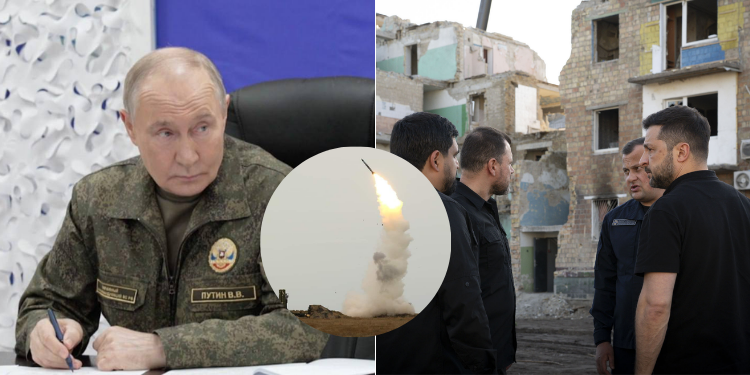
President Volodymyr Zelenskyy has broken his silence after Ukraine and Russia both declared ceasefires for Orthodox Easter, offering a temporary pause in hostilities during the holiday.
Zelenskyy, in a statement on Friday, April 10, said Ukraine is prepared to take “symmetrical steps” in response to Russia’s announcement.
“We proposed a ceasefire during the Easter holidays this year and will act accordingly,” he said. “People need an Easter free from threats and real movement toward peace, and Russia has a chance not to return to strikes after Easter as well.”
The announcement by Zelenskyy comes after the Russian Ministry of Foreign Affairs on Thursday confirmed that President Vladimir Putin ordered a halt to combat operations from 4:00 p.m. on April 11 until the end of April 12.
Defense Minister Andrey Belousov and Chief of the General Staff Valery Gerasimov were instructed to enforce the ceasefire across all areas.
Also Read: Putin Declares Easter Ceasefire in Ukraine as War Rages On
The ministry said Russian troops would remain ready to repel “any possible provocations by the enemy” and added: “We proceed from the assumption that the Ukrainian side will follow Russia’s example.”
Sanctions and international law
The ceasefire comes as Deputy Foreign Minister Dmitry Lyubinsky delivered a speech in Geneva on Thursday, criticizing Western sanctions.
Speaking at the International Conference on Humanitarian Action, Remedy and Responsibility in a unilateral sanctions environment, Geneva, Lyubinsky described unilateral sanctions as “unlawful acts of aggression” and a “modern form of colonial policy.”
He argued that sanctions imposed outside the UN Security Council framework undermine international law and primarily harm ordinary citizens.
“Depriving ordinary people of access to food and medicine is not a political measure; it is a true crime against humanity,” Lyubinsky said.
Russia has faced approximately 30,000 sanctions, according to its Ministry of Finance, more than any other country. Lyubinsky said the measures have failed to weaken Russia, instead consolidating society and spurring economic adaptation.
He noted that Russia has signed declarations with countries including Belarus, Iran, Nicaragua, Syria, Zimbabwe, and Cuba to counter the impact of sanctions.
The deputy foreign minister also pointed to Europe’s energy crisis, arguing that embargoes on Russian energy imports have led to falling living standards and rising unemployment.
Also Read: Two European Nations Join NATO Operation Against Putin’s Forces
He said humanitarian exemptions in sanctions regimes are “completely unworkable” and continue to block access to grain and fertilizer exports.
Russia-Ukraine peace talks in Washington
The ceasefire coincides with reports that Putin’s special envoy Kirill Dmitriev is in the United States for discussions with members of President Donald Trump’s administration.
Sources told Reuters the talks focus on a potential peace deal for Ukraine and U.S.-Russia economic cooperation. The visit comes ahead of a U.S. decision on whether to extend sanctions relief on Russian oil, which expires on Saturday.
The United States last month issued a 30-day waiver allowing countries to buy sanctioned Russian oil stranded at sea, in an effort to stabilize energy markets disrupted by the war in Iran.