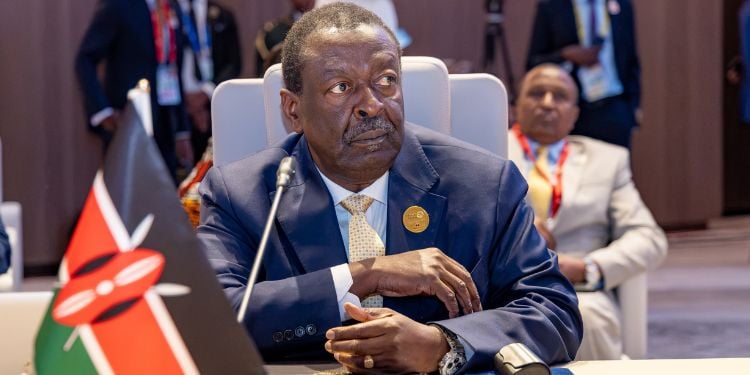
Prime Cabinet Secretary Musalia Mudavadi has urged Kenyans seeking employment abroad to verify job opportunities through official government channels and avoid unregistered recruitment agents.
Speaking during the 4th Annual Employment and Labour Relations Symposium and Exhibition (ELRASE IV) at Strathmore University in Nairobi on September 16, Mudavadi, who is also the Cabinet Secretary for Foreign and Diaspora Affairs, said Kenya had signed labour agreements with several countries as part of efforts to create safer and more structured opportunities for Kenyans seeking jobs overseas.
“We have signed agreements with countries including the United Kingdom, Saudi Arabia, the United Arab Emirates, Qatar, Germany, Austria and most recently Italy. We are actively exploring frameworks with other nations,” Mudavadi said.
Through the Kazi Majuu programme and government-to-government bilateral labour agreements, he said the Government was creating structured, safe and dignified pathways for Kenyans to work abroad.
Government Warns Against Rogue Recruitment Agents
Mudavadi cautioned Kenyans, particularly young people looking for jobs overseas, against falling for deceptive offers or dealing with unregistered agents.
Also Read: Mombasa County Rolls Out 3,000 Jobs: Qualifications, How to Apply and Deadline
“Recent records indicate that over 540,000 Kenyans have secured employment abroad. Our diaspora remittances exceeded $5 billion in 2025, making them our largest single source of foreign exchange,” he said.
He said the figures demonstrated the opportunities available to Kenyans abroad while also pointing to the need to protect migrant workers from exploitation.
Mudavadi said the Government had closed more than 600 recruitment agencies suspected of facilitating recruitment-related malpractices.
He also said Kenya had initiated efforts to repatriate citizens trapped in war zones linked to the Russia-Ukraine conflict and scam compounds in Myanmar.
“These are not just statistics; they represent the lives and dignity of our brothers and sisters,” Mudavadi said.
He warned that some Kenyans had been lured into unsafe jobs, exposed to human trafficking networks and, in some cases, deceived into becoming combatants in foreign conflicts.
Mudavadi Calls for Better Protection of Migrant Workers
Mudavadi also called for stronger legal protections for Kenyans working outside the country, particularly low-wage migrant workers and domestic workers.
Also Read: Dream Jobs Young People Want in 2026 Revealed
He said migrant workers often face difficulties when seeking justice because their cases can involve different jurisdictions, economic challenges, and unequal power between workers and employers.
“Their justice journeys often traverse multiple jurisdictions, power imbalances, trauma, and economic precarity,” he said.
Mudavadi said Kenyan courts and the justice system had a role to play in addressing issues such as recruitment accountability, joint liability and the enforcement of employment rights arising from work performed abroad.
He further challenged stakeholders to examine employment contracts more closely and identify agreements that may conceal coercion or structural inequality.
Mudavadi said the Government remained committed to facilitating safe, regular and orderly labour migration as part of the national labour mobility agenda.
He urged the Judiciary, lawyers, employers, workers’ representatives and development partners to work with the Government to strengthen protections for Kenyans working overseas.
“But we cannot do this alone. We need the partnership of the Judiciary, of legal practitioners, of employers and workers’ representatives, of development partners, and of all stakeholders,” he said.
CJ Koome Calls for Justice to Follow Kenyans Working Abroad
Chief Justice Martha Koome has also called for Kenya’s justice system to adapt to the growing number of citizens seeking employment abroad, saying migrant workers should remain protected by the law even when they cross international borders.
The CJ said labour migration was reshaping the world of work and creating new demands for justice institutions.
“Justice must travel with the worker,” the CJ said, stressing that crossing an international border in search of employment should not mean losing access to legal protection.
Koome said migrant workers often face exploitation, language barriers, and challenges seeking help or justice when working abroad.
She identified accessible procedures, timely justice, effective enforcement and suitable dispute-resolution mechanisms as key to protecting migrant workers, while calling for urgent relief in time-sensitive labour disputes.
The CJ also urged stronger cooperation in cross-border service, evidence gathering and enforcement, while noting the vulnerabilities faced by women migrant workers, domestic workers, young workers, persons with disabilities and victims or potential victims of trafficking.
She further encouraged the responsible use of Court-Annexed Mediation, conciliation and other dispute-resolution mechanisms, saying such processes must remain voluntary, fair and respectful of workers’ rights.
Follow our WhatsApp Channel and X Account for real-time news updates