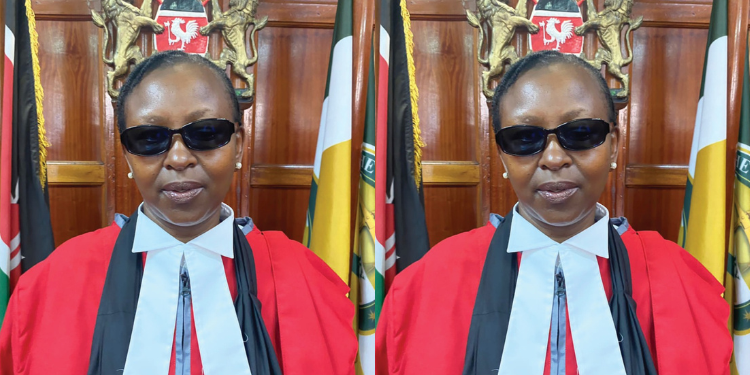
Monica Mbaru, a Kenyan judge, was elected the Principal Judge of Kenya’s Employment and Labour Relations Court on March 5, 2026.
Monica is set to replace Byram Ongaya following his appointment to the Court of Appeal, and her position carries a five-year term, renewable once.
Justice Mbaru is expected to officially assume office on March 27, 2026, during an installation ceremony presided over by Chief Justice Martha Koome. As Principal Judge, she will lead the court that handles employment, labour relations, and workplace disputes across the country.
Monica Mbaru Education Background
Justice Mbaru trained as a lawyer at the University of Nairobi, where she earned her Bachelor of Laws degree. She later completed a Postgraduate Diploma in Law at the Kenya School of Law and was admitted to the Bar as an advocate of the High Court of Kenya in 1996.
She went on to further her studies in human rights, obtaining a Master of Laws degree in Human Rights and Democratisation in Africa from the University of Pretoria in South Africa.
She is currently pursuing a Doctor of Laws degree at the University of Nairobi, with her research focusing on disability rights and the law.
Also Read: Profile of David Keter Dollarline Eyeing Emurua Dikirr MP Seat for the Fourth Time
Career
Justice Monica Mbaru was appointed a judge of the Employment and Labour Relations Court in July 2012. Since then, she has served in different parts of the country, including Nairobi, Nakuru, and Mombasa.
Before her election as Principal Judge, she was serving as the Presiding Judge of the court in Mombasa. Over more than ten years on the bench, she has handled numerous employment and labour disputes, gaining extensive experience in workplace law and labour relations.
Before joining the Judiciary, Beatrice Mbaru worked as a lawyer with a strong interest in human rights, social justice, and improving access to justice for disadvantaged groups.
In addition, she worked with several organisations involved in legal aid and public‑interest work, including the Hivos Foundation in East Africa, the Kenya Chapter of the International Commission of Jurists, Kituo Cha Sheria, and the Legal Resources Foundation.
Her work included offering legal assistance, training paralegals, supporting community outreach programmes, and contributing to policy advocacy.
Beyond Kenya, Justice Mbaru has also been involved in regional legal work. She served as a consultant to the Secretariat of the African Decade for Persons with Disabilities, where she worked with the African Union and the East African Community to develop laws and policies to protect and promote the rights of persons with disabilities.
Also Read: Profile of Allen Gichuhi, Top-Rated Arbitrator and Litigator who Rose from LSK President to SC
Mbaru’s Achievements
In her decisions, Mbaru has consistently upheld workers’ rights. In one case, she ruled that a domestic worker could be compensated for unfair dismissal even in the absence of a written contract.
In another, she affirmed that annual leave is a legal right and that punishing an employee for taking it constitutes unfair dismissal.
She has also handled cases involving wrongful termination and workplace misconduct, awarding compensation to employees who were dismissed unfairly and clarifying how employment laws should be applied in such situations.
In addition to her judicial work, Justice Mbaru has long been known for speaking out on human rights issues, including the affecting minority groups, even before joining the bench. She has also been linked to organisations like the Federation of Women Lawyers–Kenya, which focuses on empowering women through legal education and access to justice.