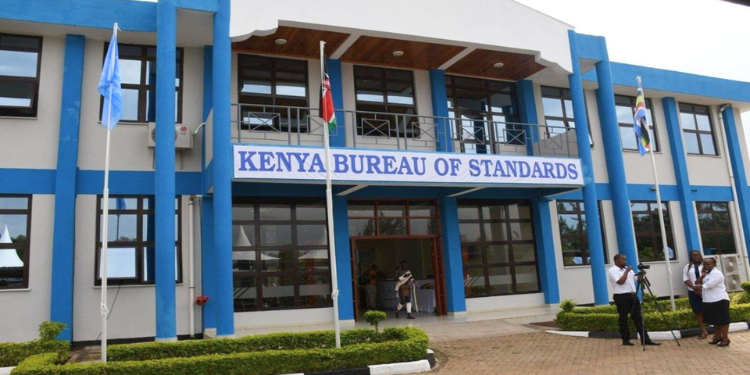

Kenya’s manufacturing sector has raised strong objections to the new Standards (Standards Levy) Order, 2025, issued by the Kenya Bureau of Standards (KEBS) and gazetted under Legal Notice No. 136 of 8th August 2025.
In a public statement dated March 11, industry associations warned that the revised levy will increase the cost of doing business and weaken the country’s competitiveness.
The new order requires manufacturers to remit 0.2 percent of their monthly turnover, excluding VAT and discounts, but the maximum annual levy now rises sharply to Ksh4 million for the first five years and Ksh 6 million thereafter.
This marks a significant increase from the previous annual limit of Ksh400,000 under the 1990 Order.
At the highest rate, businesses will pay up to Ksh11,000 per day in the first three years, rising to Ksh16,000 per day thereafter, including weekends and public holidays.
KEBS Faces Backlash
Manufacturers say the revised levy will increase financial pressure at a time when companies are already facing high operational costs and a slow economic recovery.
“The increase in the Standards Levy does not necessarily translate to enhanced service delivery. All KEBS services are offered at a cost, which has been increasing over the last 3 years. Companies are already paying significant amounts to KEBS in form of standard marks, inspections, diamond marks and testing services in the rates of millions and the 4 million cap subjects the companies to excesses of 8 million paid to a single regulator (KEBS) per year. In principle, a levy should be attached to a service and not used as a resource mobilization tool,” read part of the joint statement by manufacturers.
The manufacturers argue that the abrupt increase will weaken the private sector’s ability to create jobs, support value chains, and contribute revenue to the government.
Also Read: TSC Announces 170 Senior Administrative Jobs: How to Apply
They also warn that the added cost will eventually be passed on to consumers, worsening the already tough business environment.
With many factories struggling to stay afloat, the industry leaders argue that extra charges will definitely undermine the country’s ability to attract investment and grow exports.
Industry Groups Call for Action
Due to their dissatisfaction with the new levy, industry groups have issued a five‑point call to action, urging the government to suspend the Standards Levy Order, 2025, and reopen consultations.
They want the order taken back to stakeholders to address the rising cost of doing business, the impact on manufacturing competitiveness, and the formula used to set the levy.
Also Read: Safaricom Explains Why Phone Numbers Are Redacted in M-PESA Statements
The groups also want an independent review of KEBS’s financing to ensure the agency follows constitutional, fiscal, and service‑based rules.
In the joint statement, the groups also called for stronger accountability through annual audits and full transparency regarding how KEBS uses the funds it collects.
“To this end, we call for the joint public–private working group comprising KEBS, the Ministry of Investments, Trade and Industry (MITI), other regulators, and the business community (through BMOs) to design sustainable, service-driven financing mechanisms,” the statement read.
The manufacturers also want exemptions for sectors not covered by KEBS technical obligations, including horticulture, pharmaceuticals, and EPZ firms.
Lastly, the groups want levy rates aligned with global trade rules requiring fees to match the actual cost of services.
However, the government has defended the levy as necessary to strengthen Kenya’s quality infrastructure and ensure predictable funding for KEBS.
It has defended the new Standards Levy as a necessary tool to strengthen Kenya’s quality‑control system and provide predictable funding for KEBS.