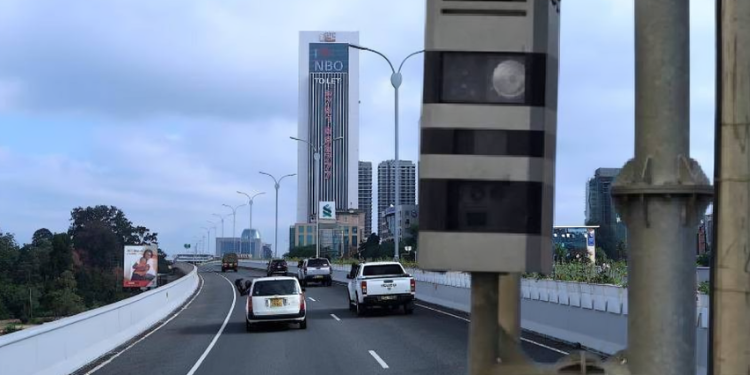
A viral social media post showing a vehicle with its front number plate covered by a piece of cloth has sparked widespread debate, with motorists sharing what they claim are ways of avoiding detection by the National Transport and Safety Authority’s (NTSA) automated speed cameras.
The image, which has been widely circulated on Facebook, shows a black Toyota Prado with a cloth draped over its front number plate, concealing the vehicle’s registration details.
It was shared with the caption, “This is how people are dealing with the speed limits,” drawing hundreds of reactions from motorists discussing the newly introduced camera enforcement system.
Kenyans Share Tricks to Evade NTSA Speed Cameras
Reacting to the post, some users claimed they had adopted different methods to conceal their registration plates.
One Facebook user said he had installed a privacy number plate cover designed to make the registration details difficult to see from certain angles.
“I have already installed a privacy number plate cover. You can only see my number plate when you are standing directly in front of the vehicle, but not from the sides or above. It works just like a privacy screen protector.”
Others suggested different methods they believed could help motorists avoid detection.
One user wrote:
“Apply grease to your number plates. Thank me later.”
Another advised motorists to conceal both the QR code and the registration numbers.
“I don’t want to teach people how to break the law, but cover the QR code on the number plate and then cover the registration numbers.”
Other users claimed motorists had resorted to using reflective compact discs (CDs) on their dashboards or flip-style number plate holders, although none provided evidence that the methods are effective.
Not everyone agreed that concealing the registration plate would work.
One motorist said he had attempted to hide his number plate but was still identified by the system through the QR code.
“The QR code can still be read. I was caught on Thika Road after hiding my number plate, but the QR code identified my vehicle. I ended up paying KSh10,000.”
Also Read: Matatu Operators Speak After Proposal to Give NTSA Power to Set Fares
Some Users Say the Tricks Do Not Work
Several motorists also warned that the enforcement system can detect more than just speeding offences.
One commenter said the cameras monitor attempts to conceal registration plates in addition to recording speed violations.
“There are other cameras that monitor motorists’ behaviour, including covering number plates. Speed cameras are just one part of the registration system.”
Another dismissed the alleged tricks altogether.
“You can’t hide. The camera can even scan your insurance sticker at 180 km/h. Don’t be fooled into thinking covering the number plate will help.”
Some of the comments were clearly humorous. One user joked:
“The only way to avoid being caught on camera is to drive at more than 200 km/h.”
Another sarcastically added: “Drive past at 140 km/h and the camera won’t have enough time to capture you.”
Debate Shifts to Kenya’s Speed Limits
Beyond the shared methods of avoiding the cameras, the conversation shifted to the speed limits being enforced on Kenyan roads.
Some motorists argued that the issue was not the cameras themselves but the speed limits on certain roads.
“Speed cameras are not the problem. The problem is having a 50 km/h speed limit on dual carriageways.”
Others questioned whether the limits had been set after proper assessments of traffic conditions.
“I don’t mind observing the speed limits. My only question is whether the recommendations were made after practical driving on those roads. Do they all make sense? Are they all justified?”
In addition, some users defended the cameras, saying stricter enforcement could help reduce road crashes caused by speeding.
“People should slow down. We will all get to our destinations safely.”
Also Read: NTSA Announces Nationwide Crackdown on Highways and All Major Roads
Current NTSA Speed Limits on Major Roads
The discussion comes as NTSA continues rolling out automated traffic enforcement to curb speeding and improve road safety across the country.
Under the current speed limits, motorists are required to drive at 50 km/h in urban areas and towns, 80 km/h on national and rural roads as well as designated bypass sections, and up to 110 km/h on selected major highways.
The speed limits vary depending on the road. On Thika Road, motorists can drive up to 110 km/h between Safari Park and the Thika Road stretch, while the limit drops to 80 km/h at sections including the Jomoko turnoff, Allsops, Pangani and parts of Roysambu.
Along Waiyaki Way, the speed limit ranges between 60 km/h and 80 km/h, while most monitored sections of the Southern Bypass, Northern Bypass, Nairobi Expressway and Mombasa Road have an 80 km/h limit.
Follow our WhatsApp Channel and X Account for real-time news updates.