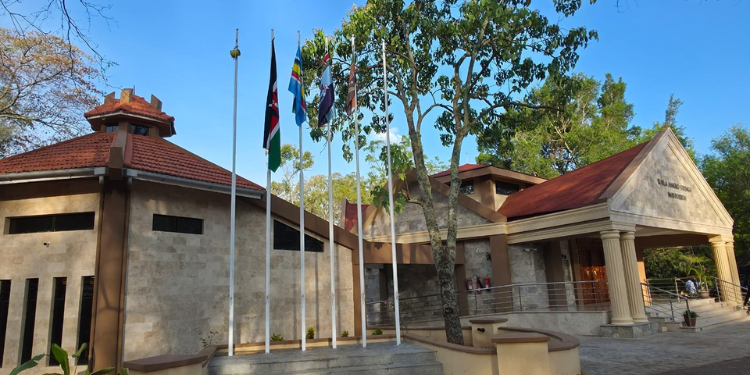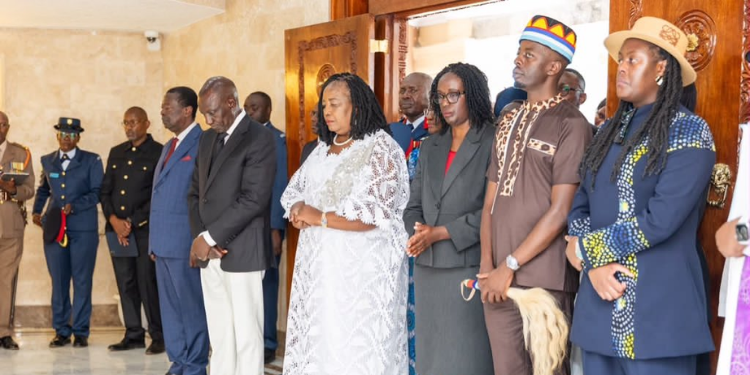
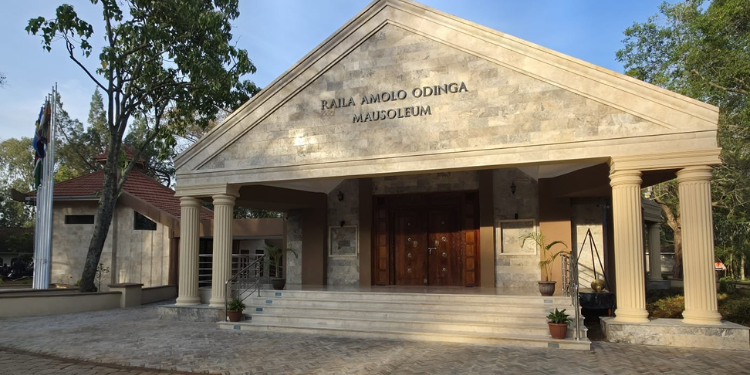
The new mausoleum of former Prime Minister Raila Odinga unveiled by President William Ruto on Wednesday, October 7, carries more than his remains.
Its design brings together symbols from his political life, his family’s history and the ideals he championed during decades at the centre of Kenya’s political struggle.
At Kang’o ka Jaramogi in Bondo, Siaya County, the Raila Odinga mausoleum now stands alongside that of his late father, Jaramogi Oginga Odinga, Kenya’s first Vice President.
Raila was buried at the Oginga family home on October 19, 2025, four days after his death in India at the age of 80.
The new structure, however, was designed to tell its own story.
Why Raila Odinga Mausoleum is a Pentagon
One of the most distinctive features of the mausoleum is its pentagonal shape.
Officials involved in the project explained that the design was deliberately developed in relation to Jaramogi’s mausoleum, which is hexagonal.
The two different geometries were used to create what the designers described as architectural harmony between the memorials of the father and son.
“For that architectural harmony, we try to play around with the geometry of Jaramogi Mausoleum, which is a hexagon, and we came up with Raila Mausoleum, which is a pentagon,” an official explained during the tour.
The “Pentagon” was also a political coalition formed under the Orange Democratic Movement (ODM) ahead of the 2007 general elections
In the run up to the 2007 election, Raila assembled what was easily the most potent team in Kenya’s electoral history- the Pentagon.
It was made up of a star-studded team of politicians representing most of Kenya’s regions.
They included Musalia Mudavadi – now Prime CS, President William Ruto, Joe Nyaga and Najib Balala. Charity Ngilu joined them later completing a team of six influential politicians.
The group was designed to give ODM a national outlook by uniting key political figures representing diverse communities across Kenya.
Each member of the Pentagon played a strategic role in mobilizing support from their respective regions, helping ODM emerge as a formidable force in the 2007 elections.
Also Read: Ida Odinga Takes a Stand on Who Owns Raila’s Tribute
Words and Photographs on the Walls
The walls of Raila Odinga mausoleum also carry some of his own words, placed alongside photographs documenting different stages of his life.
One of the messages comes from his address during the 2020 Madaraka Day celebrations, where Raila spoke about the values he believed were necessary for Kenya’s future.
“Let us reflect on patriotism, sacrifice, personal responsibility, dignity of our people and respect for our nation. These ideals are going to be critical in the gigantic task of reconstructing and rebuilding our nation. ”
The words appear alongside a collection of photographs of Raila, giving visitors both a visual and written account of the former Prime Minister’s life.
Among the photographs is an image of Raila from his time as a student in Germany.
Raila left Kenya for East Germany in the 1960s, where he studied at the Herder Institute in Leipzig before pursuing mechanical engineering studies in Magdeburg. He graduated in 1970.
The photographs then move into the political chapters that came to define his public life.
They capture the period around his detention following the failed 1982 coup attempt and his involvement in the struggle for multiparty democracy.
Raila spent years in detention without trial during the one-party era. His experiences during that period became an important part of the political history later associated with his name.
Also Read: Who Is Omondi Oginga, the Low-Profile Brother of Raila Odinga
Raila’s Political Struggle and Jowi Symbol
The design also incorporates symbols associated with Raila’s public life.
Among them is the raised fist, a gesture that became closely associated with him during political rallies and public appearances.
During the mausoleum tour, the gesture was described not simply as a sign of defiance, but as a representation of authority, power and a call to action and unity.
That symbolism reflects a significant part of Raila’s political journey.
Another symbol incorporated into the memorial is the buffalo, known as Jowi.
Raila was associated with the Jowi chant during his political engagements, with the symbol being used to rally crowds.
Officials explaining the memorial said the buffalo was not intended to represent violence. Instead, they described it as a symbol used by Raila to call people to action.
More than a Burial Site
The mausoleum is also intended to serve a purpose beyond being Raila’s final resting place.
Officials described the site as a heritage centre and a “living classroom” where Afrocentric materials will be exhibited.
The aim is to create a place where visitors from Kenya and abroad can learn about Raila’s life, his family history and aspects of African heritage.
The site is intended to provide a place of remembrance and reflection, but also one where future generations can engage with the history surrounding Raila’s public life.
Raila Odinga mausoleum complex has been listed for protection by the National Museums of Kenya as part of the country’s national heritage.
The Ministry of Defence took charge of construction in July 2026, with military engineers and museum technical teams completing the works ahead of the October 7 dedication.
Follow our WhatsApp Channel and X Account for real-time news updates.