
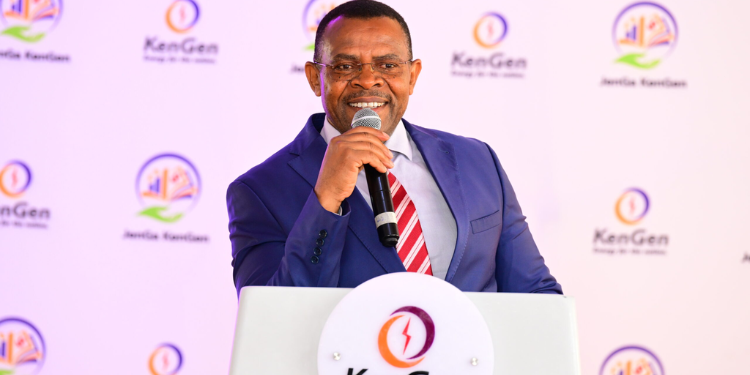
Kenya Electricity Generating Company PLC (KenGen) shareholders have endorsed a revised governance framework that alters the composition and election of the company’s board. This follows President William Ruto’s announcement that the government will allow private-sector investors to have representation on the boards of state-linked companies.
Shareholders say the move aims to strengthen board independence and minority shareholder protections, as the state-backed utility seeks to bolster investor confidence.
The resolution was approved at a convened General Meeting held virtually on February 12, as private investors increasingly assert influence over long-term capital allocation and governance discipline within Kenya’s listed state-controlled entities.
The company chairperson Alfred Agoi said that the changes will strengthen the independence at the board level.
“These changes are about predictability and trust,” Alfred Agoi said.
“They strengthen independence at board level while preserving the government’s position as majority shareholder,” he added.
KenGen, which supplies over 60% of the country’s electricity, affirmed that the approved amendments do not dilute or alter the Government of Kenya’s ownership stake.
Instead, executives framed the reforms as a structural upgrade intended to align the company with international governance standards for publicly listed firms with dominant state shareholders.
KenGen Approves Restructuring of Its Board Composition
The revised board structure expands the role of independent directors.
Under the new framework, independent directors must step down if they assume political office or become employees of government or state-owned entities, provisions designed to limit political exposure and perceived governance risk.
For minority investors, the most consequential change is the introduction of a ringfenced voting mechanism that allows non-state shareholders to elect independent directors without the majority shareholder’s participation.
Also Read: KenGen Addresses Power Supply Interruption Concerns After Wind Turbine Fire Incident
Managing Director and CEO Peter Njenga said the reforms were intended to support disciplined capital allocation and operational performance.
“Strong governance lowers risk premiums,” he said.
“That matters when you are financing large-scale energy infrastructure over decades as we plan to do between now and 2034.”
The governance reset comes as KenGen continues to execute capital-intensive investments in geothermal, hydro, nuclear, solar, and wind power projects that require long-term funding visibility and stable policy backing.
Also Read: KenGen Moves to Expand Masinga Dam in New Flood Control Plan
Private Investors to Gain Board Representation in State-Linked Companies
On February 10, the President stated that the initiative aims to close long-standing governance gaps in state corporations with mixed ownership, where boards have traditionally been fully appointed by the government despite the involvement of private shareholders.
Ruto indicated that the reforms, already implemented at Kenya Pipeline, will soon extend to KenGen and Kenya Re, ensuring greater private-sector participation in decision-making.
Under the revised framework, private investors will have the right to nominate board members based on their shareholding, allowing them to participate more actively in governance rather than merely contributing capital.
Follow our WhatsApp Channel and X Account for real-time news updates.