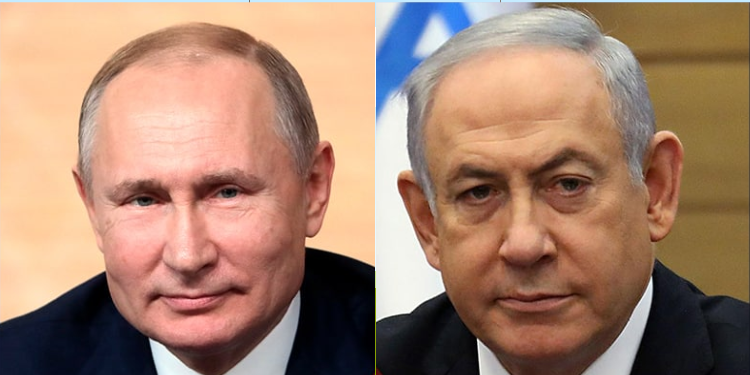
Russian President Vladimir Putin held separate telephone conversations with Israeli Prime Minister Benjamin Netanyahu and Iranian President Masoud Pezeshkian.
The Friday, January 16, calls came amid intensified tensions across the Middle East related to the unrest in Iran and mounting international pressure over the crisis.
According to Russia’s Ministry of Foreign Affairs, the call between Putin and Netanyahu focused on “the situation in the Middle East and developments related to Iran,” with Moscow reaffirming its role in diplomatic engagement.
“The situation in the Middle East & developments related to Iran were discussed. The Russian Side reaffirmed its readiness to continue appropriate mediation efforts,” the Ministry said.
Putin in calls with Netanyahu and Iran President
The conversation marked Putin’s first public diplomatic response to the latest escalation, coming as regional actors brace for potential fallout following strong rhetoric from the United States over events inside Iran.
Also Read: Trump Threatened if the United States Attacks Iran
On the same day, the Russian President also spoke by phone with Iranian President Masoud Pezeshkian.
The Russian Foreign Ministry, in a separate statement, said both leaders reaffirmed their shared position “in favour of the earliest possible de-escalation around Iran and across the region exclusively through political and diplomatic means.”
The Kremlin later described the outreach as part of ongoing efforts to prevent further deterioration in relations between Tehran and Washington.
“This is assistance not only to Iran, but to the entire region, as well as to the cause of regional stability and peace,” Kremlin spokesman Dmitry Peskov told reporters, adding that further details would be released.
United States threats
The diplomatic activity comes amid mass demonstrations in Iran that erupted in late December, driven largely by soaring inflation and economic hardship. Iranian authorities say more than 100 security force personnel have been killed in clashes with protesters, while opposition activists claim the death toll among demonstrators exceeds 1,000.
The unrest has prompted reactions from United States President Donald Trump, who last week threatened possible military action against Iran, stating the U.S. military was “locked and loaded” should Iranian forces continue firing on protesters.
Also Read: Trump’s Ambassador Shares Bank Account With Top Iranian Officials to Deposit Over $1.5 Billion
The President also called on Iranians to take over state institutions, promising that “help is on the way.” Although Trump later appeared to soften his stance after assurances from Tehran that the killing of protesters would stop, his remarks left the region bracing for possible escalation.
Iran, Russia push back at UN Security Council
At an emergency UN Security Council meeting on Thursday, requested by the United States, Iran’s deputy permanent representative Gholamhossein Darzi warned against any military intervention, arguing that humanitarian rhetoric was being misused.
“Any threat [of the] use of force against Iran, under any pretext, including claims of protecting protesters or supporting the Iranian people, constitutes a grave and manifest violation of international law and the UN charter,” Darzi said.
“Evoking humanitarian rhetoric to justify force [is] a deliberate abuse of international law.”
Darzi further accused the U.S. and Israel of attempting to manufacture unrest following what he described as their failure in a 12-day war against Iran last June.
“Unable to achieve their objectives through the 12-day war of aggression against Iran in June 2025, they now seek to pursue the same goals through political destabilisation, internal unrest and chaos.”
UN warns of rising volatility
The United Nations also voiced concern over the growing rhetoric surrounding Iran. UN Assistant Secretary-General Martha Pobee warned that public threats of military action were worsening an already fragile situation.
“We note with alarm various public statements suggesting possible military strikes on Iran. This external dimension adds volatility to an already combustible situation,” Pobee told the Security Council.
“All efforts must be undertaken to prevent any further deterioration.”
Russia’s permanent representative to the UN, Vassily Nebenzia, sharply criticised Washington for convening the meeting, accusing the U.S. of escalating tensions.
“Today’s meeting … is nothing more than another attempt to justify blatant aggression and interference in the internal affairs of a sovereign state,” Nebenzia said, describing the session as a “cheap circus.”
Nebenzia added that Moscow stood in “solidarity with the people of Iran” while warning that “hostile foreign forces” were exploiting the unrest to undermine Iranian sovereignty.
Follow our WhatsApp Channel and X Account for real-time news updates.