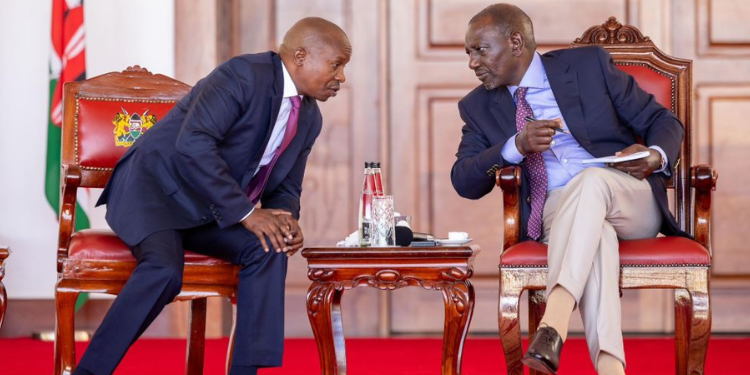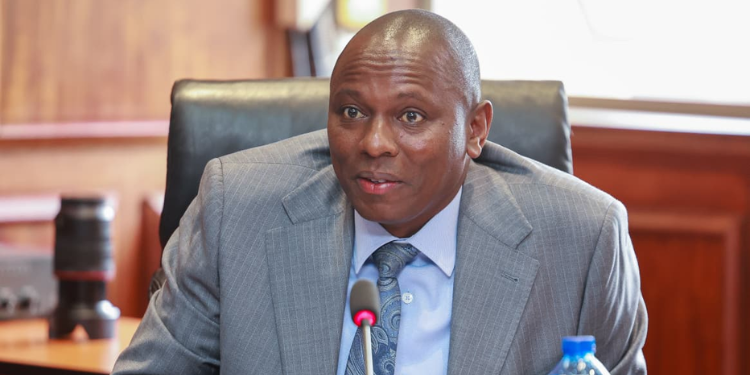
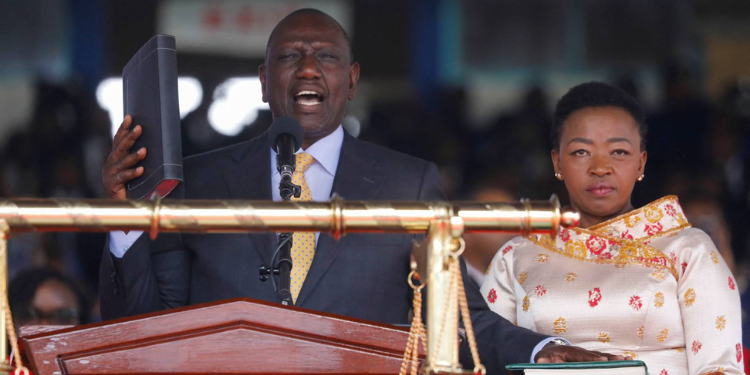
President William Ruto has strongly backed Deputy President Kithure Kindiki while sharply criticizing former Deputy President Rigathi Gachagua, in remarks pointed to early succession politics ahead of 2032.
The President had earlier attended a Thanksgiving service at Burieruri Boys High School to mark the institution’s 60th anniversary, then stopped to address a large crowd along the road, where he delivered a brief but politically charged speech.
Ruto Backs Kindiki as Successor
In his address, the President defended Kindiki, saying he was being unfairly criticized and undermined by some leaders.
“This man is strong, isn’t he? Yet some people are looking down on him and trying to bring him down,” Ruto said, drawing loud responses from the crowd.
He then directly asked residents whether Kindiki was capable of leadership.
The President went on to ask the crowd to compare Kindiki with his predecessor and to question whether the Deputy President understood his work.
“Is this gentleman equal to the task or not? Does he understand the job? Should he continue or not?” he asked Meru residents at Maili Tatu.
The exchange is part of a deliberate effort by President Ruto to publicly test and demonstrate support for Kindiki in the Mt Kenya East region, where political loyalties are increasingly shifting.
At the same rally, Ruto took a direct swipe at Gachagua, accusing him of engaging in tribal politics and promoting division.
Without naming him initially, the President described his former deputy as a leader driven by “tribalism, jealousy and hatred,” in remarks that marked one of the sharpest attacks yet amid their growing political fallout.
Also Read: NTSA Chaos as Drivers’ License Records Disappear from System
The comments come at a time of an escalating rivalry between camps allied to Kindiki and Gachagua, as both sides seek to consolidate influence in the Mt Kenya region ahead of the 2027 General Election and the longer-term 2032 succession contest.
Mt Kenya Political Alliance
The Mt Kenya political alliance is now split between two rival factions led by Deputy President Kithure Kindiki and former Deputy President Rigathi Gachagua.
Kindiki is backed by President William Ruto and has consolidated support in Meru, Embu, and Tharaka-Nithi, with several elected leaders from the region aligning with the government.
Gachagua remains influential in parts of Nyeri, Murang’a, and Kiambu, where he has been holding rallies and directly criticizing Ruto’s administration.
The rivalry between Kindiki and Gachagua is now open, with both leaders mobilising support bases across Mt Kenya while trading public attacks.
Historically, Mt Kenya has voted as a bloc, playing a decisive role in national elections.
The region largely backed Mwai Kibaki in 2002 and 2007, Uhuru Kenyatta in 2013 and 2017, and later supported William Ruto in 2022 as part of the Kenya Kwanza coalition.
This unity has made Mt Kenya one of the most influential voting blocs in the country.
Also Read: Profile of Sue Nsibirwa, Nation Media Group MD in Uganda’s Muhoozi Media Row
The current split marks a shift from that tradition, turning the region into a contested political battleground ahead of the 2027 election and the 2032 succession race.
2027 Kenya Presidential Race
The 2027 presidential election will be held on August 10, 2027, under a two-round system that requires a candidate to secure more than 50 percent of the vote and at least 25 percent in 24 counties, or face a runoff.
The race is centered on President William Ruto, who is expected to seek re-election, entering with an incumbency advantage and an early lead in the polls.
His main challengers include Kalonzo Musyoka, Fred Matiang’i, Rigathi Gachagua, Martha Karua, and Okiya Omtatah, as well as declared candidates such as David Maraga, Boniface Mwangi, Miguna Miguna, and Eliud Owalo.
The election is shaping up to be a Ruto versus coalition opposition contest, with opposition leaders under pressure to unite behind a single candidate to avoid splitting the vote.
It will be the first presidential race without Raila Odinga, creating a leadership vacuum and fragmentation within former opposition strongholds.
Key battlegrounds are Mt. Kenya, Western, the Coast, and Nairobi, where voting patterns remain competitive and alliance-driven.
Follow our WhatsApp Channel and X Account for real-time news updates.