Kenya’s annual inflation rose to 4.3 per cent in February 2026, driven mainly by higher food, transport, and housing costs.
The rate reflects a 4.3 per cent increase in the general price level compared to February 2025.
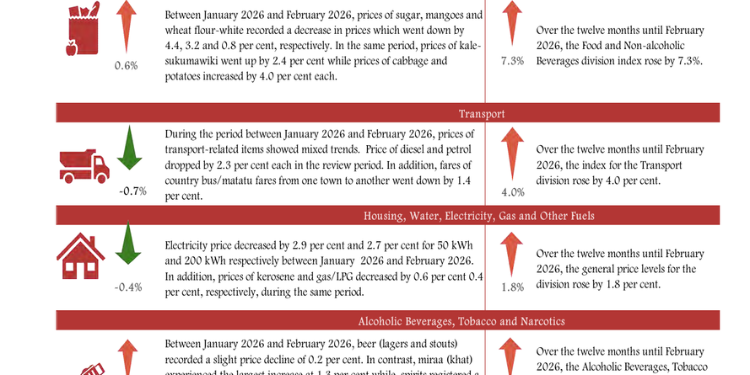
According to a KNBS report released on February 27, the main contributors to the rise were food and non-alcoholic beverages (7.3%), transport (4.0 %), and housing, water, electricity, Gas and other fuels (1.8%)
“Annual consumer price inflation as measured by the Consumer Price Index (CPI) was 4.3 per cent in February 2026. This implies that the general price level was 4.3 per cent higher in February 2026 than it was in February 2025,” read part of the report.
In the same period, prices of kale sukumawiki rose by 2.4 per cent, while prices of cabbage and potatoes rose by 4.0 per cent each.
Miraa, also known as khat, recorded a 1.3 per cent price increase, while spirits rose by 0.3 per cent. Dishwashing paste and liquid rose by 1.6 per cent, while general medical practitioner services increased by 0.7 per cent.
Educational materials also became more expensive, with exercise books rising by 0.5 per cent. Pre-primary and primary school textbooks also rose by 0.3 per cent.
Still in matters of education, certificate course fees saw a marginal 0.1 per cent increase.
Hospitality and food services also experienced cost pressures, with hotel and restaurant cakes and snacks rising by 0.8 per cent, lodging and guest expenses by 0.6 per cent, and food from vendors by 0.8 per cent.
Insurance premiums were also up, with medical and motor vehicle insurance each rising by 0.2 per cent. Personal care and hygiene items recorded notable increases, including hairdressing services by 0.1 per cent, toilet soap by 0.9 per cent, and toilet paper by 1.4 per cent.
KNBS Lists Items That Decreased in Prices
Between January and February 2026, Diesel and Petrol prices each fell by 2.3 per cent, while country bus and matatu fares declined by 1.4 per cent.
| Item | Price Change (%) | Trend |
|---|---|---|
| Diesel | -2.3% | Decrease |
| Petrol | -2.3% | Decrease |
| Country bus/matatu fares | -1.4% | Decrease |
| Electricity (50 kWh) | -2.9% | Decrease |
| Electricity (200 kWh) | -2.7% | Decrease |
| Kerosene | -0.6% | Decrease |
| Gas/LPG | -0.4% | Decrease |
| Beer (lagers & stouts) | -0.2% | Decrease |
| Girls’ dresses | -0.6% | Decrease |
| Men’s suits | -0.4% | Decrease |
| Men’s T-shirts | -4.1% | Decrease |
| Detergents | -0.1% | Decrease |
| Refrigerators & freezers | -2.6% | Decrease |
| Dewormers | -0.1% | Decrease |
| Honeymoon packages | -0.1% | Decrease |
Also Read: KNBS Reports Growth Across All Kenyan Economic Sectors
Retail Prices for Food Items
According to KNBS, the price of sugar declined from KSh174.17 to KSh166.56 per kilogramme, while the price of mangoes dropped from KSh149.09 to KSh144.37 per kilogramme.
Tomatoes registered a marginal decrease, falling from KSh87.98 to KSh87.90 per kilogramme.
In contrast, the price of Irish potatoes rose from KSh98.25 to KSh102.16 per kilogramme, while cabbage increased from KSh71.47 to KSh74.33 per kilogramme during the same period.
Also Read: Items Kenyans Will Pay Less for in 2026
The price of kerosene also declined from KSh154.96 to KSh153.96 per litre.
Electricity charges dropped, with the cost of 200 kWh falling from KSh5,718.08 to KSh5,564.96, and the cost of 50 kWh decreasing from KSh1,304.29 to KSh1,265.96.
Fuel prices followed a similar trend, with petrol reducing from KSh183.59 to KSh179.35 per litre and diesel from KSh171.64 to KSh167.72 per litre.
Follow our WhatsApp Channel and X Account for real-time news updates.