President William Ruto has ordered the Kenya Revenue Authority (KRA) to review the Sh3.2 million customs benchmark imposed on consolidated cargo and restore the previous Ksh2.5 million threshold, as he moved to ease the burden on small importers.
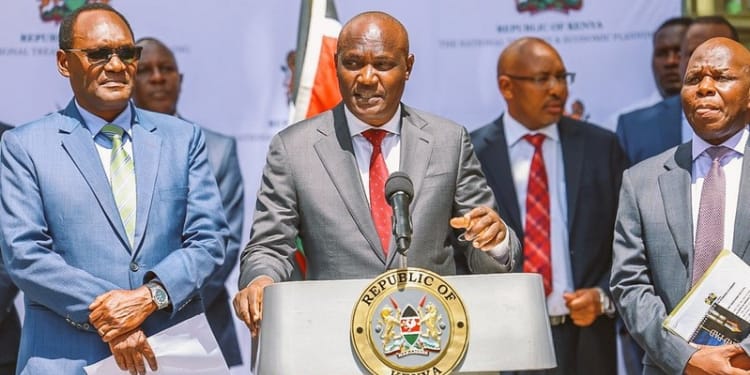
Speaking while hosting MSME traders at Statehouse on Wednesday, September 2, Ruto also directed KRA to prepare and communicate a clear list of high-value goods that will not qualify for consolidation, saying traders should know in advance which products are excluded from the arrangement.
The President said the measures would allow small traders to continue combining their consignments in containers while ensuring high-value goods are subjected to appropriate customs treatment.
“I want us to agree here. The people from KRA should give us high-value items which do not qualify for consolidation. It is one, two, three, four, five. Let it be known to these consolidators,” Ruto said.
He directed KRA to communicate the list to consolidators through an official mechanism, including gazettement or another formal communication.
Ruto’s intervention followed concerns from traders and cargo consolidators over the increase of the customs benchmark from Ksh2.2 million per container to Ksh2.5 million and later to Ksh3.2 million.
Also Read: Businesses in Nairobi to Pay New Tariffs as KRA Changes Cargo System
Ruto Defends Consolidation
The President said consolidation was an important system for small traders who cannot afford to import an entire container on their own.
He said a trader importing goods worth Ksh50,000, Ksh100,000 or Ksh200,000 would struggle to ship the consignment independently, making it necessary for several traders to combine their goods and share the cost of transportation.
“Consolidation is the right thing to do. It enables everybody in their smallness and in their sizes to be able to do their business by pulling together,” Ruto said.
He compared the practice to the Kenya Tea Development Agency (KTDA) model, where tea produced by farmers with small landholdings is combined before being exported.
A farmer with half an acre, he said, would not be able to independently export tea to Europe, but the consolidation of produce from several farmers creates a shipment large enough to reach international markets.
“What you are doing is consolidation in reverse. So it is not a new thing,” Ruto said.
President Questions Ksh3.2 Million Benchmark
Ruto said traders had asked the government to reduce the current benchmark and asked whether they wanted it restored to Ksh2.5 million or reduced further to Ksh2 million.
He said he was willing to consider their proposal but stressed that the government also needs revenue to finance essential public services.
Ruto said taxes collected from Kenyans contribute towards paying teachers, security officers and other public servants.
“We must contribute. Everybody must contribute,” he said.
The President, however, questioned the fairness of applying the same customs benchmark to containers carrying goods of substantially different values.
He said the Sh2.5 million benchmark was based on an assumption that goods inside a consolidated container were worth about Sh6 million.
He questioned whether a trader with goods worth Sh20 million should pay the same amount as another whose goods are valued at Sh6 million.
High-Value Goods to Be Excluded
To address the concern, Ruto proposed separating high-value goods from ordinary consolidated consignments.
He said containers without high-value items should continue under the previous customs arrangement, while goods considered high value should be identified and treated separately.
The President said KRA must therefore establish exactly which products do not qualify for consolidation instead of leaving traders and consolidators to determine the categories themselves.
He said the list should be specific and known to consolidators before they combine goods for shipment.
The move is expected to reduce uncertainty for small importers and prevent legitimate consignments from being disrupted during customs clearance.
Also Read: KRA Forced to Clarify New Business Taxes After Uproar and Protest Notice
Ruto Seeks Clear Rules for Consolidators
Ruto also called for a clear system to identify legitimate consolidators.
He questioned whether anyone should be allowed to simply declare themselves a consolidator without meeting established requirements.
The President said the government should define who qualifies to provide consolidation services and ensure traders can easily identify authorised consolidators.
The proposed changes would therefore address three key areas: the customs benchmark for consolidated cargo, the identification of high-value goods excluded from consolidation, and the registration or identification of legitimate consolidators.
Ruto said the objective was to protect small traders while ensuring the government continues to collect the revenue needed to provide public services.
Follow our WhatsApp Channel and X Account for real-time news updates.