Tall buildings, new roads, new markets – and a population with shrinking payslips, no jobs, and empty hospital shelves. The hardware is going up. The software was never installed.
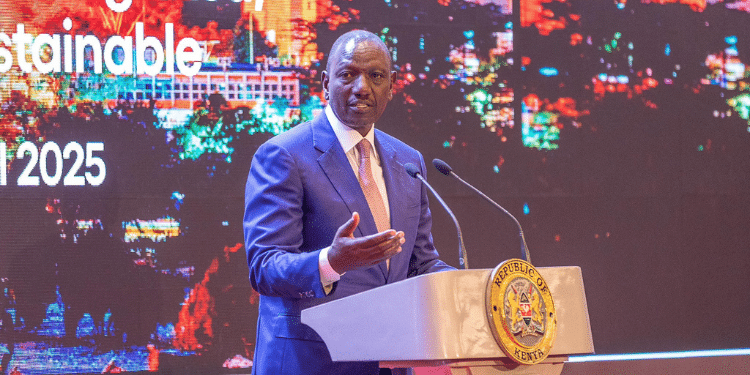
President William Ruto’s government has built a lot, and it continues to do so. Housing towers. Roads. Bridges. Markets. Piers, name them. What it has not built is a population that feels any richer, more employed, or better cared for because of it. That gap between what the state constructs and what a citizen actually experiences is the real story of this presidency, and nowhere is it more exposed than in the government’s favorite talking point: the promise that Kenya is walking the same road Singapore once walked.
Every government that asks citizens to accept short-term pain for long-term transformation eventually looks to Singapore. A poor, resourceless island that turned compulsory savings into first-world housing within a generation is the most seductive precedent in development politics. It is no surprise the Affordable Housing Levy leans on that logic: a mandatory deduction today, in exchange for a housing stock the country doesn’t have yet. The comparison is meant to borrow legitimacy. Looked at closely, it hands the levy’s critics a precise inventory of everything the Kenyan version is missing.
The precedent that actually applies
If you’re going to defend compulsory extraction with a global example, Singapore’s Central Provident Fund is the honest one to cite, not the Enclosure Acts, not Soviet collectivization, not the various “primitive accumulation” stories historians tell about how industrial economies got their start. Those precedents involve dispossession with no individual claim attached: land taken, labor conscripted, benefits flowing to someone other than the person who paid. CPF is different in kind. It is compulsory, payroll-deducted, and used to fund housing through the HDB system, structurally close to what Kenya’s levy is attempting. And it worked.
Also Read: Singapore Didn’t Perform a Miracle, Mr. President — It Simply Refused to Make Peace with Corruption
It worked for specific, reproducible reasons, not mystical ones. Every contributor has an individual account in their name and a balance they can check. The money leaving a Singaporean payslip has a traceable line to a housing unit or a retirement asset that comes back to that person, specifically — not to a general pool someone else is trusted to manage well. And the system had roughly sixty years to build a track record of consistent, low-corruption delivery before it became the assumed backdrop of Singaporean life. Coercion became bearable because the state had already spent decades proving it would deliver.
The Singapore Math that doesn’t add up
Put the two schemes side by side, and the comparison collapses when you look at the numbers.
The rate. Singapore’s CPF takes a combined 37% of wages – 20% from the employee, 17% from the employer – funding housing, retirement, and healthcare in one system. Kenya’s Affordable Housing Levy takes 3% of gross salary – 1.5% each from employee and employer – funding housing alone. Ruto’s government is asking citizens to accept CPF-level faith for roughly a twelfth of CPF’s actual commitment.
The account. CPF money sits in an account with the contributor’s name on it – visible, traceable, redeemable. The Housing Levy deposits into the Affordable Housing Fund, a general pool with no individual balance, no guaranteed unit, no redemption date. No mechanism lets a specific shilling deducted from a specific payslip find its way back to the person who paid it.
The clock. CPF earned its legitimacy over roughly sixty years of delivery before Singapore became a reference point for anyone. Kenya is being asked to accept the conclusion of that story – trust the deduction, the house is coming – in year one, from a fund with no track record, run by a state whose most recent comparable vehicles, NHIF and NSSF, carry their own histories of opacity and mismanagement allegations.
The 2024 High Court ruling settled the legal question: the levy is constitutional and public participation was conducted. It settled nothing about the design question – whether an ordinary contributor can trace a line from deduction to personal benefit. They can’t. That is not a communications failure to be fixed with better messaging. It is the architecture of the fund.
The Trust Deficit Nobody in Government Wants to Name
Singapore’s compulsory-savings culture wasn’t sold on a promise – it was accepted because the promise had already been kept, repeatedly, for decades, before anyone thought to compare it to anything. Kenya’s government is asking for that same order of trust on a brand-new mechanism, from citizens whose most recent memories of state-managed compulsory funds are exactly the ones giving them the least reason to comply. Asking for CPF-level trust in a fund with none of CPF’s track record is not unreasonable in theory. In practice, it is asking for the payoff of sixty years of institutional credibility on day one.
The Ruto Problem: Hardware Without Software
The housing levy is not an isolated design flaw. It is the clearest example of a pattern that runs through the entire presidency: government as a construction site, measured in structures completed rather than lives improved.
The hardware is real and visible, and that is precisely why it is the easier story to tell. Towers rising. Tarmac being laid. Modern markets offering decent business spaces. A High Court ruling confirming the levy was properly enacted. All of it buildable, and all of it built.
The software is what a citizen actually carries home: a payslip that covers less than it used to, a labour market that isn’t absorbing the young people leaving university every year, a public hospital that is out of the basic drugs a prescription calls for. None of that shows up in a commissioning ceremony. None of it can be ruled into existence by a court, and none of it survives being pointed at a skyline.
Also Read: Professor Hiroyuki Hino: The Economist Helping Ruto Draft Vision 2060 and His Connection to Raila
That’s why the Singapore comparison backfires instead of reassuring. It invites the very audience the government is trying to persuade – citizens, journalists, opposition MPs – to run the comparison themselves. And the mapping fails at every point that matters: no individual account, no visible balance, no redemption guarantee, no decades of delivery to draw on. Anyone who does that comparison unprompted doesn’t come away persuaded. They come away with a checklist of exactly what’s missing, more precise than any opposition talking point.
A version of Singapore’s story could help Ruto’s case, but it requires building toward it rather than borrowing its name. Individualised contributor accounts. Transparent reporting on where the money goes. A visible, dated path to either a unit or a refund. Something closer to what CPF actually is, not what it symbolises on a podium. That is a harder story to tell than “Singapore did this too” but it is the only version of the comparison that survives contact with the question it invites.
About the Author
This article was written by Kevin Ogutu. He is Press Secretary and Head of Strategic Communications to Hon. Ruth Odinga, Woman Representative for Kisumu County. He brings over a decade of experience across journalism, crisis reporting, and political communications.
Ogutu holds a Bachelor of Arts in Journalism and Mass Communication from Masinde Muliro University of Science and Technology (2010–2014). He began his career as a news reporter and correspondent for KTN (Standard Group) in the Nyanza region, covering breaking news, politics, lifestyle, and features. He later served as Features Editor in South Sudan, reporting from one of the region’s most demanding environments and sharpening his eye for storytelling under pressure. Drawing on this foundation, he founded Ogasi Communications, a firm offering strategic communications and media advisory services.
Today, as Press Secretary and Head of Strategic Communications to Hon. Ruth Odinga, Kevin drives digital-first, social impact storytelling across multimedia platforms and oversees strategic policy communication, translating her legislative work in Parliament into clear, actionable information for constituents.
Follow our WhatsApp Channel and X Account for real-time news updates.