
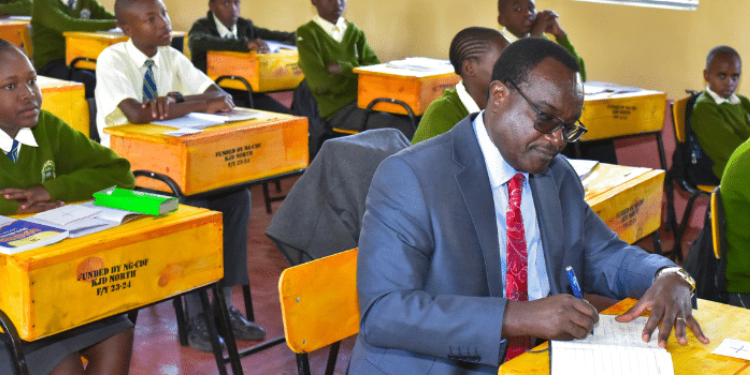
Grade 10 learners planning their future careers must make important decisions about the subjects they take in senior school, as the choices help shape the academic routes they can pursue after secondary education.
The Grade 10 Selection and Placement System allows learners to explore different pathways, subject combinations, and senior schools under the Competency-Based Education(CBE) framework.
The system groups subjects into three broad pathways — STEM, Social Sciences, and Arts & Sports Science — with different tracks and combinations available to learners.
For learners who already have careers such as medicine, engineering, or law in mind, understanding the available combinations can help them make informed choices.
The Grade 10 subject selection process means learners and parents have to look beyond the name of a career and consider the subjects needed to build a suitable academic foundation.
A learner who wants to pursue medicine, for example, needs to be comfortable with science subjects, while an aspiring engineer may need to focus on mathematics and physics.
Similarly, a learner interested in law may find subjects involving languages, history, literature and social sciences more aligned with their interests.
The Ministry’s Grade 10 selection platform helps learners explore these options before selecting their preferred pathways, combinations, and senior schools.
Medicine: Biology and Chemistry are Key Subjects for Grade 10 Learners
Learners aspiring to pursue medicine should pay close attention to science-based combinations under the STEM Pure Sciences track.
One of the combinations listed by the Ministry of Education is Core Mathematics, Biology and Chemistry.
The combination provides a strong science foundation for learners interested in health-related careers.
Other science combinations available through the Grade 10 system include Core Mathematics, Biology and Physics, and Core Mathematics, Chemistry and Physics.
Learners can also choose Biology, Business Studies and Chemistry; Biology, Chemistry and Computer Studies; as well as Chemistry, Physics and Wood Work.
Learners should, however, understand that selecting a particular Grade 10 combination does not by itself guarantee admission to a medical or law degree.
University entry requirements will still apply when learners eventually apply for higher education.
Also Read: Kenya’s CBC Revolution: What’s New as the First Grade 10 Cohort Enters Senior School
Engineering: Mathematics and Physics Offer Strong Foundation
Engineering aspirants can also consider STEM combinations that emphasize mathematics, physics, computer studies and technical subjects.
The Ministry’s subject list includes Core Mathematics, Biology and Physics; Core Mathematics, Chemistry and Physics; and Core Mathematics, Computer Studies and Physics among the available STEM Pure Sciences combinations.
The system also offers technical and applied science combinations for learners whose interests align more closely with practical and technology-oriented careers.
For learners interested in becoming software engineers, Computer Studies provides a foundation for the career under STEM Applied Sciences.
Those interested in civil engineering can build on Building & Construction, Physics and Advanced Mathematics.
For aspiring electrical engineers, the relevant foundation includes Electricity, Physics and Advanced Mathematics.
Learners interested in mechanical engineering can build on Power Mechanics, Physics and Advanced Mathematics.
The system also identifies Marine & Fisheries as a subject area for learners interested in careers such as marine officers under STEM Technical Studies.
Other technical combinations include subjects such as Electricity, Building & Construction, Power Mechanics, Computer Studies, Metal Work and Wood Work.
For example, the official selection system lists Core Mathematics, Building & Construction and Physics, while another combination is Core Mathematics, Electricity and General Science.
Also Read: KNEC Releases Grade 10 School-Based Assessment Schedule for All Schools
Law: Social Sciences Provide Relevant Options
Learners interested in becoming lawyers can explore combinations under the Social Sciences pathway.
The pathway includes the Humanities & Business Studies and Languages & Literature tracks, with combinations featuring subjects such as History & Citizenship, Geography, Business Studies and Literature in English.
The Ministry lists combinations such as Geography, History & Citizenship, and Literature in English; Business Studies, Geography, and Literature in English; and Business Studies, History & Citizenship, and Literature in English.
Other options include Christian Religious Education, Geography and History & Citizenship, as well as combinations involving Kiswahili literature and History & Citizenship.
The Grade 10 selection system also provides a wider range of Humanities & Business Studies combinations for learners interested in law and related fields.
These include Computer Studies, Geography and Islamic Religious Education; Christian Religious Education, Geography and Mandarine Chinese; and Christian Religious Education, Geography and History & Citizenship.
Learners can also choose Business Studies, Christian Religious Education and French; Business Studies, German and History & Citizenship; and Business Studies, Geography and Literature in English.
Other combinations listed include Business Studies, German and Hindu Religious Education; General Science, Geography and Hindu Religious Education; and Computer Studies, Geography and History & Citizenship.
The list further includes Geography, History & Citizenship and Mandarin Chinese; Arabic, Christian Religious Education and History & Citizenship; and Geography, History & Citizenship and Literature in English.
Learners can also select Business Studies, Geography and Indigenous Language; Business Studies, German and Islamic Religious Education; and Business Studies, History & Citizenship and Literature in English.
Other options are General Science, Geography and Islamic Religious Education; Business Studies, Fasihi ya Kiswahili and Islamic Religious Education; and Business Studies, Christian Religious Education and General Science.
The list also contains Business Studies, History & Citizenship and Mandarin Chinese, as well as Fasihi ya Kiswahili, Hindu Religious Education and History & Citizenship.
While these subjects can provide useful preparation in areas such as communication, reading, writing, history and understanding society, learners should not view any single Grade 10 combination as an automatic requirement for studying law.
Learners can use the official Grade 10 Selection and Placement System to explore available pathways and subject combinations before making their choices.
Follow our WhatsApp Channel and X Account for real-time news updates.