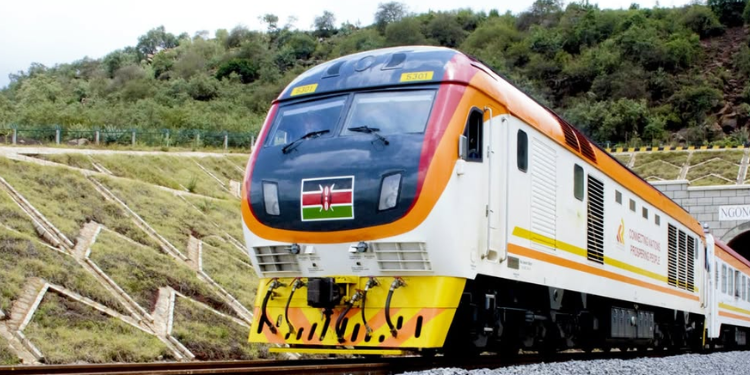
Kenya plans to extend the Standard Gauge Railway (SGR) to Kisumu via the southern corridor, abandoning the earlier proposal that routed the line through Nakuru and Eldoret.
The decision followed a comprehensive technical assessment that identified the potential to save KSh99.68 billion ($772.7 million) in costs and found the route offered a better balance between engineering feasibility and regional development.
The selected southern corridor will pass through Narok, Bomet, Kericho, Nyamira, and Kisumu counties.
The railway will begin at the terminus of the existing Nairobi–Naivasha SGR and run through Narok, Bomet, Sotik, Sondu, and Ahero before reaching Kisumu.
Alternative routes, including the northern corridor via Nairobi–Nakuru–Eldoret–Malaba and the central corridor through Nairobi–Nakuru–Kisumu–Malaba, were ruled out after assessments of terrain, construction costs, economic centres, and long-term growth potential.
The proposed SGR Phase 2B project will be overseen by the Kenya Railways Corporation (KRC).
SGR to Reach Kisumu via Southern Corridor
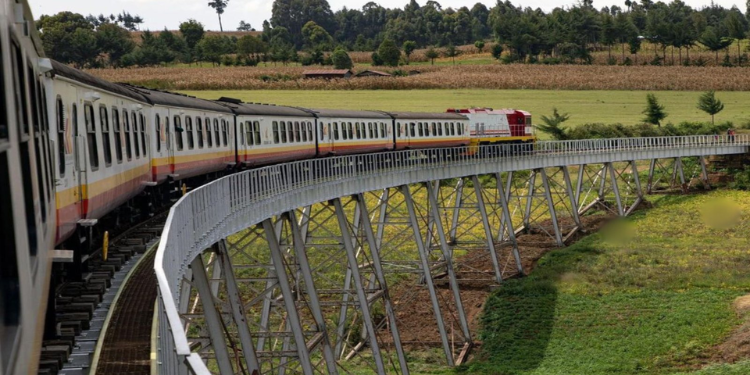
The SGR Phase 2B route will combine long open stretches with engineered sections featuring tunnels, bridges, and stations across varied terrain.
The route will feature four major logistics and commercial hubs in Narok, Bomet, Sotik, and Kisumu.
In Narok County, the line will span about 98 kilometres with intermediate stations at Narok town and Mulot.
From Narok, the railway will continue into Bomet County for roughly 46 kilometres before stretching to Kericho and Nyamira counties, where it will pass through the area via a network of tunnels, bridges, and stations, including an intermediate stop at Sondu.
In Kisumu County, the railway will stretch approximately 51 kilometres. An additional 8.69-kilometre spur will connect the main line to the upgraded Kisumu Port on Lake Victoria, linking rail and water transport.
The city will host a terminus station, freight and port facilities, and a major logistics hub at Otonglo.
The full SGR alignment will include 25 stations, comprising six intermediate stops at Narok, Mulot, Bomet, Sondu, Ahero, and Kibos, along with 18 smaller passing stations to allow trains travelling in opposite directions to cross safely.
Also Read: How Kenya Will Raise Ksh517 Billion to Extend SGR to Malaba
Train Speed
The Environmental and Social Impact Assessment (ESIA) study for the proposed Naivasha–Kisumu Standard Gauge Railway (SGR), conducted in December 2026, recommended a maximum running speed of 120 km/h.
The study evaluated two design speeds, that is, 120 km/h and 160 km/h, and concluded that while 160 km/h would improve passenger travel times, it would require extensive engineering upgrades, particularly in hilly sections, driving up project costs.
The report stated that, considering the railway’s Grade I classification, mixed freight and passenger operations, and economic feasibility, the 120 km/h design speed was deemed the most practical and cost-effective option.
“Given the line’s Grade I classification, mixed freight-passenger operations, and economic considerations, a design speed of 120 km/h is recommended,” reads part of the report.
Also Read: Kenya Railways Announces Major Rail Upgrades to Nyayo and Other Stadiums Ahead of AFCON 2027
Phases of Railway Development
The construction of a railway involves several key stages:
- Planning and Feasibility Study – This stage includes conducting feasibility studies, environmental and social impact assessments (ESIA), and selecting the most suitable route for the railway.
- Land Acquisition and Site Preparation – Activities include acquiring land, consulting with stakeholders, relocating existing utilities, and preparing the construction site.
- Design and Engineering – Detailed engineering designs are developed for stations, tracks, bridges, and tunnels. This phase also covers the selection of materials, construction methods, and the integration of signaling and communication systems.
- Earthworks and Grading – Includes excavation, construction of embankments, soil stabilization, and installation of drainage systems to ensure a stable foundation for the railway.
- Track Laying and Infrastructure Development – This phase involves installing sleepers, ballast, and rails to complete the railway line. It also includes constructing bridges, tunnels, and stations, as well as setting up electrical and signaling systems.
- Stations and Depots Development – Construction of passenger stations, freight terminals, and maintenance depots to support both operations and logistics along the railway.
- Testing and Commissioning – Conducting trial runs to assess track integrity and operational efficiency, followed by safety inspections and obtaining regulatory approvals before full-scale operations begin.
- Operations and Maintenance – Regular inspections, preventive maintenance, track repairs, and system upgrades to ensure safe and reliable service. This phase also focuses on optimizing passenger and freight operations for efficiency and performance.
Follow our WhatsApp Channel and X Account for real-time news updates.