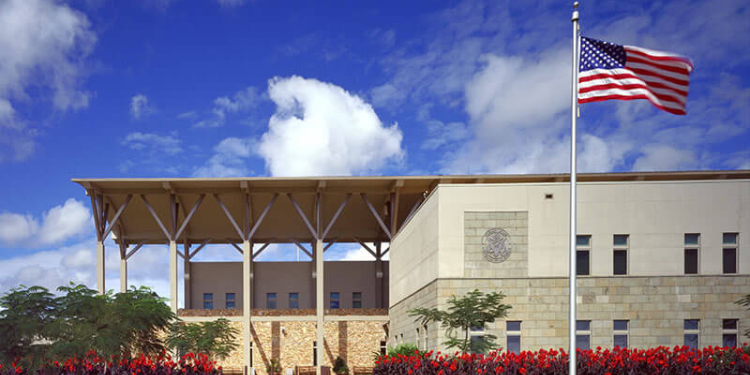
Several United States embassies have announced disruptions to some of their operations following a partial shutdown of the U.S. federal government.
The shutdown took effect at midnight on Saturday, January 31, after lawmakers in the U.S. Senate failed to pass a short-term funding bill before the deadline.
In an update issued on Saturday morning, the United States Embassy in Uganda said it would scale back activity on its official social media platforms, including X and Facebook, until full operations resume.
The embassy said its accounts would only be updated with urgent safety and security information during the funding lapse.
Despite the shutdown, the embassy said scheduled passport and visa services in the United States and at U.S. embassies and consulates abroad would continue, subject to operational capacity.
“Due to the lapse in appropriations, this X account will not be updated regularly until full operations resume, with the exception of urgent safety and security information. At this time, scheduled passport and visa transit services in the United States and at U.S. Embassies and Consulates overseas will continue during the lapse in appropriations as the situation permits. We will not update this account until full operations resume, with the exception of urgent safety and security information.”
The embassy further directed the public to the U.S. State Department’s travel website for updates on services and operating status.
The United States government shutdown triggered by funding standoff
The developments come hours after funding lapsed for several U.S. government departments following a standoff in Congress over new restrictions on federal agents involved in President Donald Trump’s immigration enforcement campaign.
The partial shutdown was triggered after Democratic senators declined to support a funding bill for the Department of Homeland Security (DHS), demanding new limits on federal agents following the recent killings of Alex Pretti in Minneapolis and Renee Good earlier in January.
Democrats argued that the DHS funding bill should be rewritten to include safeguards on enforcement operations after immigration agents were surged into Minneapolis as part of the Trump administration’s mass deportation drive.
Also Read: Trump Nominates New Federal Reserve Board of Governors Chairman
The standoff blocked a broader Republican-led push to pass a larger funding package for multiple government departments before spending authority expired on Friday. The Senate instead passed a package of five bills to fund government departments through September, along with a measure to extend DHS funding for two weeks.
Departments affected
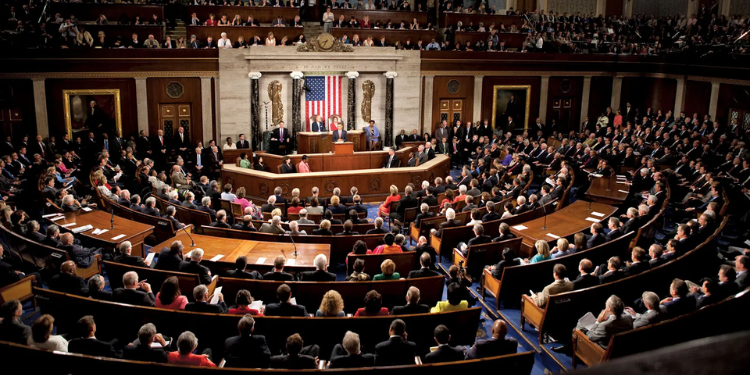
However, the legislation still requires approval by the Republican-controlled House of Representatives, which is expected to convene on Monday.
In a memo issued late Friday, Russell Vought, director of the Office of Management and Budget (OMB), confirmed that a shutdown would begin at midnight.
The memo said appropriations had expired for several departments, including Defense, Homeland Security, Labor, Health and Human Services, Education, Transportation, Housing and Urban Development, and the Department of State.
Vought directed affected agencies to begin executing orderly shutdown plans, with employees reporting to work to wind down operations.
“The Administration will continue working with Congress to address recently raised concerns and complete appropriations for Fiscal Year 2026,” the memo said, adding that guidance would be issued once funding is restored.
Also Read: Trump Govt Blocks Funding to Democratic States Amid Shutdown
The shutdown’s immediate impact remains unclear and is unlikely to be fully felt until at least Monday, the first full business day of the funding lapse.
Prospects for the broader funding package in the House remain uncertain. Speaker Mike Johnson acknowledged on Thursday that a short shutdown was possible.
“We could inevitably be in a short shutdown situation,” Johnson said. “But the House is going to do its job. We want to get the government funded, as does the president.”
Republicans control the House by a narrow one-seat margin, holding 218 seats to the Democrats’ 213, complicating efforts to pass the legislation.
Some conservative lawmakers are demanding that the appropriations bill be tied to the Save Act, which would impose voter identification requirements that critics say could disenfranchise large segments of the population.
Immigration enforcement continues
The funding lapse is not expected to halt Immigration and Customs Enforcement (ICE) operations. ICE received $75 billion under the One Big Beautiful Bill Act passed last year, funds that can be used during a shutdown. The Trump administration may also require ICE personnel to continue working.
The current shutdown follows a record 43-day funding lapse that began in October 2025, after Democrats insisted that any funding deal include an extension of tax credits that lowered premiums for Affordable Care Act health plans.
That shutdown ended after seven moderate Democratic senators joined Republicans to reopen the government in exchange for a promise of a vote on extending the tax credits — a promise that was later broken by Republicans, allowing the subsidies to expire at the end of 2025.
Follow our WhatsApp Channel and X Account for real-time news updates